Chichlowski Maciej, Rudolph Colin
Mead Johnson Nutrition, Evansville, IN, USA.
Division of Pediatric Gastroenterology, Hepatology, and Nutrition, Department of Pediatrics, University of California, San Francisco, CA, USA.
J Neurogastroenterol Motil. 2015 Mar 30;21(2):172-81. doi: 10.5056/jnm15025.
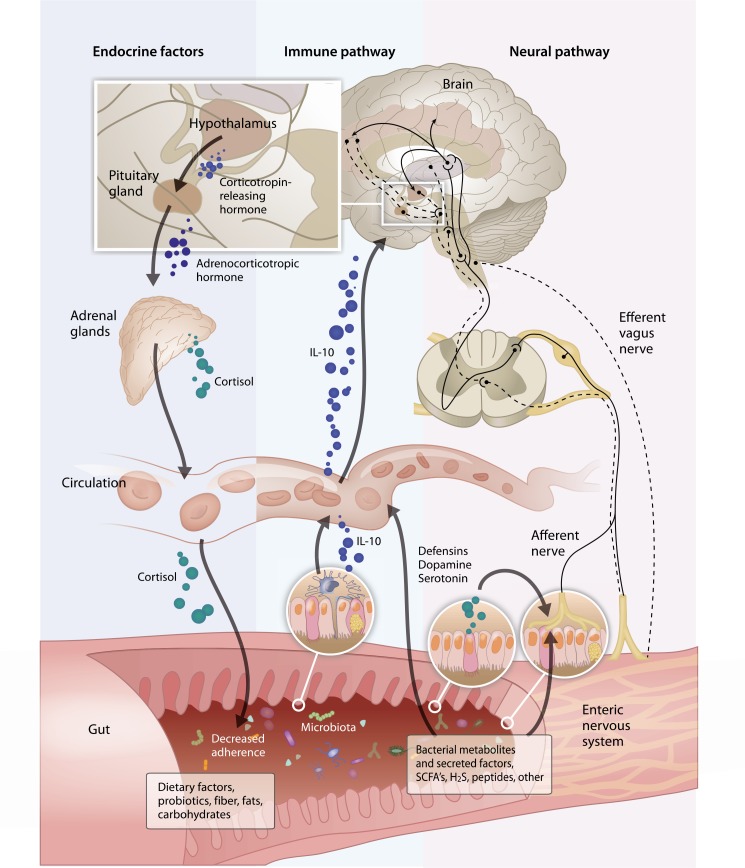
A complex set of interactions between the microbiome, gut and brain modulate responses to visceral pain. These interactions occur at the level of the gastrointestinal mucosa, and via local neural, endocrine or immune activity; as well as by the pro-duction of factors transported through the circulatory system, like bacterial metabolites or hormones. Various psychological, in-fectious and other stressors can disrupt this harmonious relationship and alter both the microbiome and visceral pain responses. There are critical sensitive periods that can impact visceral pain responses in adulthood. In this review we provide a brief background of the intestinal microbiome and emerging concepts of the bidirectional interactions between the micro-biome, gut and brain. We also discuss recent work in animal models, and human clinical trials using prebiotics and probiotics that alter the microbiome with resultant alterations in visceral pain responses.
微生物群、肠道和大脑之间复杂的相互作用调节着对内脏痛的反应。这些相互作用发生在胃肠道黏膜水平,并通过局部神经、内分泌或免疫活动;以及通过循环系统运输的因子(如细菌代谢产物或激素)的产生来实现。各种心理、感染和其他应激源会破坏这种和谐关系,并改变微生物群和内脏痛反应。存在一些关键的敏感期,会影响成年期的内脏痛反应。在本综述中,我们提供了肠道微生物群的简要背景以及微生物群、肠道和大脑之间双向相互作用的新兴概念。我们还讨论了动物模型和使用益生元和益生菌改变微生物群并导致内脏痛反应改变的人类临床试验的最新研究成果。