Jeon Christie Y, Pandol Stephen J, Wu Bechien, Cook-Wiens Galen, Gottlieb Roberta A, Merz C Noel Bairey, Goodman Marc T
Samuel Oschin Comprehensive Cancer Institute, Cedars-Sinai Medical Center, Los Angeles, CA, United States of America; Department of Epidemiology, Fielding School of Public Health, University of California Los Angeles, Los Angeles, CA, United States of America; Department of Medicine, Cedars-Sinai Medical Center, Los Angeles, CA, United States of America.
Samuel Oschin Comprehensive Cancer Institute, Cedars-Sinai Medical Center, Los Angeles, CA, United States of America; Department of Medicine, Cedars-Sinai Medical Center, Los Angeles, CA, United States of America; Department of Veterans Affairs, Los Angeles, CA, United States of America; Department of Biomedical Sciences, Cedars-Sinai Medical Center, Los Angeles, CA, United States of America.
PLoS One. 2015 Apr 1;10(4):e0121783. doi: 10.1371/journal.pone.0121783. eCollection 2015.
Pancreatic cancer has poor prognosis and existing interventions provide a modest benefit. Statin has anti-cancer properties that might enhance survival in pancreatic cancer patients. We sought to determine whether statin treatment after cancer diagnosis is associated with longer survival in those with pancreatic ductal adenocarcinoma (PDAC).
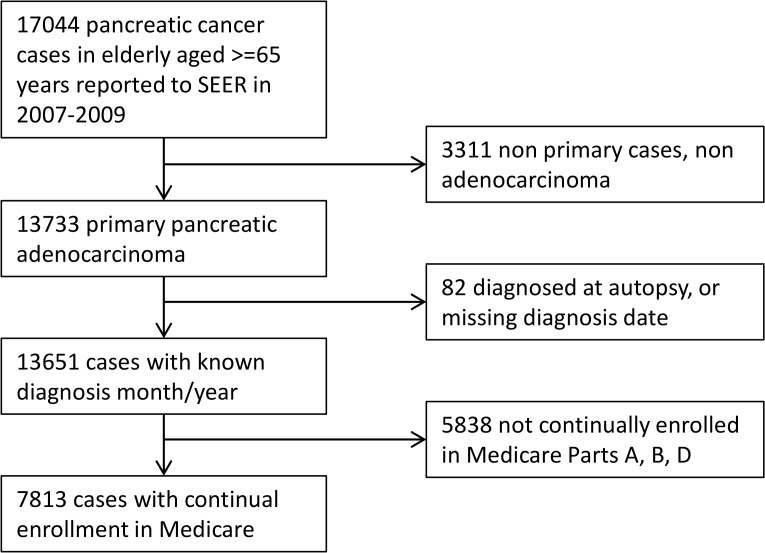
We analyzed data on 7813 elderly patients with PDAC using the linked Surveillance, Epidemiology, and End Results (SEER) - Medicare claims files. Information on the type, intensity and duration of statin use after cancer diagnosis was extracted from Medicare Part D. We treated statin as a time-dependent variable in a Cox regression model to determine the association with overall survival adjusting for follow-up, age, sex, race, neighborhood income, stage, grade, tumor size, pancreatectomy, chemotherapy, radiation, obesity, dyslipidemia, diabetes, chronic pancreatitis and chronic obstructive pulmonary disease (COPD).
Overall, statin use after cancer diagnosis was not significantly associated with survival when all PDAC patients were considered (HR = 0.94, 95%CI 0.89, 1.01). However, statin use after cancer diagnosis was associated with a 21% reduced hazard of death (Hazard ratio = 0.79, 95% confidence interval (CI) 0.67, 0.93) in those with grade I or II PDAC and to a similar extent in those who had undergone a pancreatectomy, in those with chronic pancreatitis and in those who had not been treated with statin prior to cancer diagnosis.
We found that statin treatment after cancer diagnosis is associated with enhanced survival in patients with low-grade, resectable PDAC.
胰腺癌预后较差,现有干预措施的获益有限。他汀类药物具有抗癌特性,可能会提高胰腺癌患者的生存率。我们试图确定癌症诊断后使用他汀类药物治疗是否与胰腺导管腺癌(PDAC)患者的生存期延长有关。
我们使用关联的监测、流行病学和最终结果(SEER)-医疗保险理赔文件,分析了7813例老年PDAC患者的数据。从医疗保险D部分提取癌症诊断后他汀类药物使用的类型、强度和持续时间信息。在Cox回归模型中,我们将他汀类药物视为时间依赖性变量,以确定其与总生存期的关联,并对随访、年龄、性别、种族、邻里收入、分期、分级、肿瘤大小、胰腺切除术、化疗、放疗、肥胖、血脂异常、糖尿病、慢性胰腺炎和慢性阻塞性肺疾病(COPD)进行调整。
总体而言,在考虑所有PDAC患者时,癌症诊断后使用他汀类药物与生存率无显著关联(风险比=0.94,95%置信区间0.89,1.01)。然而,癌症诊断后使用他汀类药物与I级或II级PDAC患者的死亡风险降低21%相关(风险比=0.79,95%置信区间(CI)0.67,0.93),在接受胰腺切除术的患者、患有慢性胰腺炎的患者以及癌症诊断前未接受他汀类药物治疗的患者中,降低程度相似。
我们发现癌症诊断后使用他汀类药物治疗与低级别、可切除的PDAC患者的生存期延长有关。