National Renewable Energy Laboratory, National Bioenergy Center, 15013, Denver West Parkway, Golden, CO 80401 USA.
Biotechnol Biofuels. 2015 Mar 31;8:55. doi: 10.1186/s13068-015-0233-z. eCollection 2015.
Complete conversion of the major sugars of biomass including both the C5 and C6 sugars is critical for biofuel production processes. Several inhibitory compounds like acetate, hydroxymethylfurfural (HMF), and furfural are produced from the biomass pretreatment process leading to 'hydrolysate toxicity,' a major problem for microorganisms to achieve complete sugar utilization. Therefore, development of more robust microorganisms to utilize the sugars released from biomass under toxic environment is critical. In this study, we use continuous culture methodologies to evolve and adapt the ethanologenic bacterium Zymomonas mobilis to improve its ethanol productivity using corn stover hydrolysate.
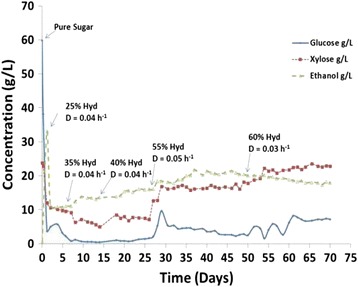
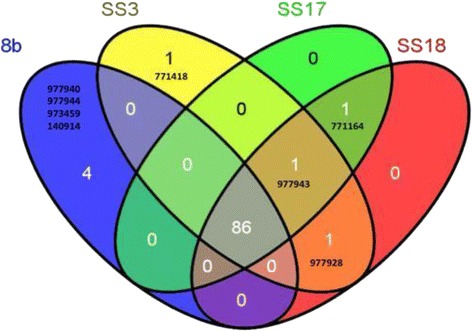
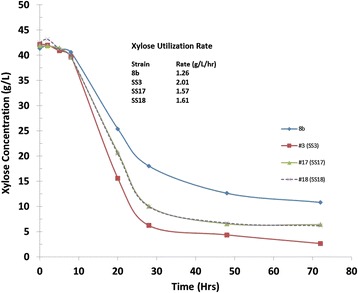
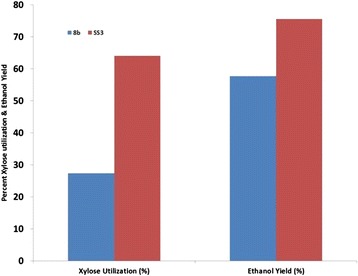
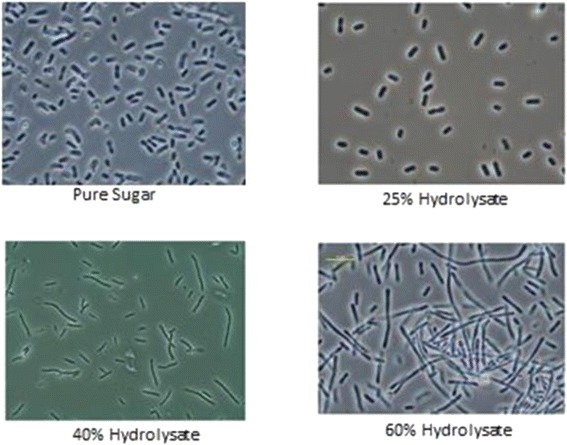
A turbidostat was used to adapt the Z. mobilis strain 8b in the pretreated corn stover liquor. The adaptation was initiated using pure sugar (glucose and xylose) followed by feeding neutralized liquor at different dilution rates. Once the turbidostat reached 60% liquor content, the cells began washing out and the adaptation was stopped. Several 'sub-strains' were isolated, and one of them, SS3 (sub-strain 3), had 59% higher xylose utilization than the parent strain 8b when evaluated on 55% neutralized PCS (pretreated corn stover) liquor. Using saccharified PCS slurry generated by enzymatic hydrolysis from 25% solids loading, SS3 generated an ethanol yield of 75.5% compared to 64% for parent strain 8b. Furthermore, the total xylose utilization was 57.7% for SS3 versus 27.4% for strain 8b. To determine the underlying genotypes in these new sub-strains, we conducted genomic resequencing and identified numerous single-nucleotide mutations (SNPs) that had arisen in SS3. We further performed quantitative reverse transcription PCR (qRT-PCR) on genes potentially affected by these SNPs and identified significant down-regulation of two genes, ZMO0153 and ZMO0776, in SS3 suggesting potential genetic mechanisms behind SS3's improved performance.
We have adapted/evolved Z. mobilis strain 8b for enhanced tolerance to the toxic compounds present in corn stover hydrolysates. The adapted strain SS3 has higher xylose utilization rate and produce more ethanol than the parent strain. We have identified transcriptional changes which may be responsible for these phenotypes, providing foundations for future research directions in improving Z. mobilis as biocatalysts for the production of ethanol or other fuel precursors.
包括 C5 和 C6 糖在内的生物质主要糖的完全转化对于生物燃料生产过程至关重要。一些抑制性化合物,如乙酸盐、羟甲基糠醛 (HMF) 和糠醛,是由生物质预处理过程产生的,导致“水解毒性”,这是微生物完全利用糖的一个主要问题。因此,开发更健壮的微生物来利用在有毒环境下从生物质中释放的糖是至关重要的。在这项研究中,我们使用连续培养方法来进化和适应产乙醇细菌运动发酵单胞菌,以提高其利用玉米秸秆水解物生产乙醇的产量。
使用恒浊器使 Z. mobilis 8b 菌株适应预处理的玉米秸秆醪液。适应性从纯糖(葡萄糖和木糖)开始,然后以不同的稀释率进料中和后的醪液。一旦恒浊器达到 60%的醪液含量,细胞开始冲洗出来,适应性停止。分离出几个“亚系”,其中一个亚系 SS3(亚系 3)在评估 55%中和的 PCS(预处理的玉米秸秆)醪液时,比亲本菌株 8b 利用木糖的效率提高了 59%。使用从 25%固含量的酶解生成的糖化 PCS 浆,SS3 生成的乙醇得率为 75.5%,而亲本菌株 8b 为 64%。此外,SS3 总木糖利用率为 57.7%,而 8b 菌株为 27.4%。为了确定这些新亚系中的潜在基因型,我们进行了基因组重测序,并鉴定出 SS3 中出现的许多单核苷酸突变 (SNP)。我们进一步对可能受这些 SNP 影响的基因进行了定量逆转录 PCR (qRT-PCR),并鉴定出 SS3 中两个基因 ZMO0153 和 ZMO0776 的表达显著下调,这表明 SS3 性能提高的潜在遗传机制。
我们已经适应/进化了 Z. mobilis 8b 菌株,以增强其对玉米秸秆水解物中存在的有毒化合物的耐受性。适应的 SS3 菌株比亲本菌株 8b 具有更高的木糖利用率和生产更多的乙醇。我们已经确定了可能导致这些表型的转录变化,为未来作为生物催化剂生产乙醇或其他燃料前体的 Z. mobilis 的改进提供了研究方向。