Simon Christian M, Klein David W, Schartz Helen A
Program in Bioethics and Humanities, Carver College of Medicine, University of Iowa, Iowa City, Iowa, USA.
Department of Internal Medicine, Carver College of Medicine, University of Iowa, Iowa City, Iowa, USA.
Genet Med. 2016 Jan;18(1):57-64. doi: 10.1038/gim.2015.33. Epub 2015 Apr 2.
The potential of interactive multimedia to improve biobank informed consent has yet to be investigated. The aim of this study was to test the separate effectiveness of interactivity and multimedia at improving participant understanding and confidence in understanding of informed consent compared with a standard, face-to-face (F2F) biobank consent process.
A 2 (face-to-face versus multimedia) × 2 (standard versus enhanced interactivity) experimental design was used with 200 patients randomly assigned to receive informed consent. All patients received the same information provided in the biobank's nine-page consent document.
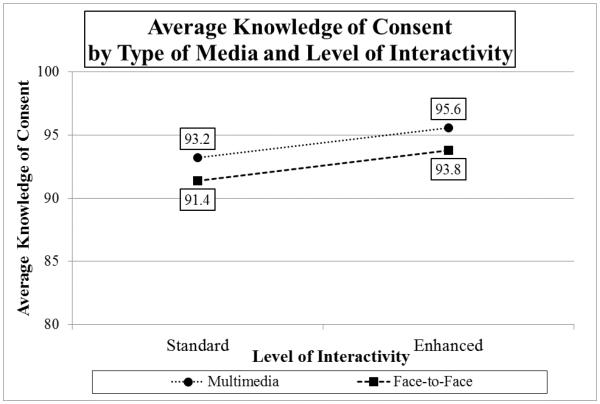
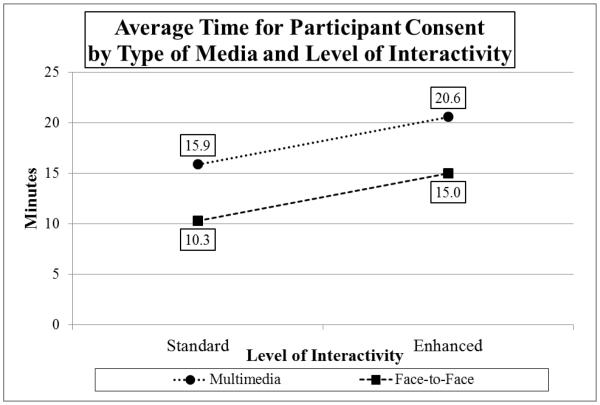
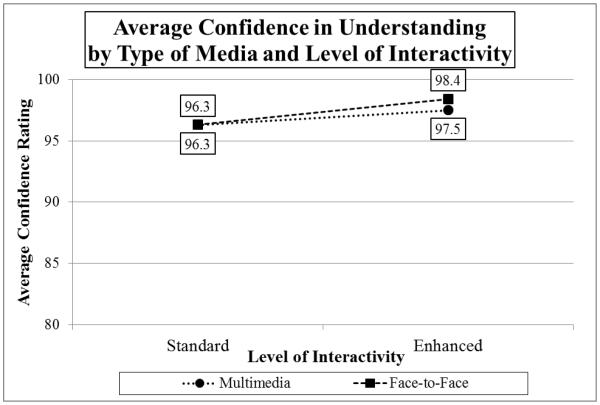
Interactivity (F(1,196) = 7.56, P = 0.007, partial η(2) = 0.037) and media (F(1,196) = 4.27, P = 0.04, partial η(2) = 0.021) independently improved participants' understanding of the biobank consent. Interactivity (F(1,196) = 6.793, P = 0.01, partial η(2) = 0.033), but not media (F(1,196) = 0.455, not significant), resulted in increased participant confidence in their understanding of the biobank's consent materials. Patients took more time to complete the multimedia condition (mean = 18.2 min) than the face-to-face condition (mean = 12.6 min).
This study demonstrated that interactivity and multimedia each can be effective at promoting an individual's understanding and confidence in their understanding of a biobank consent, albeit with additional time investment. Researchers should not assume that multimedia is inherently interactive, but rather should separate the two constructs when studying electronic consent.
交互式多媒体在改善生物样本库知情同意方面的潜力尚未得到研究。本研究的目的是测试与标准的面对面(F2F)生物样本库同意程序相比,交互性和多媒体在提高参与者对知情同意的理解和理解信心方面的单独效果。
采用2(面对面与多媒体)×2(标准与增强交互性)实验设计,随机分配200名患者接受知情同意。所有患者都收到了生物样本库九页同意文件中提供的相同信息。
交互性(F(1,196)=7.56,P=0.007,偏η(2)=0.037)和媒体(F(1,196)=4.27,P=0.04,偏η(2)=0.021)独立地提高了参与者对生物样本库同意的理解。交互性(F(1,196)=6.793,P=0.01,偏η(2)=0.033),但不是媒体(F(1,196)=0.455,不显著),导致参与者对其对生物样本库同意材料的理解信心增加。患者完成多媒体条件(平均=18.2分钟)比面对面条件(平均=12.6分钟)花费更多时间。
本研究表明,交互性和多媒体各自都可以有效地促进个人对生物样本库同意的理解和理解信心,尽管需要额外的时间投入。研究人员不应假设多媒体本质上是交互式的,而应在研究电子同意时将这两种结构分开。