Yan Wei, Peng Li-Ying, Ban Cheng-Jun, Xu Xue-Feng, Zhu Min, Liu Yan, Zhang Shu, Zhai Zhen-Guo, Wang Chen, Dai Hua-Ping
Department of Respiratory and Critical Care Medicine, Beijing Chao-Yang Hospital, Capital Medical University; Beijing Key Laboratory of Respiratory and Pulmonary Circulation, Beijing Institute of Respiratory Medicine, Beijing 100020, China.
Chin Med J (Engl). 2015 Apr 5;128(7):896-901. doi: 10.4103/0366-6999.154284.
Pulmonary hypertension (PH) frequently complicates the course of idiopathic pulmonary fibrosis (IPF) patients and is associated with significantly worse outcomes. The aim of the present study was to investigate the incidence of PH in IPF patients and evaluate the correlation between clinical parameters and systolic pulmonary artery pressure (sPAP).
Hospitalized patients with IPF, who were evaluated for sPAP by Doppler echocardiography from January 2004 to December 2011, were enrolled in our study. Patients were defined as PH by an estimated sPAP > 50 mmHg and graded as PH likely, PH possible and PH unlikely, based on the 2009 European Society of Cardiology/European Respiratory Society PH Guidelines. The correlations between clinical parameters and sPAP were analyzed by multiple linear regression.
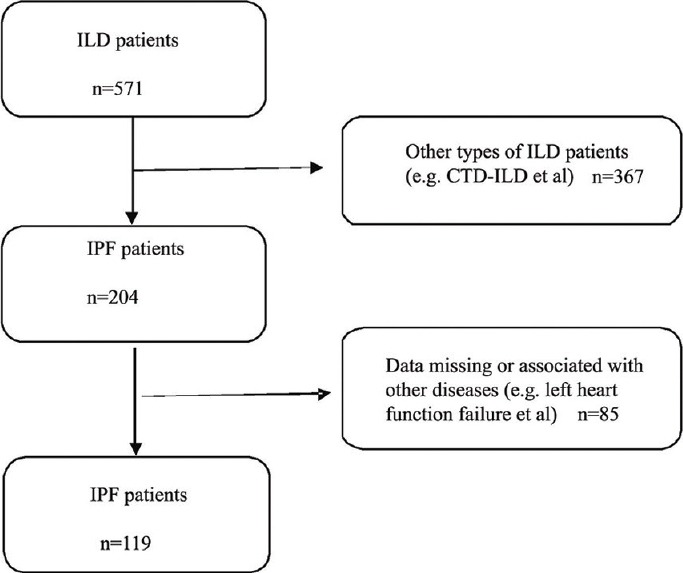
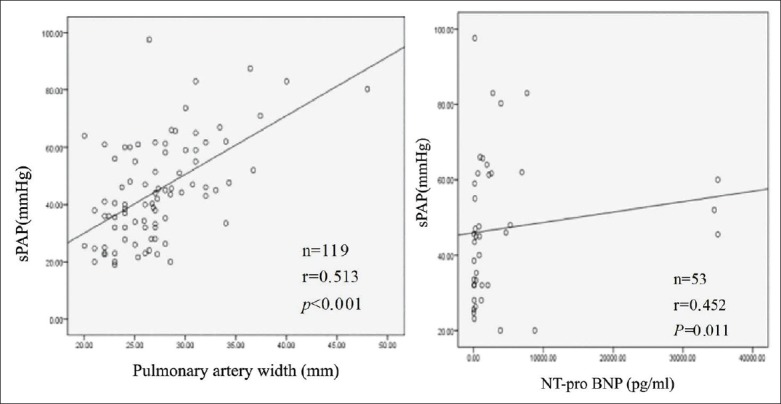
Totally, 119 IPF patients were enrolled in our study and 28 (23.5%), 20 (16.8%) and 71 (59.7%) patients were PH likely, PH possible and PH unlikely, respectively. Borg dyspnea score was positively correlated with sPAP, r = 0.467, P < 0.001. Oxygen saturation was negatively correlated with sPAP, r = -0.416, P < 0.001. Diffusing capacity of the lung for carbon monoxide percentage predicted was negatively correlated with sPAP, r = -0.424, P = 0.003. N-terminal fragment of pro-brain natriuretic peptide and pulmonary artery width was positively correlated with sPAP, r = 0.452, P = 0.011 and r = 0.513, P < 0.001, respectively.
The incidence of PH in IPF patients was 23.5% in a single center of China. PH may worsen the dyspnea, right heart dysfunction and decrease the life quality of the patients with IPF.
肺动脉高压(PH)常使特发性肺纤维化(IPF)患者病情复杂化,并与显著更差的预后相关。本研究的目的是调查IPF患者中PH的发生率,并评估临床参数与收缩期肺动脉压(sPAP)之间的相关性。
纳入2004年1月至2011年12月期间因IPF住院且通过多普勒超声心动图评估sPAP的患者。根据2009年欧洲心脏病学会/欧洲呼吸学会PH指南,估计sPAP>50 mmHg的患者被定义为PH,并分为可能PH、疑似PH和不太可能PH。通过多元线性回归分析临床参数与sPAP之间的相关性。
本研究共纳入119例IPF患者,其中可能PH、疑似PH和不太可能PH的患者分别为28例(23.5%)、20例(16.8%)和71例(59.7%)。Borg呼吸困难评分与sPAP呈正相关,r = 0.467,P < 0.001。氧饱和度与sPAP呈负相关,r = -0.416,P < 0.001。预测的一氧化碳弥散量百分比与sPAP呈负相关,r = -0.424,P = 0.003。脑钠肽前体N端片段和肺动脉宽度与sPAP呈正相关,r分别为0.452,P = 0.011和r = 0.513,P < 0.001。
在中国的一个单中心,IPF患者中PH的发生率为23.5%。PH可能会加重IPF患者的呼吸困难、右心功能不全并降低其生活质量。