McCullough Colleen M, Wang Jason J, Parsons Amanda S, Shih Sarah C
New York City Department of Health and Mental Hygiene.
Montefiore Medical Center.
EGEMS (Wash DC). 2015 Jan 6;3(1):1131. doi: 10.13063/2327-9214.1131. eCollection 2015.
To date, little research has been published on the impact that the transition from paper-based record keeping to the use of electronic health records (EHR) has on performance on clinical quality measures. This study examines whether small, independent medical practices improved in their performance on nine clinical quality measures soon after adopting EHRs.
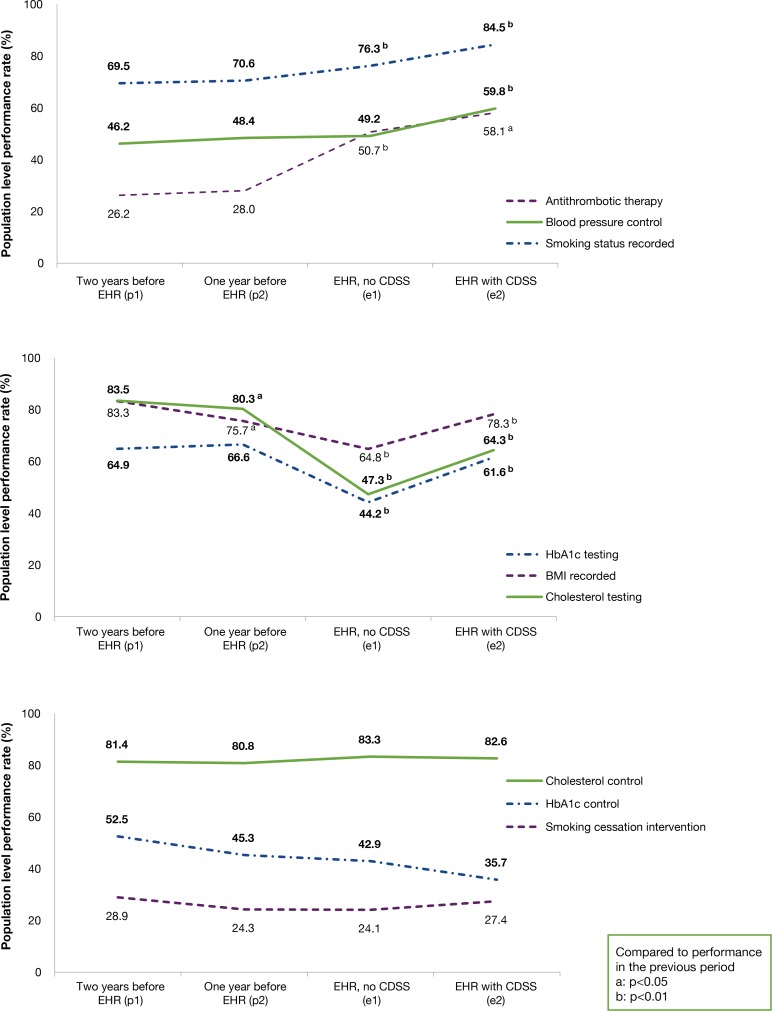
Data abstracted by manual review of paper and electronic charts for 6,007 patients across 35 small, primary care practices were used to calculate rates of nine clinical quality measures two years before and up to two years after EHR adoption.
For seven measures, population-level performance rates did not change before EHR adoption. Rates of antithrombotic therapy and smoking status recorded increased soon after EHR adoption; increases in blood pressure control occurred later. Rates of hemoglobin A1c testing, BMI recorded, and cholesterol testing decreased before rebounding; smoking cessation intervention, hemoglobin A1c control and cholesterol control did not significantly change.
The effect of EHR adoption on performance on clinical quality measures is mixed. To improve performance, practices may need to develop new workflows and adapt to different documentation methods after EHR adoption.
In the short term, EHRs may facilitate documentation of information needed for improving the delivery of clinical preventive services. Policies and incentive programs intended to drive improvement should include in their timelines consideration of the complexity of clinical tasks and documentation needed to capture performance on measures when developing timelines, and should also include assistance with workflow redesign to fully integrate EHRs into medical practice.
迄今为止,关于从纸质记录保存过渡到使用电子健康记录(EHR)对临床质量指标表现的影响,发表的研究很少。本研究考察了小型独立医疗诊所采用电子健康记录后不久,在九项临床质量指标上的表现是否有所改善。
通过人工查阅35家小型初级保健诊所的6007名患者的纸质和电子病历摘要数据,计算采用电子健康记录前两年直至采用后两年的九项临床质量指标的比率。
对于七项指标,在采用电子健康记录之前,总体表现率没有变化。采用电子健康记录后不久,抗血栓治疗和吸烟状况记录的比率有所上升;血压控制率的上升则出现得较晚。糖化血红蛋白检测、记录的体重指数和胆固醇检测的比率在反弹之前有所下降;戒烟干预、糖化血红蛋白控制和胆固醇控制没有显著变化。
采用电子健康记录对临床质量指标表现的影响喜忧参半。为了提高表现,诊所在采用电子健康记录后可能需要开发新的工作流程并适应不同的记录方法。
短期内,电子健康记录可能有助于记录改善临床预防服务提供所需的信息。旨在推动改进的政策和激励计划在制定时间表时,应在其时间安排中考虑临床任务的复杂性以及记录指标表现所需的文档,并应包括协助重新设计工作流程,以将电子健康记录全面整合到医疗实践中。