Shaw Andrew J, Ingham Stephen A, Atkinson Greg, Folland Jonathan P
English Institute of Sport, Loughborough University, Loughborough, United Kingdom; School of Sport, Exercise and Health Sciences, Loughborough University, Loughborough, United Kingdom.
English Institute of Sport, Loughborough University, Loughborough, United Kingdom.
PLoS One. 2015 Apr 7;10(4):e0123101. doi: 10.1371/journal.pone.0123101. eCollection 2015.
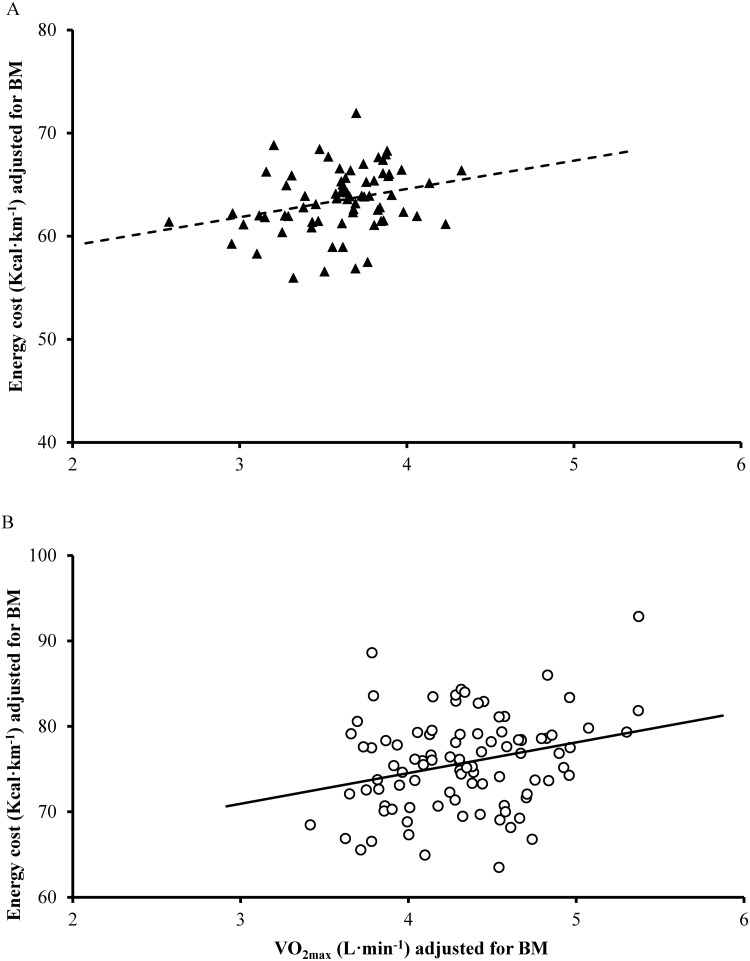
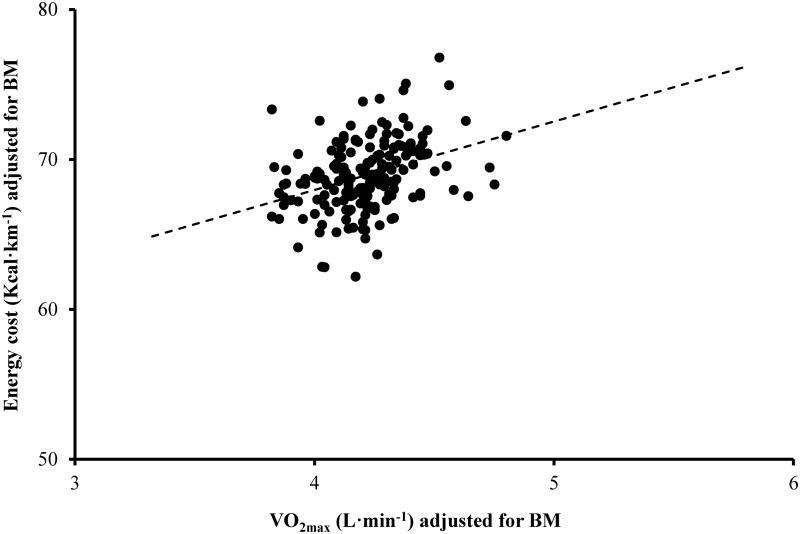
A positive relationship between running economy and maximal oxygen uptake (V̇O2max) has been postulated in trained athletes, but previous evidence is equivocal and could have been confounded by statistical artefacts. Whether this relationship is preserved in response to running training (changes in running economy and V̇O2max) has yet to be explored. This study examined the relationships of (i) running economy and V̇O2max between runners, and (ii) the changes in running economy and V̇O2max that occur within runners in response to habitual training. 168 trained distance runners (males, n = 98, V̇O2max 73.0 ± 6.3 mL∙kg-1∙min-1; females, n = 70, V̇O2max 65.2 ± 5.9 mL kg-1∙min-1) performed a discontinuous submaximal running test to determine running economy (kcal∙km-1). A continuous incremental treadmill running test to volitional exhaustion was used to determine V̇O2max 54 participants (males, n = 27; females, n = 27) also completed at least one follow up assessment. Partial correlation analysis revealed small positive relationships between running economy and V̇O2max (males r = 0.26, females r = 0.25; P<0.006), in addition to moderate positive relationships between the changes in running economy and V̇O2max in response to habitual training (r = 0.35; P<0.001). In conclusion, the current investigation demonstrates that only a small to moderate relationship exists between running economy and V̇O2max in highly trained distance runners. With >85% of the variance in these parameters unexplained by this relationship, these findings reaffirm that running economy and V̇O2max are primarily determined independently.
在训练有素的运动员中,跑步经济性与最大摄氧量(V̇O2max)之间存在正相关关系,但先前的证据并不明确,可能受到统计假象的干扰。这种关系在跑步训练(跑步经济性和V̇O2max的变化)的反应中是否依然存在尚待探索。本研究调查了(i)跑步者之间的跑步经济性与V̇O2max的关系,以及(ii)跑步者在习惯性训练后跑步经济性和V̇O2max的变化。168名训练有素的长跑运动员(男性,n = 98,V̇O2max 73.0 ± 6.3 mL∙kg-1∙min-1;女性,n = 70,V̇O2max 65.2 ± 5.9 mL kg-1∙min-1)进行了一次不连续的次最大跑步测试以确定跑步经济性(千卡∙公里-1)。通过持续递增的跑步机跑步测试至自愿疲劳来确定V̇O2max。54名参与者(男性,n = 27;女性,n = 27)也完成了至少一次随访评估。偏相关分析显示,跑步经济性与V̇O2max之间存在小的正相关关系(男性r = 0.26,女性r = 0.25;P<0.006),此外,在习惯性训练后,跑步经济性的变化与V̇O2max之间存在中等程度的正相关关系(r = 0.35;P<0.001)。总之,当前的调查表明,在训练有素的长跑运动员中,跑步经济性与V̇O2max之间仅存在小到中等程度的关系。由于这些参数中超过85%的方差无法用这种关系来解释,这些发现再次证实跑步经济性和V̇O2max主要是独立决定的。