Zhang Jie, He Jing, Zeng Xiao-Hong, Ge Shi-Jun, Huang Yu, Su Jie, Ding Xue-Mei, Yang Ji-Qing, Cao Yong-Jiu, Chen Hong, Zhang Ying-Hong, Zhu Bao-Sheng
Genetic Diagnosis Center, Yunnan Provincial Key Laboratory For Birth Defects and Genetic Diseases, the First People's Hospital of Yunnan Province, Kunming, People's Republic of China; Genetics Department, Kunming University of Science and Technology, Kunming, People's Republic of China.
Department of Clinical Laboratory, the Peoples' Hospital of Dehong Autonamic Prefecture of Dai and Jingpo, Mangshi, People's Republic of China.
PLoS One. 2015 Apr 7;10(4):e0122956. doi: 10.1371/journal.pone.0122956. eCollection 2015.
The aim of this study was to investigate the geographic distribution of β-globin gene mutations in different ethnic groups in Yunnan province.
From 2004 to 2014, 1,441 subjects with hemoglobin disorders, identified by PCR-reverse dot blot and DNA sequencing, were studied according to ethnicity and geographic origin. Haplotypes were examined among 41 unrelated thalassemia chromosomes.
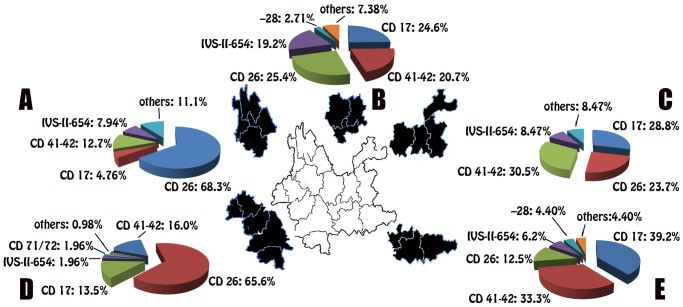
Eighteen β-thalassemia mutations and seven hemoglobin variants were identified for 1,616 alleles in 22 different ethnic groups from all 16 prefecture-level divisions of Yunnan. The prevalence of β-thalassemia was heterogeneous and regionally specific. CD 41-42 (-TCTT) was the most prevalent mutation in the populations of northeastern Yunnan. CD 17 (A>T) was the most common mutation in the populations of southeastern Yunnan, especially for the Zhuang minority, whereas Hb E (CD 26, G>A) was the most prevalent mutation in populations of southwestern Yunnan, especially for the Dai minority. Among the seven types of haplotypes identified, CD 17 (A>T) was mainly linked to haplotype VII (+ - - - - - +) and IVS-II-654 (C>T) was only linked to haplotype I (+ - - - - + +).
Our data underline the heterogeneity of β-globin gene mutations in Yunnan. This distribution of β-globin mutations in the geographic regions and ethnic populations provided a detailed ethnic basis and evolutionary view of humans in southern China, which will be beneficial for genetic counseling and prevention strategies.
本研究旨在调查云南省不同民族β-珠蛋白基因突变的地理分布情况。
2004年至2014年,对1441例经聚合酶链反应-反向点杂交和DNA测序鉴定为血红蛋白病的受试者,按照种族和地理来源进行研究。对41条无关的地中海贫血染色体进行单倍型检测。
在云南省16个地级行政区的22个不同民族中,共鉴定出18种β-地中海贫血突变和7种血红蛋白变异体,涉及1616个等位基因。β-地中海贫血的患病率存在异质性且具有区域特异性。CD 41-42(-TCTT)是滇东北地区人群中最常见的突变。CD 17(A>T)是滇东南地区人群中最常见的突变,尤其是壮族;而Hb E(CD 26,G>A)是滇西南地区人群中最常见的突变,尤其是傣族。在鉴定出的7种单倍型中,CD 17(A>T)主要与单倍型VII(+-+-+-+-)相关,IVS-II-654(C>T)仅与单倍型I(+-+-+++)相关。
我们的数据强调了云南β-珠蛋白基因突变的异质性。β-珠蛋白突变在地理区域和民族人群中的这种分布,为中国南方人类提供了详细的民族基础和进化观点,这将有利于遗传咨询和预防策略。