Maarleveld Timo R, Wortel Meike T, Olivier Brett G, Teusink Bas, Bruggeman Frank J
Systems Bioinformatics, Amsterdam Institute for Molecules, Medicines and Systems, VU University, Amsterdam, The Netherlands; Life Sciences, Centrum Wiskunde & Informatica (CWI), Amsterdam, The Netherlands.
Systems Bioinformatics, Amsterdam Institute for Molecules, Medicines and Systems, VU University, Amsterdam, The Netherlands; Kluyver Centre for Genomics of Industrial Fermentation, Delft, The Netherlands.
PLoS Comput Biol. 2015 Apr 7;11(4):e1004166. doi: 10.1371/journal.pcbi.1004166. eCollection 2015 Apr.
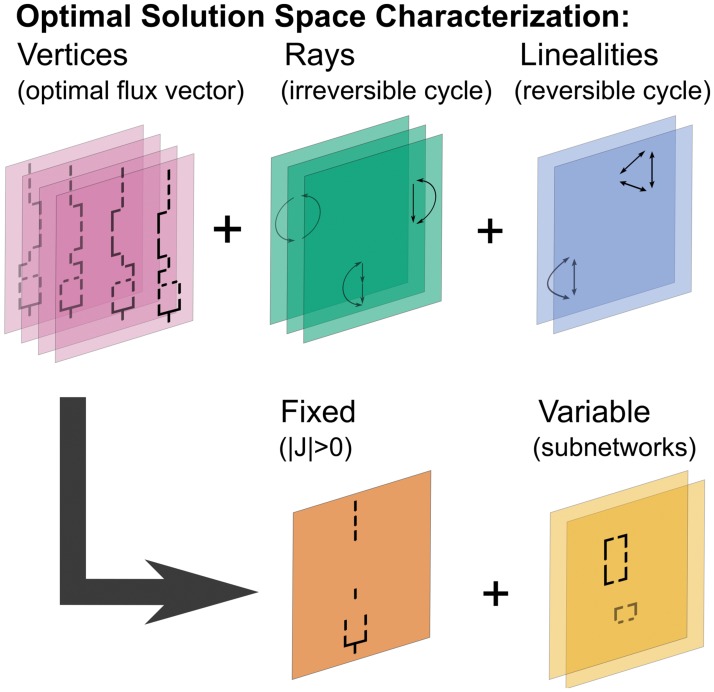
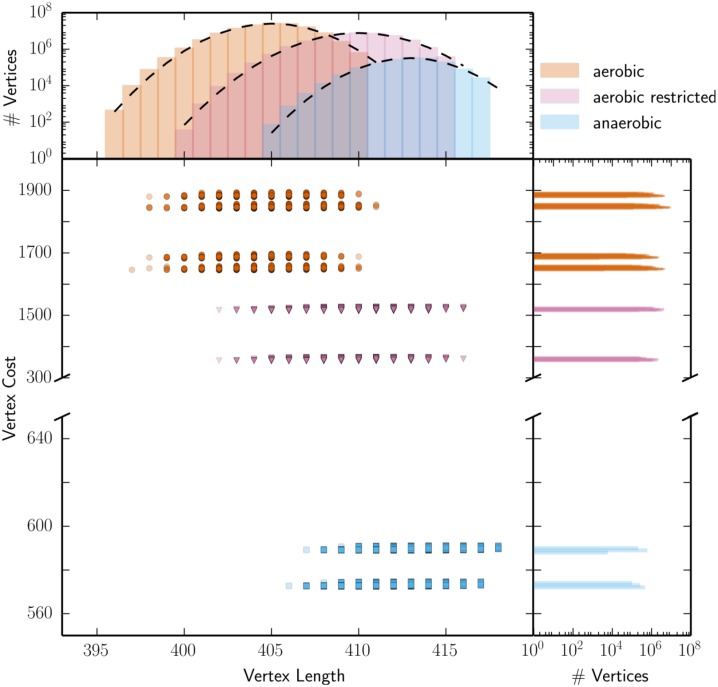
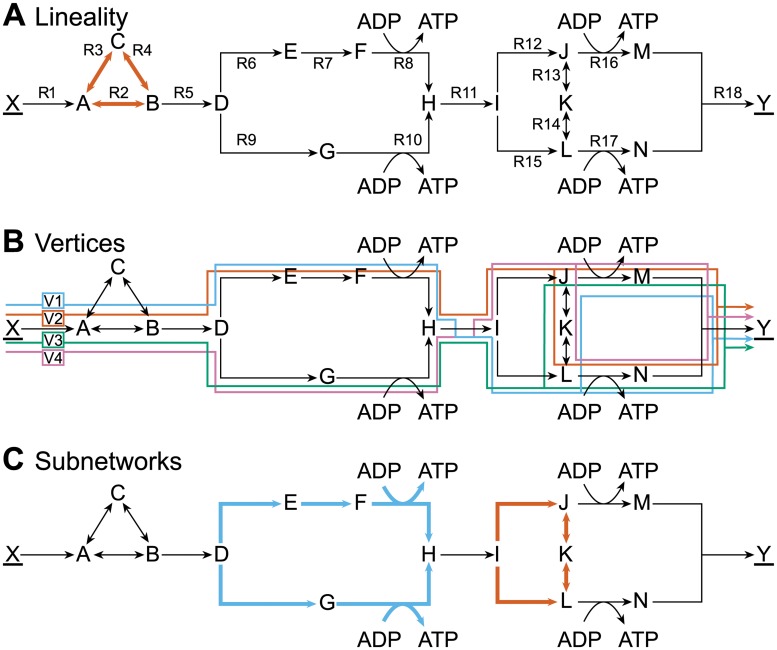
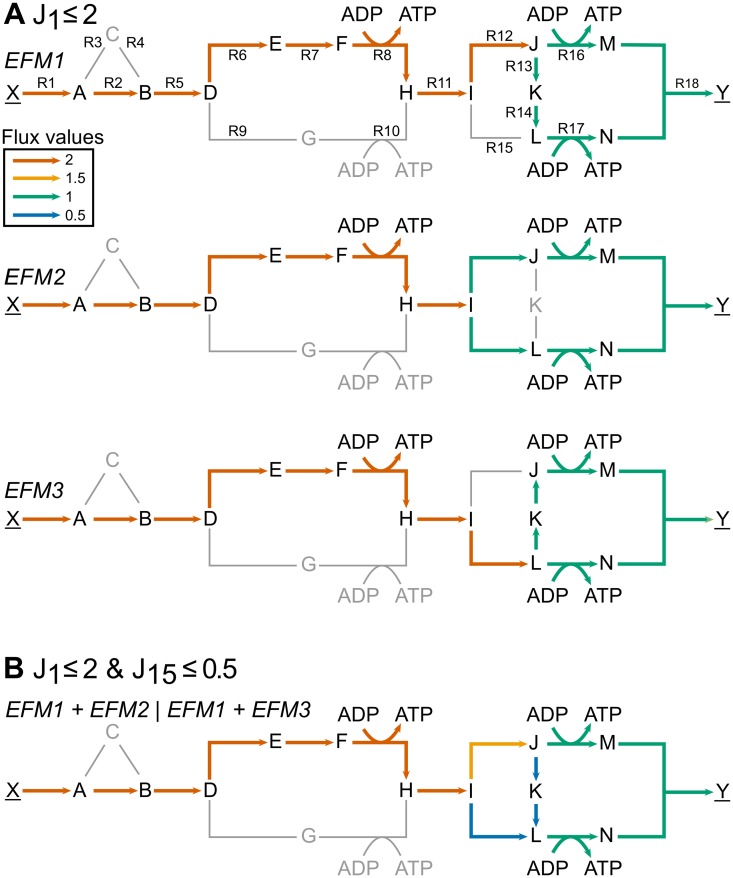
High-throughput data generation and genome-scale stoichiometric models have greatly facilitated the comprehensive study of metabolic networks. The computation of all feasible metabolic routes with these models, given stoichiometric, thermodynamic, and steady-state constraints, provides important insights into the metabolic capacities of a cell. How the feasible metabolic routes emerge from the interplay between flux constraints, optimality objectives, and the entire metabolic network of a cell is, however, only partially understood. We show how optimal metabolic routes, resulting from flux balance analysis computations, arise out of elementary flux modes, constraints, and optimization objectives. We illustrate our findings with a genome-scale stoichiometric model of Escherichia coli metabolism. In the case of one flux constraint, all feasible optimal flux routes can be derived from elementary flux modes alone. We found up to 120 million of such optimal elementary flux modes. We introduce a new computational method to compute the corner points of the optimal solution space fast and efficiently. Optimal flux routes no longer depend exclusively on elementary flux modes when we impose additional constraints; new optimal metabolic routes arise out of combinations of elementary flux modes. The solution space of feasible metabolic routes shrinks enormously when additional objectives---e.g. those related to pathway expression costs or pathway length---are introduced. In many cases, only a single metabolic route remains that is both feasible and optimal. This paper contributes to reaching a complete topological understanding of the metabolic capacity of organisms in terms of metabolic flux routes, one that is most natural to biochemists and biotechnologists studying and engineering metabolism.
高通量数据生成和基因组规模的化学计量模型极大地促进了对代谢网络的全面研究。利用这些模型,在化学计量、热力学和稳态约束条件下计算所有可行的代谢途径,能为细胞的代谢能力提供重要见解。然而,可行的代谢途径如何从通量约束、最优性目标以及细胞的整个代谢网络之间的相互作用中产生,目前仅得到部分理解。我们展示了通量平衡分析计算得出的最优代谢途径是如何从基本通量模式、约束条件和优化目标中产生的。我们用大肠杆菌代谢的基因组规模化学计量模型来说明我们的发现。在存在一个通量约束的情况下,所有可行的最优通量途径仅可从基本通量模式推导得出。我们发现了多达1.2亿个这样的最优基本通量模式。我们引入了一种新的计算方法,能够快速且高效地计算最优解空间的角点。当我们施加额外约束时,最优通量途径不再仅仅依赖于基本通量模式;新的最优代谢途径由基本通量模式的组合产生。当引入额外目标(例如与途径表达成本或途径长度相关的目标)时,可行代谢途径的解空间会大幅缩小。在许多情况下,只剩下一条既可行又最优的代谢途径。本文有助于从代谢通量途径的角度对生物体的代谢能力达成完整的拓扑理解,这对于研究和设计代谢的生物化学家和生物技术专家来说是最自然的理解方式。