Kempker Jordan A, West Kathryn G, Kempker Russell R, Siwamogsatham Oranan, Alvarez Jessica A, Tangpricha Vin, Ziegler Thomas R, Martin Greg S
Division of Pulmonary, Allergy, Critical Care and Sleep Medicine, Emory University School of Medicine, 615 Michael Street, Suite 205, Atlanta, GA 30322, United States of America.
Emory University School of Medicine, Atlanta, United States of America.
PLoS One. 2015 Apr 7;10(4):e0122136. doi: 10.1371/journal.pone.0122136. eCollection 2015.
To identify patient characteristics associated with low serum 25-hydroxyvitamin D (25(OH)D) concentrations in the medical intensive care unit (ICU) and examine the relationship between serum 25(OH)D and the risk for hospital-acquired infections.
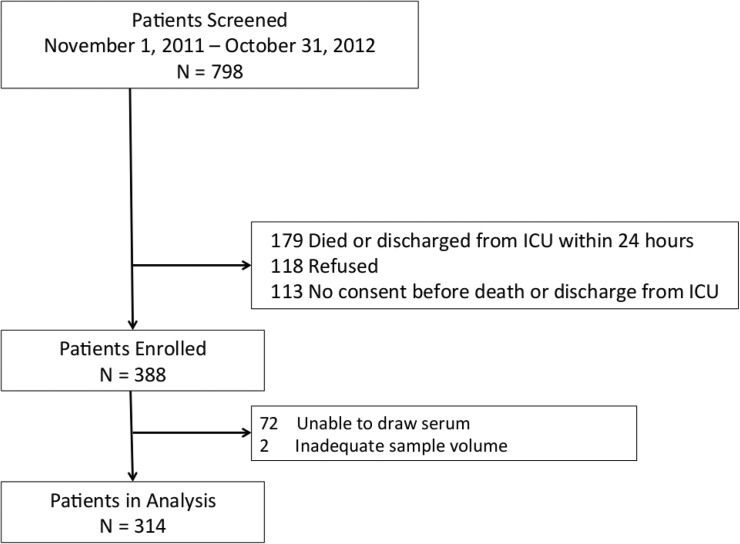
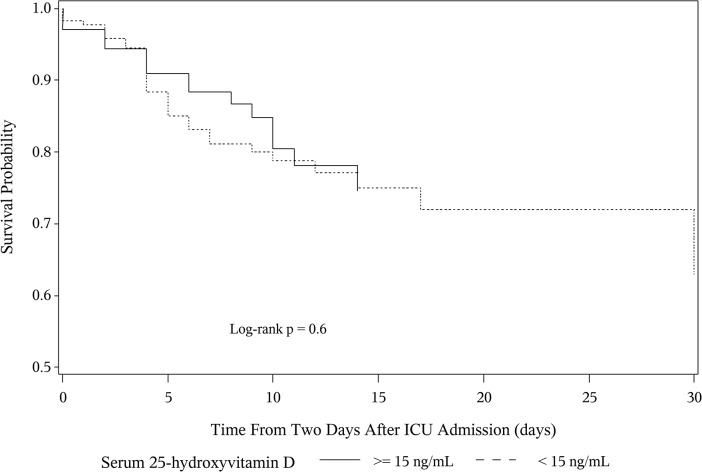
This is a prospective observational cohort of adult patients admitted to the medical ICU at an urban safety net teaching hospital in Atlanta, Georgia from November 1, 2011 through October 31, 2012 with an anticipated ICU stay ≥ 1 day. Phlebotomy for serum 25(OH)D measurement was performed on all patients within 5 days of ICU admission. Patients were followed for 30 days or until death or hospital discharge, whichever came first. Hospital-acquired infections were determined using standardized criteria from review of electronic medical record.
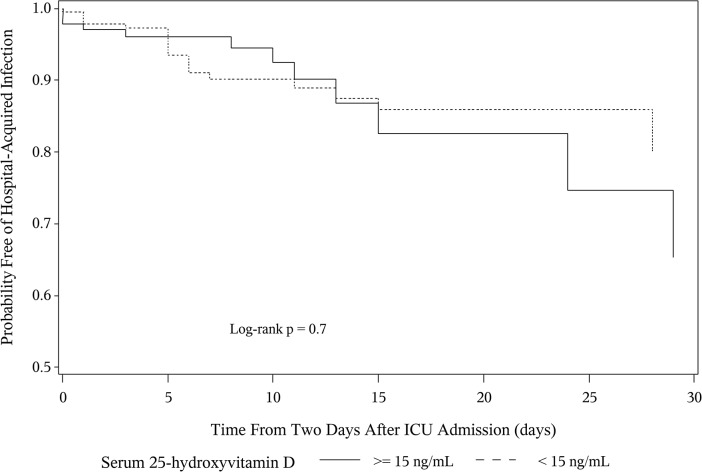
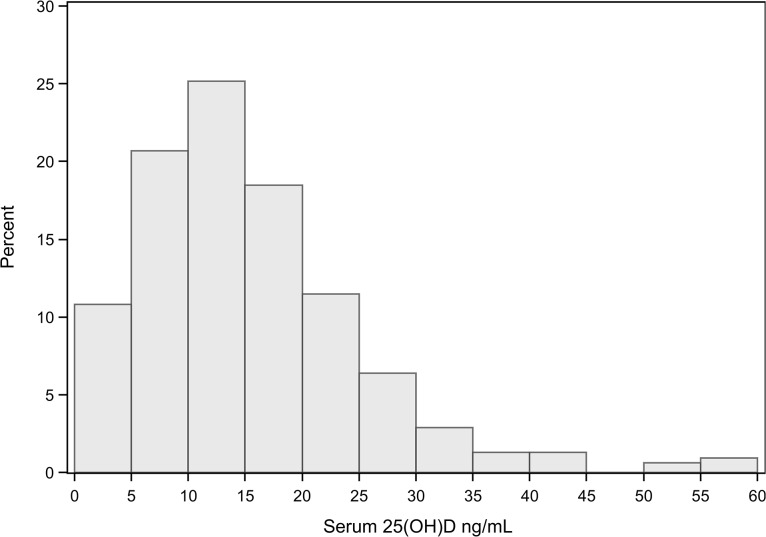
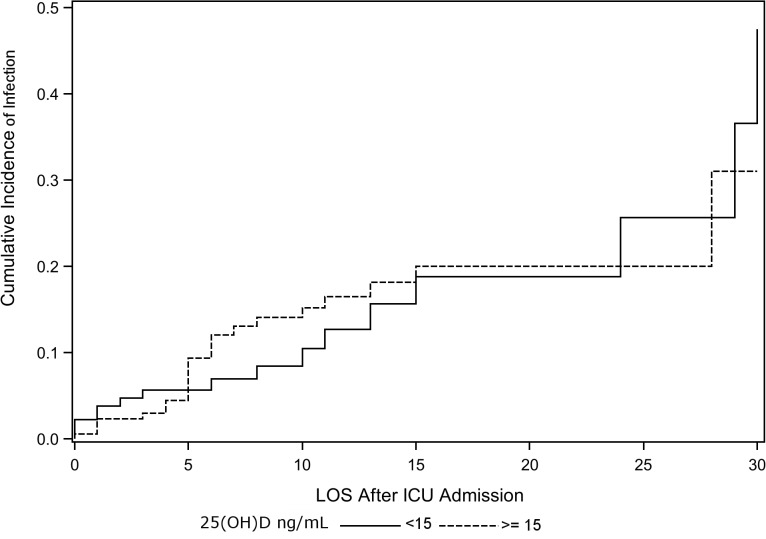
Among the 314 patients analyzed, 178 (57%) had a low vitamin D at a serum 25(OH)D concentration < 15 ng/mL. The patient characteristics associated with low vitamin D included admission during winter months (28% vs. 18%, P = 0.04), higher PaO2/FiO2 (275 vs. 226 torr, P = 0.03) and a longer time from ICU admission to study phlebotomy (1.8 vs. 1.5 days, P = 0.02). A total of 36 (11%) patients were adjudicated as having a hospital-acquired infection and in multivariable analysis adjusting for gender, alcohol use, APACHE II score, time to study phlebotomy, ICU length of stay and net fluid balance, serum 25(OH)D levels < 15 ng/mL were not associated with risk for hospital-acquired infections (HR 0.85, 95% CI 0.40-1.80, P = 0.7).
In this prospective, observational cohort of adults admitted to a single-center medical ICU, we did not find a significant association between low 25(OH)D and the risk for hospital-acquired infections.
确定医学重症监护病房(ICU)中与低血清25-羟基维生素D(25(OH)D)浓度相关的患者特征,并研究血清25(OH)D与医院获得性感染风险之间的关系。
这是一项前瞻性观察性队列研究,研究对象为2011年11月1日至2012年10月31日期间入住佐治亚州亚特兰大市一家城市安全网教学医院医学ICU的成年患者,预计ICU住院时间≥1天。所有患者在入住ICU后5天内进行静脉穿刺以测量血清25(OH)D。对患者进行30天随访,或直至死亡或出院,以先发生者为准。使用电子病历审查的标准化标准确定医院获得性感染。
在分析的314例患者中,178例(57%)血清25(OH)D浓度<15 ng/mL,维生素D水平较低。与低维生素D相关的患者特征包括冬季入院(28%对18%,P = 0.04)、较高的PaO2/FiO2(275对226 torr,P = 0.03)以及从入住ICU到研究性静脉穿刺的时间较长(1.8对1.5天,P = 0.02)。共有36例(11%)患者被判定发生医院获得性感染,在对性别、酒精使用、APACHE II评分、研究性静脉穿刺时间、ICU住院时间和净液体平衡进行多变量分析时,血清25(OH)D水平<15 ng/mL与医院获得性感染风险无关(HR 0.85,95%CI 0.40-1.80,P = 0.7)。
在这个单中心医学ICU收治的成人前瞻性观察性队列中,我们未发现低25(OH)D与医院获得性感染风险之间存在显著关联。