Reed William R, Pickar Joel G
From the Palmer Center for Chiropractic Research, 741 Brady Street, Davenport, IA.
Spine (Phila Pa 1976). 2015 Jul 1;40(13):E752-9. doi: 10.1097/BRS.0000000000000915.
In vivo cat model study.
To determine whether intervertebral facet joint fixation and segmental thrust level alter paraspinal muscle spindle activity during simulated spinal manipulation.
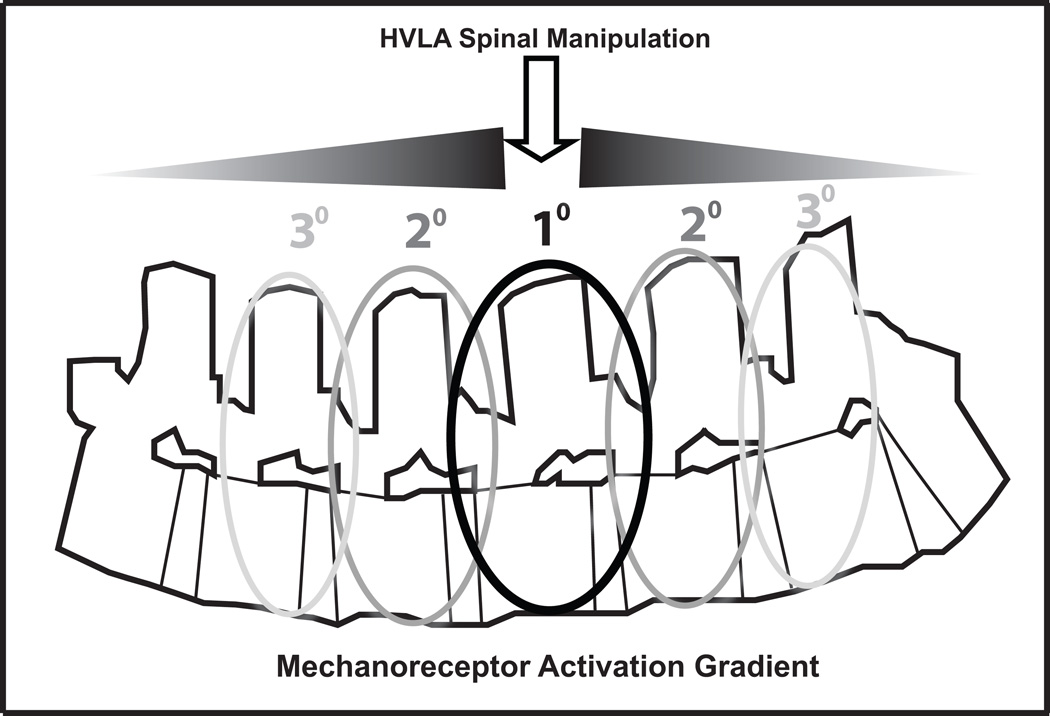
Intervertebral motion is commonly assessed by manual therapy practitioners during clinical evaluation and treatment. Mechanoreceptor activity elicited during spinal manipulation has been theorized as a potential mechanism of its efficacy. The degree to which intervertebral fixation and segmental thrust level alter paraspinal muscle spindle activity during high velocity low amplitude spinal manipulation (HVLA-SM) is unclear.
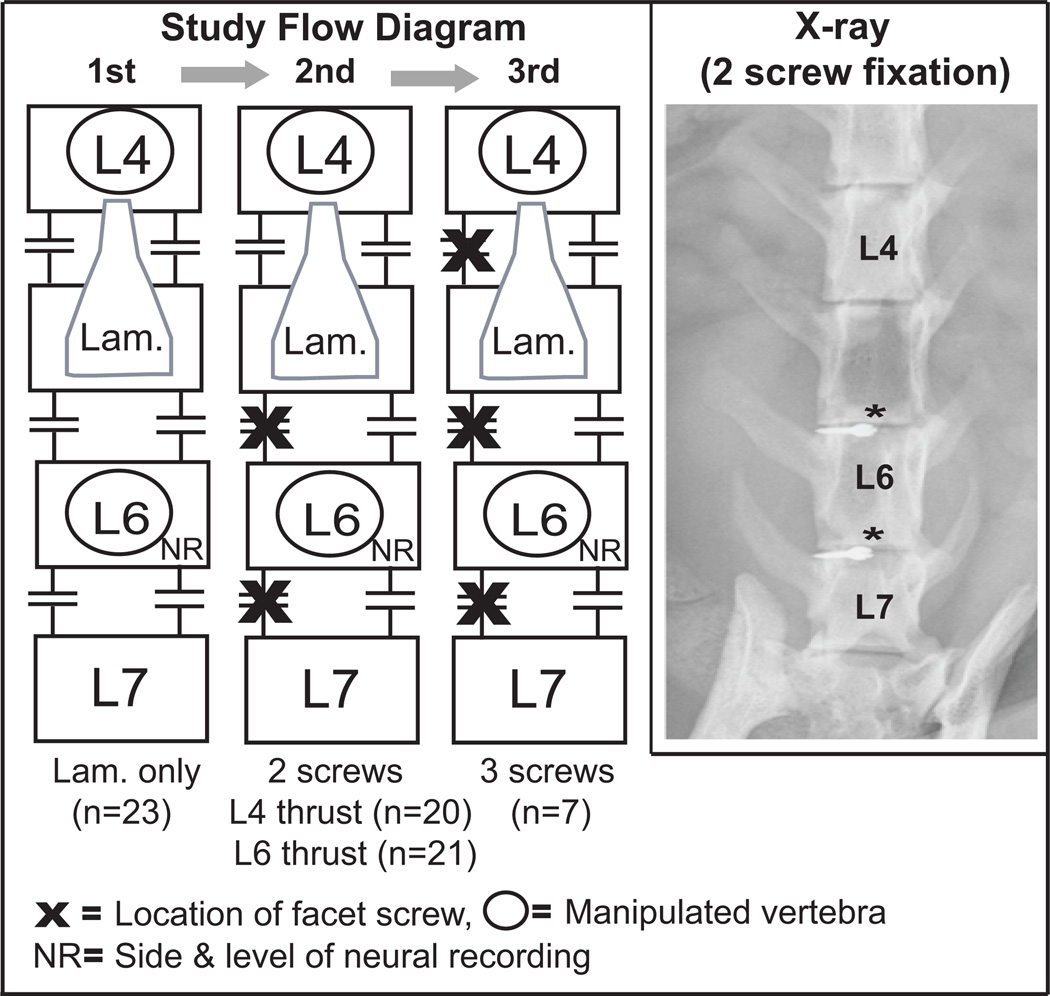
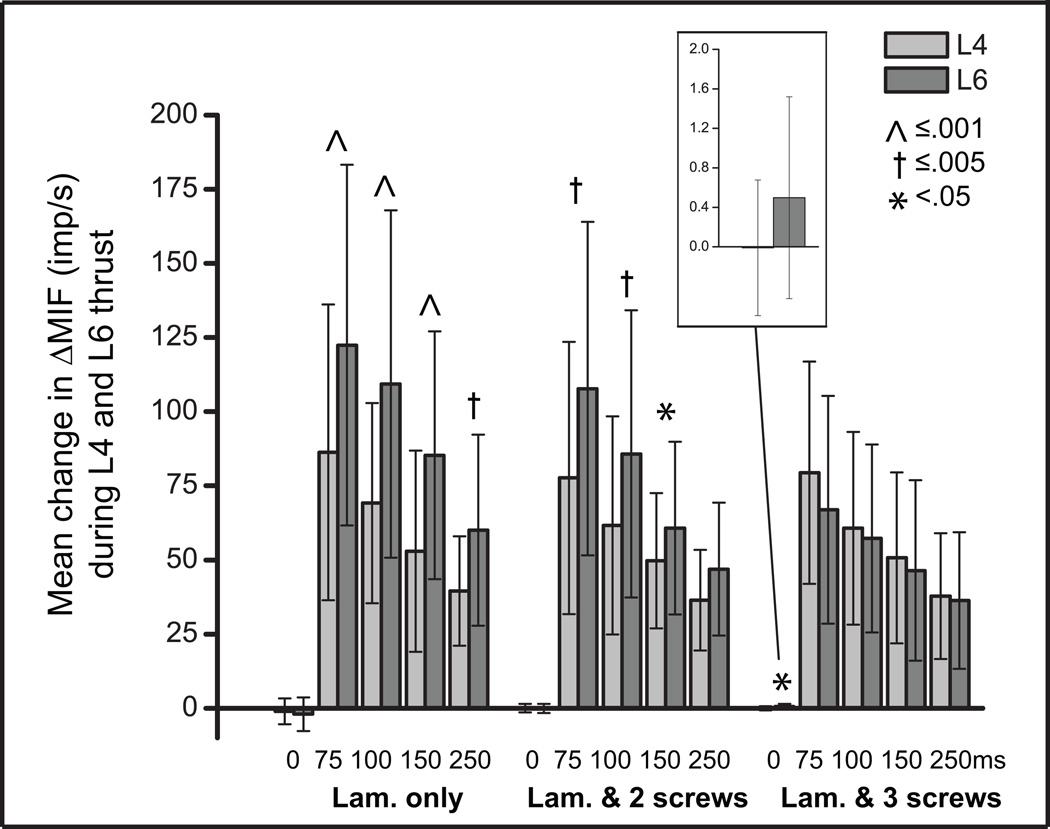
Intervertebral fixation was created by inserting facet screws through the left L(5-6) and L(6-7) and left L(4-5), L(5-6), and L(6-7) facet joints of a cat spine. Changes in the mean instantaneous frequency of L6 muscle spindle discharge were determined during 5 HVLA-SM thrust durations (0-control, 75, 100, 150, 250 ms) delivered at the L4 or L6 spinous process in each of the 3 conditions within the same preparation: laminectomy-only (surgical control; n = 23), L(5-6) and L(6-7) fixations (n = 20), and L(4-5), L(5-6), and L(6-7) fixations (n = 7). Comparisons were made between thrust levels, thrust durations, and spinal joint conditions using a linear mixed model.
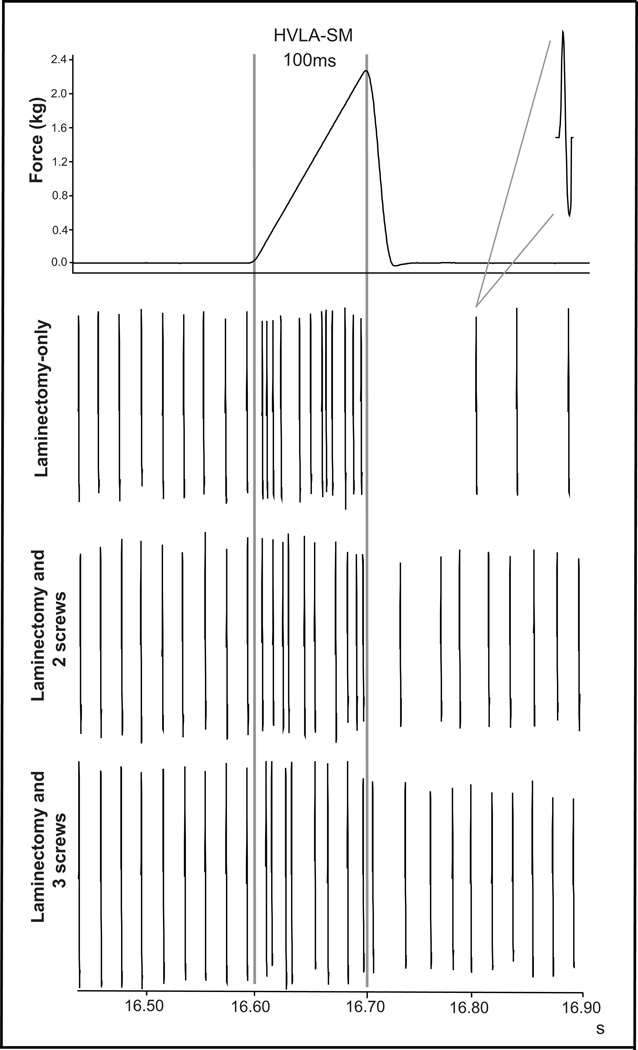
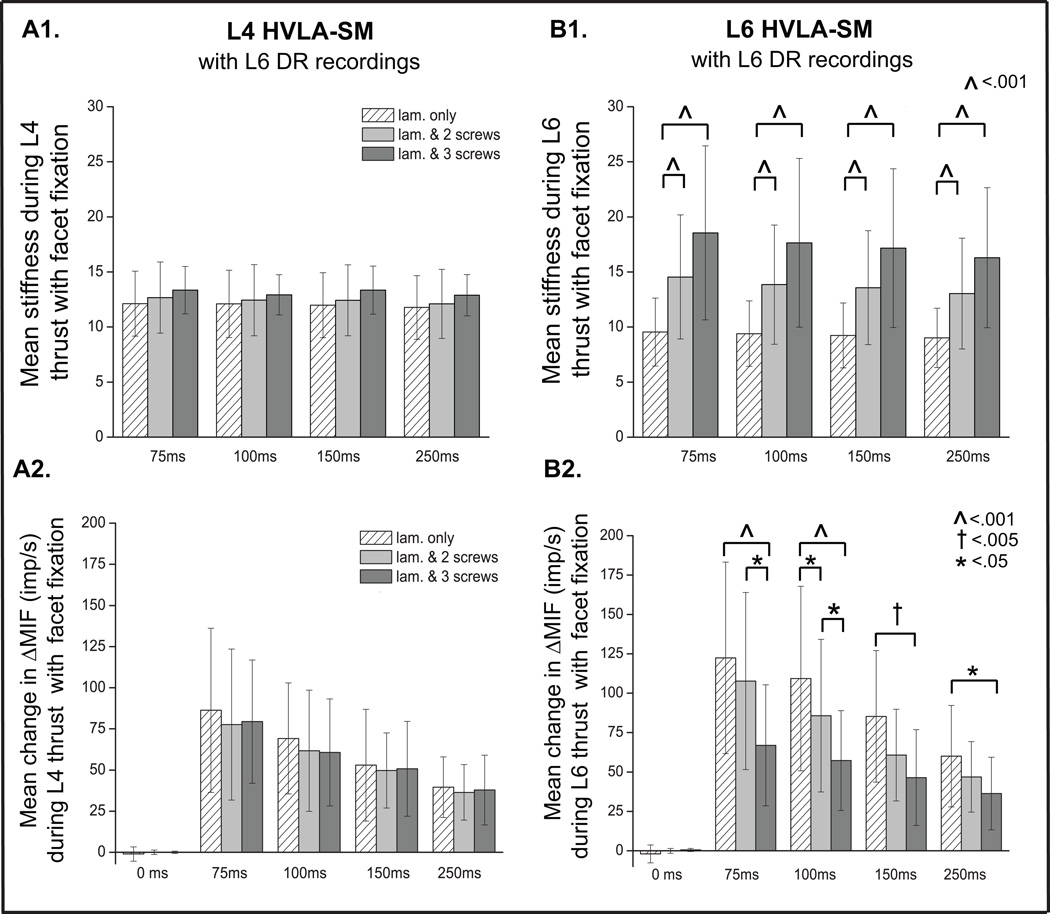
Insertion of facet screws compared with laminectomy-only significantly increased (P < 0.001) lumbar spinal stiffness during L6 HVLA-SM. Compared with laminectomy-only, both the 2 facet screw (100 ms; P < 0.05) and 3 screw conditions [75 ms and 100 ms (P < 0.001), 150 ms (P < 0.005), and 250 ms (P < 0.05)] significantly decreased L6 spindle response during the L6 HVLA-SM. HVLA-SM-delivered 2 segments rostral to the level of muscle spindle input significantly decreases spindle response compared with HVLA-SM-delivered at-level; however, nontarget HVLA-SM still elicits 60% to 80% of at-level muscle spindle response.
Intervertebral fixation decreases paraspinal muscle spindle response during L6 HVLA-SM in a cat model. Whereas HVLA-SM target accuracy maximizes spindle response, nontarget HVLA-SM still elicits substantial levels of muscle spindle activity.
N/A.
体内猫模型研究。
确定在模拟脊柱手法治疗过程中,椎间小关节固定和节段性推力水平是否会改变椎旁肌梭活动。
在临床评估和治疗过程中,手动治疗从业者通常会评估椎间运动。脊柱手法治疗过程中引发的机械感受器活动被认为是其疗效的潜在机制。在高速低振幅脊柱手法治疗(HVLA-SM)过程中,椎间固定和节段性推力水平对椎旁肌梭活动的改变程度尚不清楚。
通过将小关节螺钉插入猫脊柱的左L(5-6)和L(6-7)以及左L(4-5)、L(5-6)和L(6-7)小关节来实现椎间固定。在同一标本的3种情况下,于L4或L6棘突处进行5次HVLA-SM推力持续时间(0-对照、75、100、150、250毫秒)时,测定L6肌梭放电的平均瞬时频率变化:仅行椎板切除术(手术对照;n = 23)、L(5-6)和L(6-7)固定(n = 20)以及L(4-5)、L(5-6)和L(6-7)固定(n = 7)。使用线性混合模型对推力水平、推力持续时间和脊柱关节状况进行比较。
与仅行椎板切除术相比,插入小关节螺钉在L6 HVLA-SM期间显著增加了腰椎脊柱刚度(P < 0.001)。与仅行椎板切除术相比,2枚小关节螺钉(100毫秒;P < 0.05)和3枚螺钉情况[75毫秒和100毫秒(P < 0.001)、150毫秒(P < 0.005)和250毫秒(P < 0.05)]在L6 HVLA-SM期间均显著降低了L6肌梭反应。与在肌梭输入水平进行的HVLA-SM相比,在肌梭输入水平上方2个节段进行的HVLA-SM显著降低了肌梭反应;然而,非目标HVLA-SM仍能引发60%至80%的在水平肌梭反应。
在猫模型中,椎间固定在L6 HVLA-SM期间降低了椎旁肌梭反应。虽然HVLA-SM的目标准确性可使肌梭反应最大化,但非目标HVLA-SM仍能引发大量的肌梭活动。
无。