Tabouret Emeline, Tchoghandjian Aurelie, Denicolai Emilie, Delfino Christine, Metellus Philippe, Graillon Thomas, Boucard Celine, Nanni Isabelle, Padovani Laetitia, Ouafik L'Houcine, Figarella-Branger Dominique, Chinot Olivier
Aix-Marseille Univ, CRO2, UMR 911, Marseille 13284, France.
APHM, Timone Hospital, Department of Neuro-Oncology, Marseille 13005, France.
Oncotarget. 2015 May 10;6(13):11664-75. doi: 10.18632/oncotarget.3256.
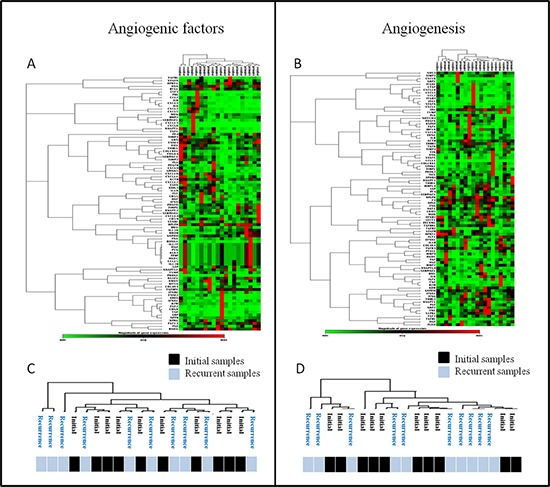
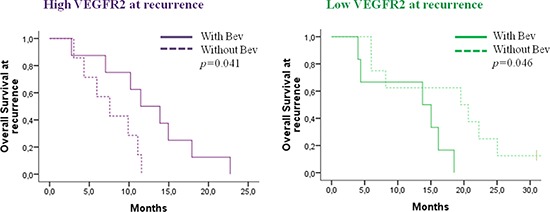
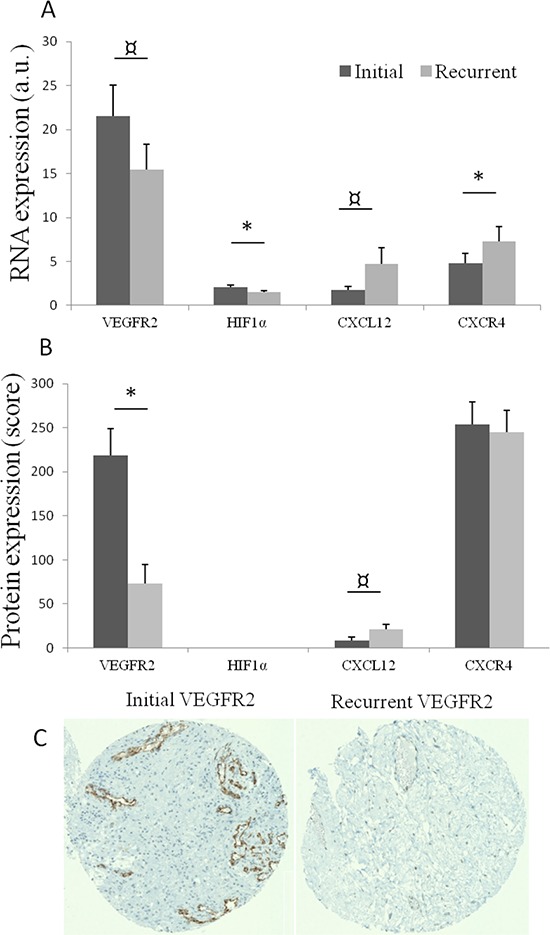
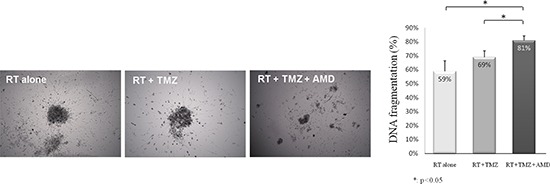
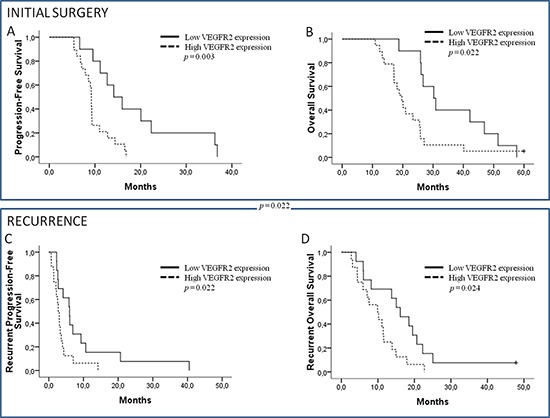
Angiogenesis is one of the key features of glioblastoma (GBM). Our objective was to explore the potential changes of angiogenic factors in GBM between initial diagnosis and recurrence after radiotherapy-temozolomide (RT/TMZ). Paired frozen tumors from both initial and recurrent surgery were available for 29 patients. Screening of genes expressions related to angiogenesis was performed using RT- PCR arrays on 10 first patients. Next, RNA expressions of the selected genes were analyzed on all samples. Protein expression was examined by immunohistochemistry. The anti-tumor effect of AMD3100 (anti-CXCR4) was tested in GBM explants. In the screening step, the initial-recurrence expression changes contributed to a selection of seven genes (VEGFA, VEGFR2, VEGFR1, CXCL12, CXCR4, uPA HIF1α). By quantitative RT-PCR, RNA expressions of CXCR4 (p = 0.029) and CXCL12 (p = 0.107) were increased while expressions of HIF1α (p = 0.009) and VEGFR2 (p = 0.081) were decreased at recurrence. Similarly, CXCL12 protein expression tended to increase (p = 0.096) while VEGFR2 staining was decreased (p = 0.004) at recurrence. An increase of anti-tumoral effect was observed with the combination of AMD3100 and RT/TMZ versus RT/TMZ alone in GB explants. Recurrence of GB after chemo-radiation could be associated with a switch of angiogenic pattern from VEGFR2-HIF1α to CXCL12-CXCR4 pathway, leading to new perspectives in angiogenic treatment.
血管生成是胶质母细胞瘤(GBM)的关键特征之一。我们的目的是探讨胶质母细胞瘤在放疗-替莫唑胺(RT/TMZ)初始诊断和复发之间血管生成因子的潜在变化。29例患者可获得初次手术和复发性手术的配对冷冻肿瘤。对10例首批患者使用RT-PCR芯片进行与血管生成相关的基因表达筛选。接下来,对所有样本分析所选基因的RNA表达。通过免疫组织化学检测蛋白质表达。在GBM外植体中测试了AMD3100(抗CXCR4)的抗肿瘤作用。在筛选步骤中,初始-复发表达变化促成了7个基因(VEGFA、VEGFR2、VEGFR1、CXCL12、CXCR4、uPA、HIF1α)的选择。通过定量RT-PCR,复发时CXCR4(p = 0.029)和CXCL12(p = 0.107)的RNA表达增加,而HIF1α(p = 0.009)和VEGFR2(p = 0.081)的表达降低。同样,复发时CXCL12蛋白表达倾向于增加(p = 0.096),而VEGFR2染色减少(p = 0.004)。在GB外植体中,观察到AMD3100与RT/TMZ联合使用比单独使用RT/TMZ的抗肿瘤作用增强。放化疗后GB的复发可能与血管生成模式从VEGFR2-HIF1α向CXCL12-CXCR4途径的转变有关,这为血管生成治疗带来了新的前景。