Zhang Wenchi, Wu Jing, Ward Matthew D, Yang Sunggu, Chuang Yang-An, Xiao Meifang, Li Ruojing, Leahy Daniel J, Worley Paul F
Solomon H. Snyder Department of Neuroscience, Johns Hopkins University School of Medicine, Baltimore, MD 21205, USA.
Department of Biophysics and Biophysical Chemistry, Johns Hopkins University School of Medicine, Baltimore, MD 21205, USA.
Neuron. 2015 Apr 22;86(2):490-500. doi: 10.1016/j.neuron.2015.03.030. Epub 2015 Apr 9.
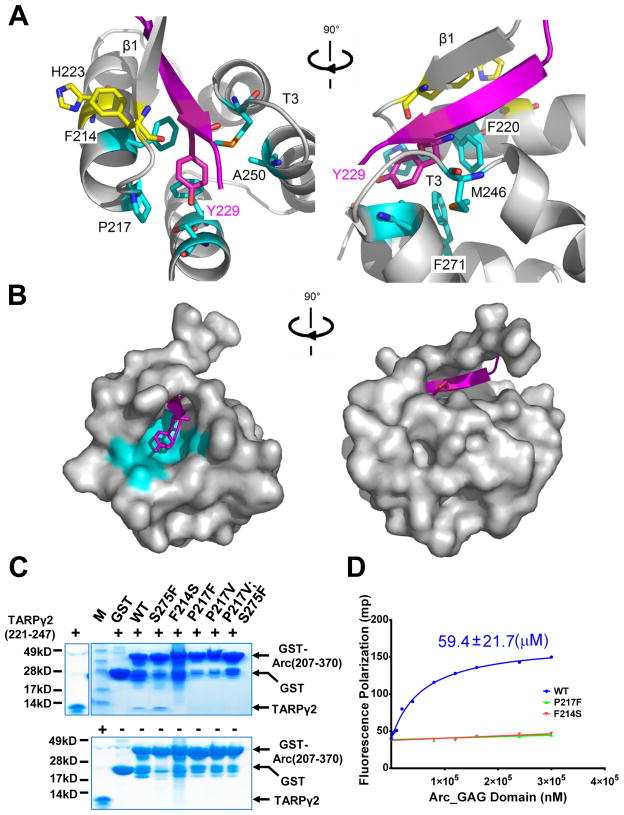
Arc is a cellular immediate-early gene (IEG) that functions at excitatory synapses and is required for learning and memory. We report crystal structures of Arc subdomains that form a bi-lobar architecture remarkably similar to the capsid domain of human immunodeficiency virus (HIV) gag protein. Analysis indicates Arc originated from the Ty3/Gypsy retrotransposon family and was "domesticated" in higher vertebrates for synaptic functions. The Arc N-terminal lobe evolved a unique hydrophobic pocket that mediates intermolecular binding with synaptic proteins as resolved in complexes with TARPγ2 (Stargazin) and CaMKII peptides and is essential for Arc's synaptic function. A consensus sequence for Arc binding identifies several additional partners that include genes implicated in schizophrenia. Arc N-lobe binding is inhibited by small chemicals suggesting Arc's synaptic action may be druggable. These studies reveal the remarkable evolutionary origin of Arc and provide a structural basis for understanding Arc's contribution to neural plasticity and disease.
Arc是一种细胞即早基因(IEG),在兴奋性突触中发挥作用,是学习和记忆所必需的。我们报道了Arc亚结构域的晶体结构,其形成了一种双叶结构,与人类免疫缺陷病毒(HIV)gag蛋白的衣壳结构域非常相似。分析表明,Arc起源于Ty3/Gypsy逆转录转座子家族,并在高等脊椎动物中被“驯化”以发挥突触功能。Arc的N端叶进化出一个独特的疏水口袋,可介导与突触蛋白的分子间结合,这在与TARPγ2(Stargazin)和CaMKII肽形成的复合物中得到解析,并且对Arc的突触功能至关重要。Arc结合的共有序列确定了几个额外的伙伴,包括与精神分裂症相关的基因。Arc N叶的结合受到小分子化学物质的抑制,这表明Arc的突触作用可能是可药物化的。这些研究揭示了Arc显著的进化起源,并为理解Arc对神经可塑性和疾病的贡献提供了结构基础。