Han Ji-Won, Shim Do-Wan, Shin Woo-Young, Heo Kang-Hyuk, Kwak Su-Bin, Sim Eun-Jeong, Jeong Jae-Hyun, Kang Tae-Bong, Lee Kwang-Ho
Department of Biotechnology, College of Biomedical & Health Science, Research Institute of Inflammatory Diseases, Konkuk University, Chungju 380-701, Korea.
Department of Food Science & Technology, Korea National University of Transportation, Chungju 368-701, Korea.
Int J Mol Sci. 2015 Apr 10;16(4):8102-9. doi: 10.3390/ijms16048102.
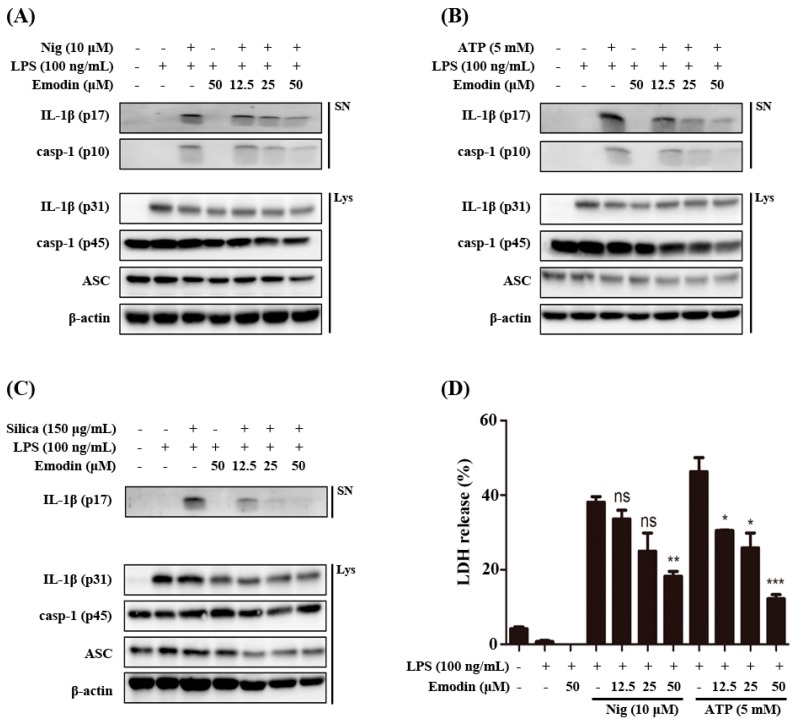
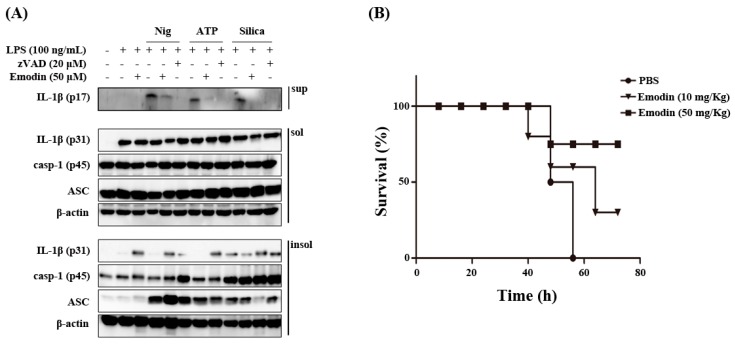
Emodin, an active constituent of oriental herbs, is widely used to treat allergy, inflammation, and other symptoms. This study provides the scientific basis for the anti-inflammasome effects of emodin on both in vitro and in vivo experimental models. Bone marrow-derived macrophages were used to study the effects of emodin on inflammasome activation by using inflammasome inducers such as ATP, nigericin, and silica crystals. The lipopolysaccharide (LPS)-induced endotoxin shock model was employed to study the effect of emodin on in vivo efficacy. Emodin treatment attenuated interleukin (IL)-1β secretion via the inhibition of NOD-like receptor family, pyrin domain containing 3 (NLRP3) inflammasome activation induced by ATP, nigericin, and silica crystals. Further, emodin ameliorated the severity of NLRP3 inflammasome-mediated symptoms in LPS-induced endotoxin mouse models. This study is the first to reveal mechanism-based evidence, especially with respect to regulation of inflammasome activation, substantiating traditional claims of emodin in the treatment of inflammation-related disorders.
大黄素是一种东方草药的活性成分,广泛用于治疗过敏、炎症及其他症状。本研究为大黄素在体外和体内实验模型中的抗炎症小体作用提供了科学依据。利用骨髓来源的巨噬细胞,通过使用三磷酸腺苷(ATP)、尼日利亚菌素和二氧化硅晶体等炎症小体诱导剂来研究大黄素对炎症小体激活的影响。采用脂多糖(LPS)诱导的内毒素休克模型来研究大黄素对体内疗效的影响。大黄素处理通过抑制由ATP、尼日利亚菌素和二氧化硅晶体诱导的含NOD样受体家族、吡啉结构域的3(NLRP3)炎症小体激活,减弱了白细胞介素(IL)-1β的分泌。此外,大黄素改善了LPS诱导的内毒素小鼠模型中NLRP3炎症小体介导症状的严重程度。本研究首次揭示了基于机制的证据,特别是关于炎症小体激活的调节,证实了大黄素在治疗炎症相关疾病方面的传统说法。