Institut für Mikrobiologie, Technische Universität Braunschweig , Braunschweig , Germany.
Max Planck Institute of Biophysical Chemistry Göttingen BO Halle , Halle , Germany.
Front Bioeng Biotechnol. 2015 Mar 27;3:41. doi: 10.3389/fbioe.2015.00041. eCollection 2015.
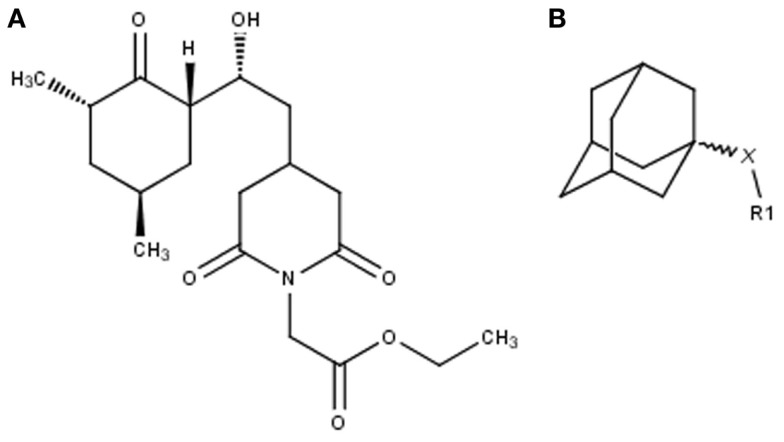
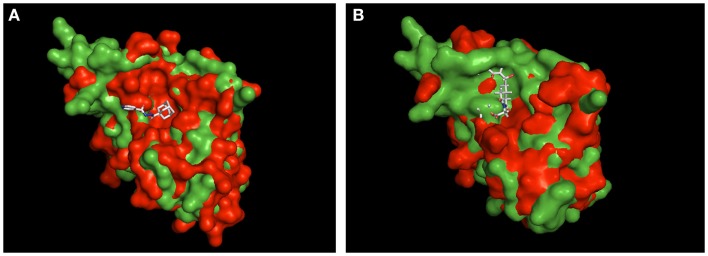
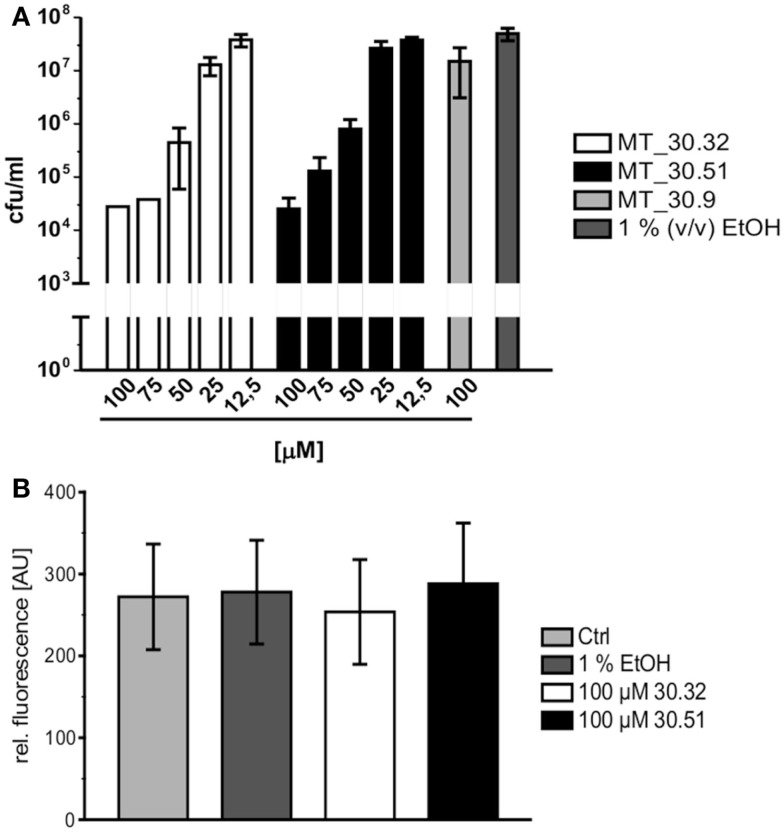
Macrophage infectivity potentiator (Mip) and Mip-like proteins are virulence factors in a wide range of pathogens including Legionella pneumophila. These proteins belong to the FK506 binding protein (FKBP) family of peptidyl-prolyl-cis/trans-isomerases (PPIases). In L. pneumophila, the PPIase activity of Mip is required for invasion of macrophages, transmigration through an in vitro lung-epithelial barrier, and full virulence in the guinea pig infection model. Additionally, Mip is a moonlighting protein that binds to collagen IV in the extracellular matrix. Here, we describe the development and synthesis of cycloheximide derivatives with adamantyl moieties as novel FKBP ligands, and analyze their effect on the viability of L. pneumophila and other bacteria. All compounds efficiently inhibited PPIase activity of the prototypic human FKBP12 as well as Mip with IC50-values as low as 180 nM and 1.7 μM, respectively. Five of these derivatives inhibited the growth of L. pneumophila at concentrations of 30-40 μM, but exhibited no effect on other tested bacterial species indicating a specific spectrum of antibacterial activity. The derivatives carrying a 3,5-dimethyladamantan-1-[yl]acetamide substitution (MT_30.32), and a 3-ethyladamantan-1-[yl]acetamide substitution (MT_30.51) had the strongest effects in PPIase- and liquid growth assays. MT_30.32 and MT_30.51 were also inhibitory in macrophage infection studies without being cytotoxic. Accordingly, by applying a combinatorial approach, we were able to generate novel, hybrid inhibitors consisting of cycloheximide and adamantane, two known FKBP inhibitors that interact with different parts of the PPIase domain, respectively. Interestingly, despite the proven Mip-inhibitory activity, the viability of a Mip-deficient strain was affected to the same degree as its wild type. Hence, we also propose that cycloheximide derivatives with adamantyl moieties are potent PPIase inhibitors with multiple targets in L. pneumophila.
巨噬细胞感染增强因子(Mip)和 Mip 样蛋白是广泛病原体(包括嗜肺军团菌)的毒力因子。这些蛋白属于 FK506 结合蛋白(FKBP)家族的肽脯氨酰顺/反式异构酶(PPIase)。在嗜肺军团菌中,Mip 的 PPIase 活性对于巨噬细胞的入侵、穿过体外肺上皮屏障的迁移以及豚鼠感染模型中的完全毒力是必需的。此外,Mip 是一种具有多功能的蛋白,与细胞外基质中的胶原 IV 结合。在这里,我们描述了带有金刚烷部分的环己酮衍生物的开发和合成,作为新型 FKBP 配体,并分析了它们对嗜肺军团菌和其他细菌活力的影响。所有化合物都能有效抑制典型人 FKBP12 以及 Mip 的 PPIase 活性,IC50 值分别低至 180 nM 和 1.7 μM。其中 5 种衍生物在 30-40 μM 浓度下抑制嗜肺军团菌的生长,但对其他测试的细菌种无影响,表明具有特定的抗菌活性谱。携带 3,5-二甲基金刚烷-1-[基]乙酰胺取代基(MT_30.32)和 3-乙基金刚烷-1-[基]乙酰胺取代基(MT_30.51)的衍生物在 PPIase 和液体生长测定中具有最强的效果。MT_30.32 和 MT_30.51 在巨噬细胞感染研究中也具有抑制作用,而没有细胞毒性。因此,通过应用组合方法,我们能够生成由环己酮和金刚烷组成的新型混合抑制剂,这两种抑制剂分别是已知的与 PPIase 结构域的不同部分相互作用的 FKBP 抑制剂。有趣的是,尽管具有已证明的 Mip 抑制活性,但 Mip 缺陷菌株的活力受到的影响与其野生型相同。因此,我们还提出,带有金刚烷部分的环己酮衍生物是具有多个靶点的 L. pneumophila 的强效 PPIase 抑制剂。