Rosenblum Serge, Lovsky Yulia, Arazi Lior, Vollmer Frank, Dayan Barak
Department of Chemical Physics, Weizmann Institute of Science, Rehovot 76100, Israel.
Laboratory of Nanophotonics &Biosensing, Max Planck Institute for the Science of Light, D-91058 Erlangen, Germany.
Nat Commun. 2015 Apr 15;6:6788. doi: 10.1038/ncomms7788.
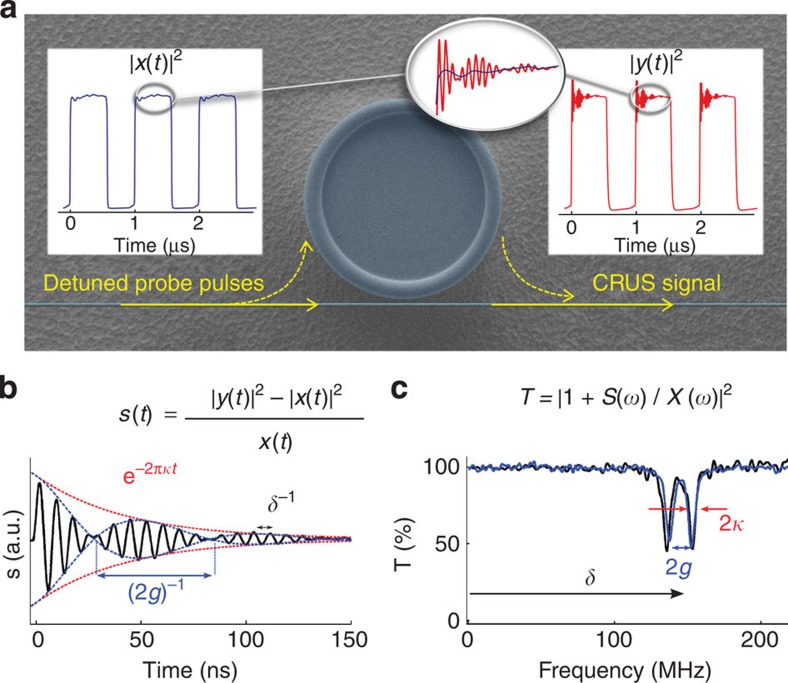
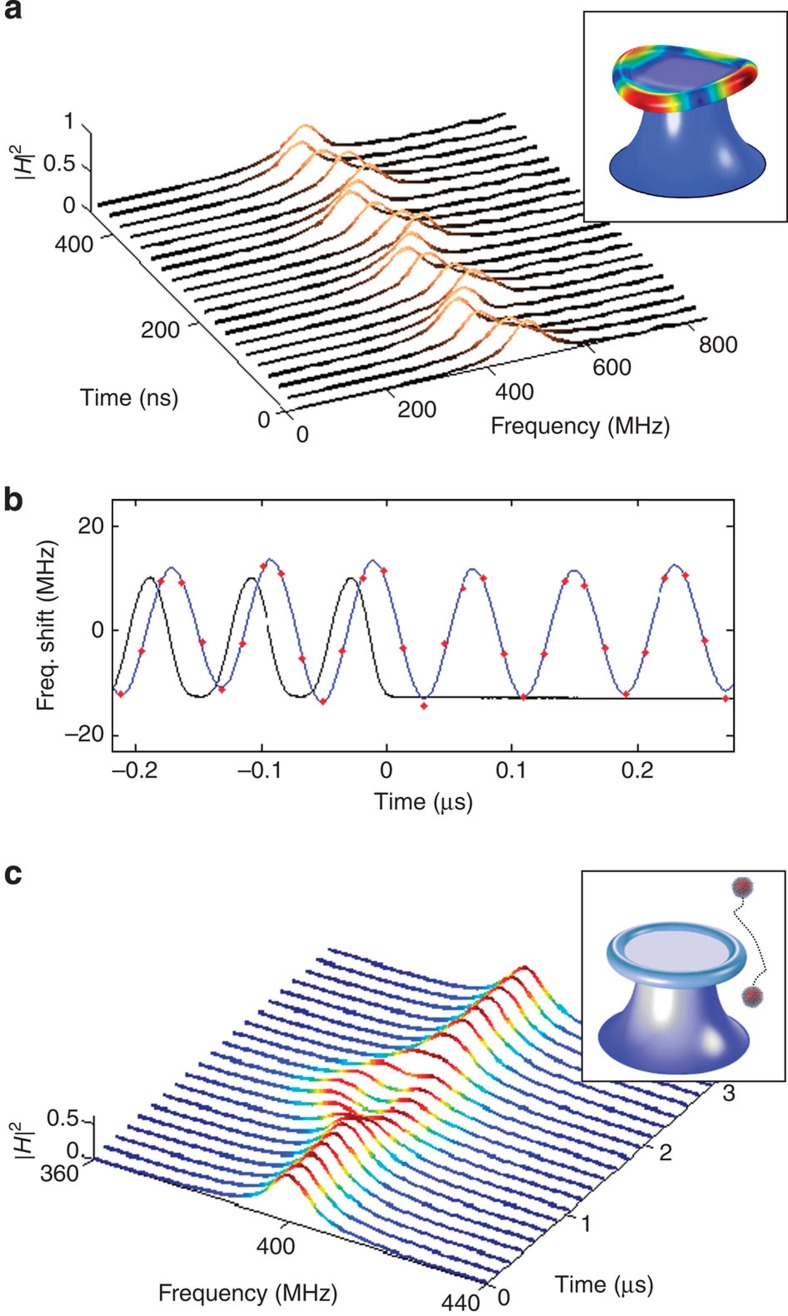
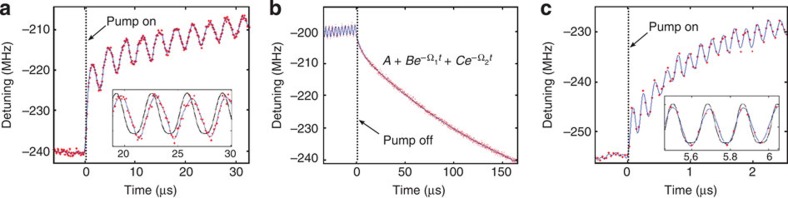
Spectroscopy of whispering-gallery mode microresonators has become a powerful scientific tool, enabling the detection of single viruses, nanoparticles and even single molecules. Yet the demonstrated timescale of these schemes has been limited so far to milliseconds or more. Here we introduce a scheme that is orders of magnitude faster, capable of capturing complete spectral snapshots at nanosecond timescales-cavity ring-up spectroscopy. Based on sharply rising detuned probe pulses, cavity ring-up spectroscopy combines the sensitivity of heterodyne measurements with the highest-possible, transform-limited acquisition rate. As a demonstration, we capture spectra of microtoroid resonators at time intervals as short as 16 ns, directly monitoring submicrosecond dynamics of their optomechanical vibrations, thermorefractive response and Kerr nonlinearity. Cavity ring-up spectroscopy holds promise for the study of fast biological processes such as enzyme kinetics, protein folding and light harvesting, with applications in other fields such as cavity quantum electrodynamics and pulsed optomechanics.
回音壁模式微谐振器光谱学已成为一种强大的科学工具,能够检测单个病毒、纳米颗粒甚至单个分子。然而,到目前为止,这些方案所展示的时间尺度一直局限于毫秒或更长时间。在此,我们介绍一种快几个数量级的方案,即腔衰荡光谱学,它能够在纳秒时间尺度上捕获完整的光谱快照。基于急剧上升的失谐探测脉冲,腔衰荡光谱学将外差测量的灵敏度与尽可能高的、变换极限采集速率相结合。作为演示,我们以短至16纳秒的时间间隔捕获微环谐振器的光谱,直接监测其光机械振动、热折射响应和克尔非线性的亚微秒动力学。腔衰荡光谱学有望用于研究诸如酶动力学、蛋白质折叠和光捕获等快速生物过程,并在腔量子电动力学和脉冲光力学等其他领域得到应用。