Hiwatashi Kiyokazu, Ueno Shinichi, Sakoda Masahiko, Iino Satoshi, Minami Koji, Yamasaki Yoichi, Okubo Keishi, Noda Masahiro, Kurahara Hiroshi, Mataki Yuko, Maemura Kosei, Shinchi Hiroyuki, Natsugoe Shoji
1. Department of Digestive Surgery, Breast and Thyroid Surgery Graduate School of Medical and Dental Sciences Kagoshima University, Sakuragaoka 8-35-1 Kagoshima, 890-8520, Japan.
2. Department of Clinical Oncology, Graduate School of Medical and Dental Sciences Kagoshima University.
J Cancer. 2015 Mar 7;6(5):438-47. doi: 10.7150/jca.10398. eCollection 2015.
The number of patients with hepatocellular carcinoma (HCC) in the absence of both hepatitis B virus surface antigen (HBsAg) and hepatitis C virus antibody (HCVAb) (NBNC-HCC) has been rapidly increasing in Japan. The objective of this study was to compare the clinical and pathological characteristics between patients with the NBNC-HCC, those with HBsAg positive HCC (B-related HCC) and HCVAb positive HCC (C-related HCC). A better understanding will facilitate the development of postoperative strategies to better manage patients with NBNC-HCC.
Consecutive 219 patients with primary HCC: (B-related, n=35; C-related, n = 104; NBNC, n = 80) were treated by hepatic resection or ablation. Clinicopathological characteristics including postoperative course were retrospectively compared between the three groups.
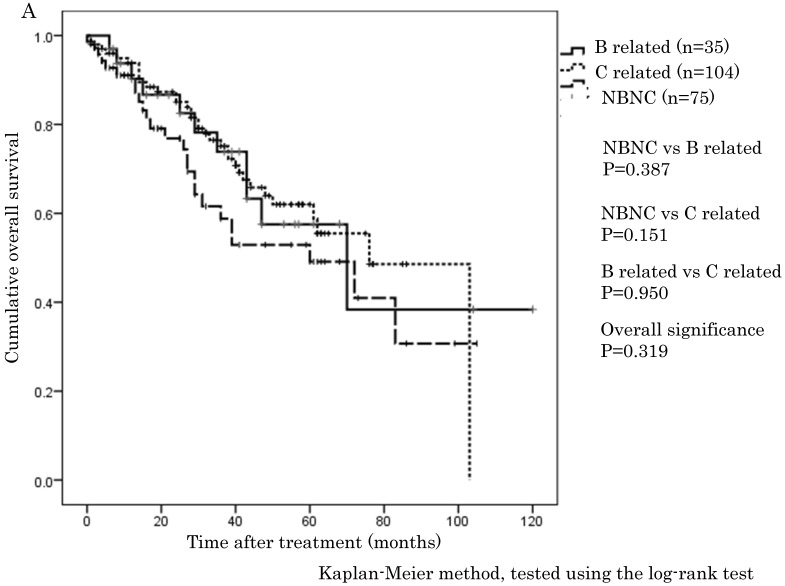
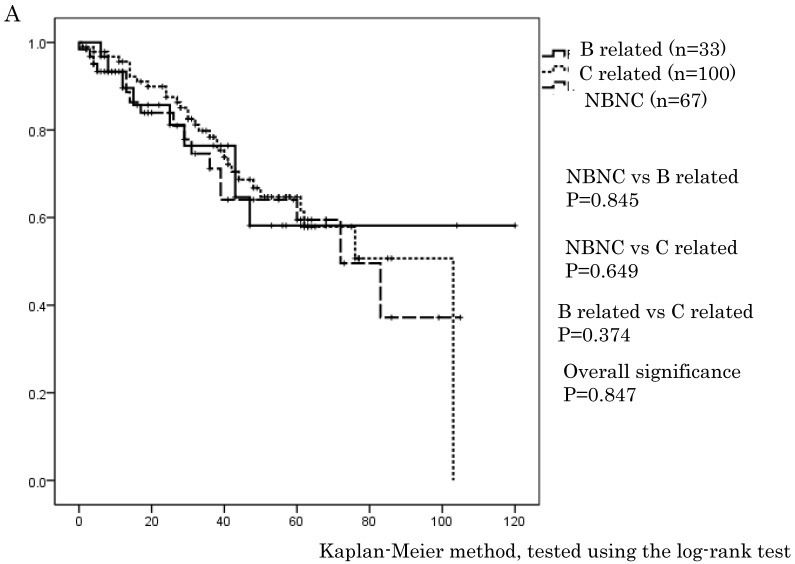
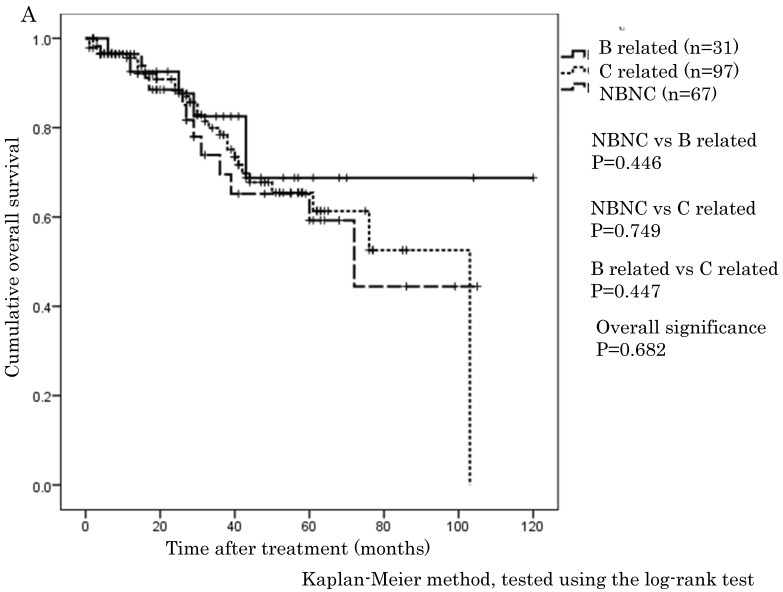
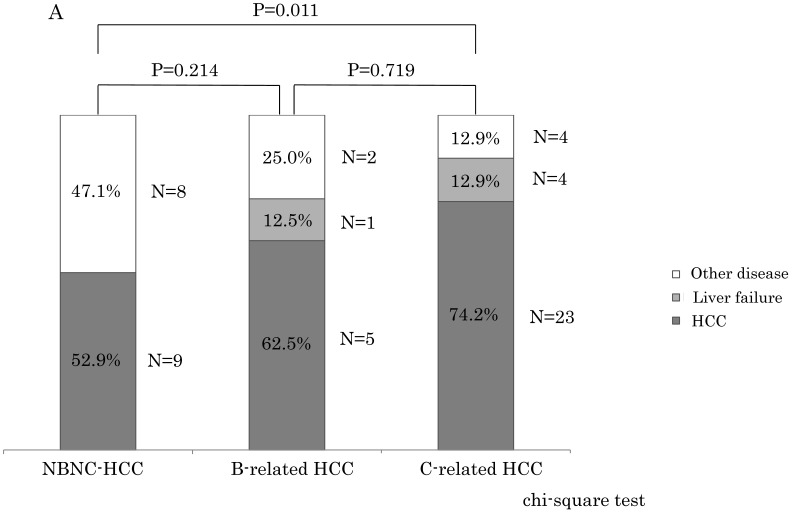
When comparing within stage I and II, the NBNC-HCC group had improved recurrence free survival (RFS) compared to the C-related HCC (p = 0.013) but had not been good overall survival (OS). Moreover, the NBNC-HCC group showed higher rate of death due to other cancers and cardiovascular disease (p = 0.011) compared to the C-related HCC. Multivariate analysis revealed that the only prognostic factor for RFS in the NBNC-HCC group was high serum total bilirubin.
In the patients with the NBNC-HCC, elevated serum bilirubin could predict poor RFS after surgery. Furthermore, patients must be carefully followed-up not only for HCC but also for the occurrence of other critical diseases including multiple other cancers.
在日本,既无乙肝表面抗原(HBsAg)也无丙肝抗体(HCVAb)的肝细胞癌(HCC)患者数量一直在迅速增加。本研究的目的是比较无HBsAg和HCVAb的HCC患者(NBNC-HCC)、HBsAg阳性的HCC患者(B相关HCC)和HCVAb阳性的HCC患者(C相关HCC)之间的临床和病理特征。更好地了解这些特征将有助于制定术后策略,以更好地管理NBNC-HCC患者。
连续纳入219例原发性HCC患者(B相关,n = 35;C相关,n = 104;NBNC,n = 80),接受肝切除或消融治疗。对三组患者的临床病理特征(包括术后病程)进行回顾性比较。
在I期和II期患者中比较时,NBNC-HCC组的无复发生存期(RFS)较C相关HCC组有所改善(p = 0.013),但总生存期(OS)不佳。此外,与C相关HCC组相比,NBNC-HCC组因其他癌症和心血管疾病导致的死亡率更高(p = 0.011)。多因素分析显示,NBNC-HCC组中RFS的唯一预后因素是血清总胆红素水平升高。
在NBNC-HCC患者中,血清胆红素升高可预测术后RFS不佳。此外,不仅要对HCC患者进行密切随访,还要对包括多种其他癌症在内的其他严重疾病的发生情况进行密切随访。