Kawazoe Hitoshi, Shimasaki Maya, Ueno Masaki, Sumikawa Satomi, Takatori Shingo, Namba Hiroyuki, Yoshida Motohira, Sato Koichi, Kojima Yoh, Watanabe Yuji, Moriguchi Toshihide, Tanaka Akihiro, Araki Hiroaki
1. Division of Pharmacy, Ehime University Hospital, Shitsukawa, Toon, Ehime 791-0295, Japan;
2. Department of Clinical Pharmacy, College of Pharmaceutical Sciences, Matsuyama University, Bunkyou, Matsuyama, Ehime 790-8578, Japan;
J Cancer. 2015 Mar 18;6(5):464-9. doi: 10.7150/jca.11189. eCollection 2015.
The aim of this study was to clarify the risk factors for discontinuing tegafur/gimeracil/oteracil potassium (S-1) adjuvant chemotherapy following gastrectomy in patients with gastric cancer.
We retrospectively investigated patients with curatively-resected gastric cancer who received S-1 adjuvant chemotherapy. S-1 was administered orally at 80-120 mg/day, depending on body surface area, on days 1-28 every 6 weeks for 1 year. The dose and treatment schedule were modified at the clinicians' discretion, according to toxicity.
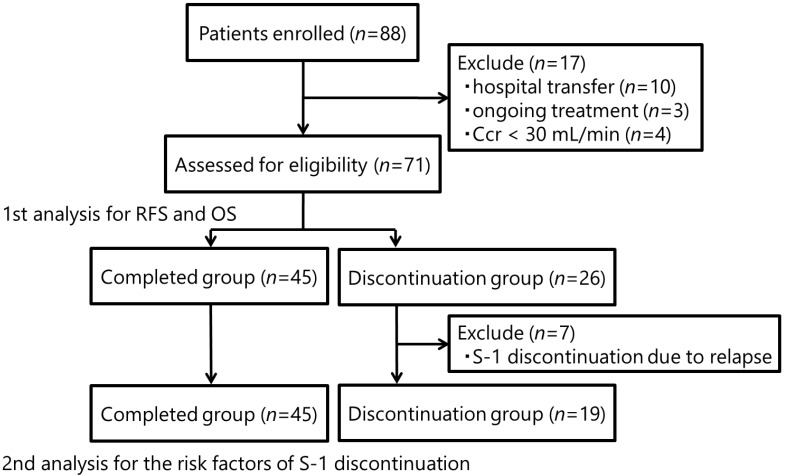
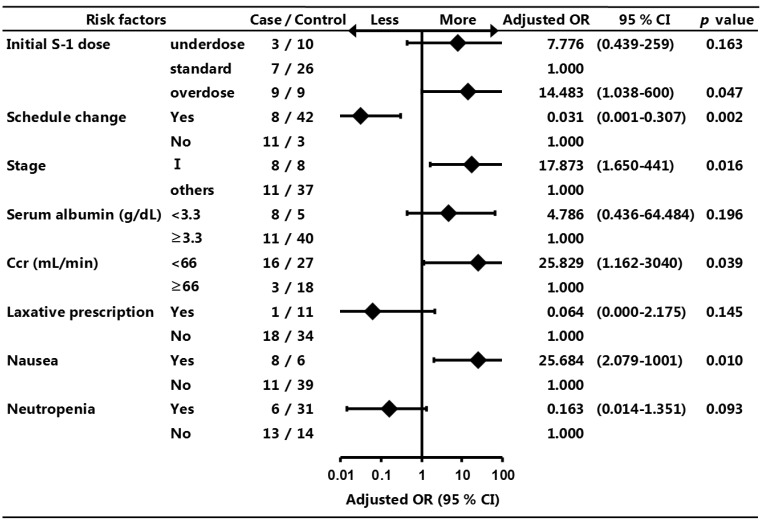
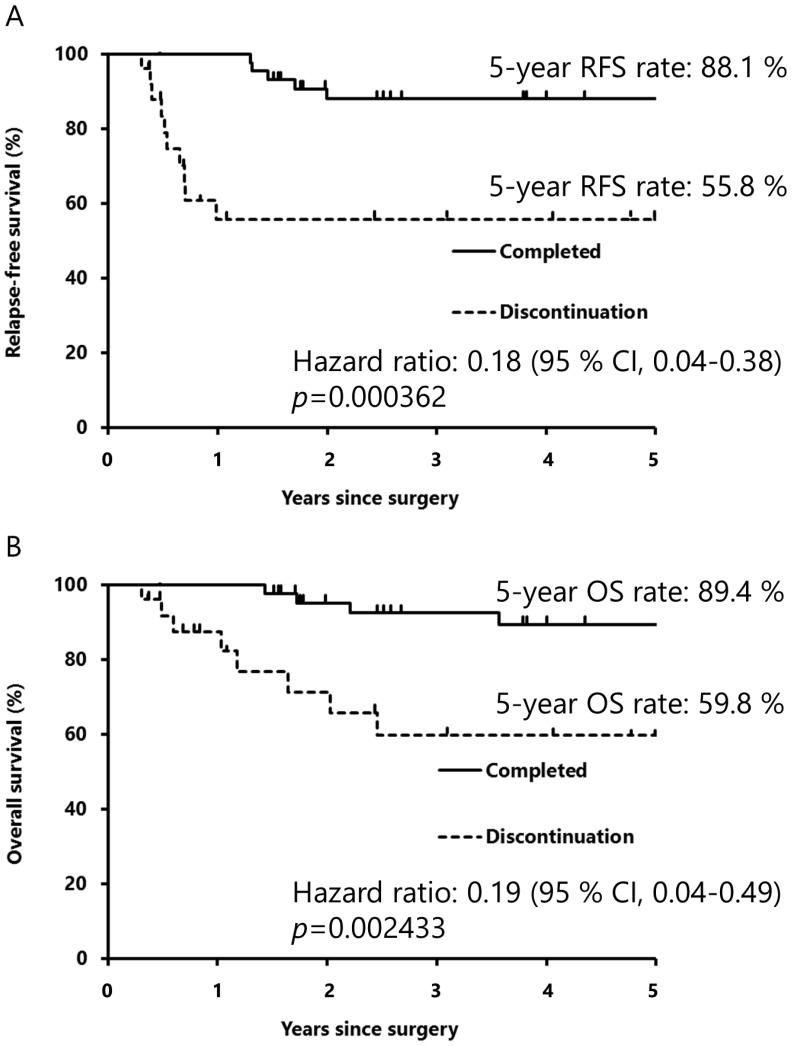
Seventy-one patients were included in the study, 26 of whom discontinued S-1 therapy. The relapse-free survival rates in the S-1-completed and S-1-discontinuation groups at 5 years post-surgery were 88.1% and 55.8%, respectively. The overall survival rates in the S-1-completed and S-1-discontinuation groups at 5 years post-surgery were 89.4% and 59.8%, respectively. The hazard ratios for relapse and death were significantly lower in the S-1-completed group compared with those in the S-1-discontinuation group (0.18; p<0.001 and 0.19; p=0.002, respectively). Multivariate logistic regression analysis revealed that S-1 discontinuation was significantly associated with an initial overdose of S-1, having stage I cancer, creatinine clearance <66 mL/min, and a side effect of nausea.
These results suggest that assessing renal function to avoid initial overdose of S-1, together with the early management of side effects, may support the continuation of S-1 adjuvant chemotherapy in patients with gastric cancer.
本研究旨在阐明胃癌患者胃切除术后停用替吉奥(S-1)辅助化疗的危险因素。
我们回顾性调查了接受S-1辅助化疗的胃癌根治性切除患者。根据体表面积,S-1以80-120mg/天的剂量口服,每6周的第1-28天给药,共1年。剂量和治疗方案可根据毒性由临床医生酌情调整。
71例患者纳入研究,其中26例停用S-1治疗。手术5年后,完成S-1治疗组和停用S-1治疗组的无复发生存率分别为88.1%和55.8%。手术5年后,完成S-1治疗组和停用S-1治疗组的总生存率分别为89.4%和59.8%。与停用S-1治疗组相比,完成S-1治疗组的复发和死亡风险比显著更低(分别为0.18;p<0.001和0.19;p=0.002)。多因素logistic回归分析显示,停用S-1与S-1初始过量、I期癌症、肌酐清除率<66mL/min以及恶心副作用显著相关。
这些结果表明,评估肾功能以避免S-1初始过量,并尽早处理副作用,可能有助于支持胃癌患者继续进行S-1辅助化疗。