Abdi Siamak, Oveis-Gharan Shahram, Sinaei Farnaz, Ghorbani Askar
Department of Neurology, School of Medicine, Shariati Hospital, Tehran University of Medical Sciences, Tehran, Iran.
Iran J Neurol. 2015 Jan 5;14(1):35-40.
Serum troponin elevation, characteristic of ischemic myocardial injury, has been observed in some acute ischemic stroke (AIS) patients. Its cause and significance are still controversial. The purpose of this study is to find determinants of troponin elevation and its relationship with stroke severity and location.
Between January 2013 and August 2013, 114 consecutive AIS patients confirmed by diffusion-weighted magnetic resonance imaging were recruited in this study. Serum troponin T level was measured as part of routine laboratory testing on admission. Ten lead standard electrocardiogram (ECG) was performed and stoke severity was assessed based on National Institutes of Health Stroke Scale (NIHSS).
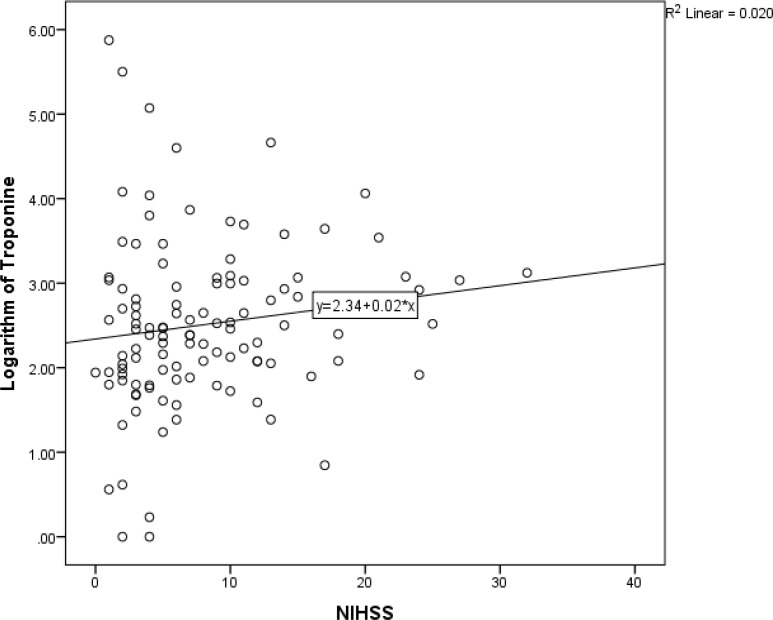
Troponin T was elevated in 20 (17.6%) of 114 patients. Patients with elevated troponin were more likely to have higher age, higher serum creatinine and ischemic ECG changes. Troponin levels were higher in patients with more severe stroke measured by NIHSS [7.96 (6.49-9.78) vs. 13.59 (10.28-18.00)]. There was no association between troponin and locations of stroke and atrial fibrillation. There were 6 (5%) patients with elevated troponin in the presence of normal creatinine and ECG.
Stroke severity, not its location, was associated with higher troponin levels. Abnormal troponin levels are more likely, but not exclusively, to be due to cardiac and renal causes than cerebral ones.
在一些急性缺血性卒中(AIS)患者中观察到血清肌钙蛋白升高,这是缺血性心肌损伤的特征。其原因和意义仍存在争议。本研究的目的是找出肌钙蛋白升高的决定因素及其与卒中严重程度和部位的关系。
在2013年1月至2013年8月期间,本研究招募了114例经弥散加权磁共振成像确诊的连续AIS患者。入院时作为常规实验室检查的一部分测量血清肌钙蛋白T水平。进行10导联标准心电图(ECG)检查,并根据美国国立卫生研究院卒中量表(NIHSS)评估卒中严重程度。
114例患者中有20例(17.6%)肌钙蛋白T升高。肌钙蛋白升高的患者更可能年龄较大、血清肌酐较高且有缺血性心电图改变。根据NIHSS测量,卒中较严重的患者肌钙蛋白水平更高[7.96(6.49 - 9.78)对13.59(10.28 - 18.00)]。肌钙蛋白与卒中部位和心房颤动之间无关联。在肌酐和心电图正常的情况下,有6例(5%)患者肌钙蛋白升高。
卒中严重程度而非部位与较高的肌钙蛋白水平相关。肌钙蛋白水平异常更可能(但并非仅)是由心脏和肾脏原因而非脑部原因引起的。