Mbengue Alassane, Bhattacharjee Souvik, Pandharkar Trupti, Liu Haining, Estiu Guillermina, Stahelin Robert V, Rizk Shahir S, Njimoh Dieudonne L, Ryan Yana, Chotivanich Kesinee, Nguon Chea, Ghorbal Mehdi, Lopez-Rubio Jose-Juan, Pfrender Michael, Emrich Scott, Mohandas Narla, Dondorp Arjen M, Wiest Olaf, Haldar Kasturi
1] Boler-Parseghian Center for Rare and Neglected Diseases, University of Notre Dame, Notre Dame, Indiana 46556, USA [2] Department of Biological Sciences, University of Notre Dame, Notre Dame, Indiana 46556, USA.
1] Boler-Parseghian Center for Rare and Neglected Diseases, University of Notre Dame, Notre Dame, Indiana 46556, USA [2] Department of Chemistry and Biochemistry, University of Notre Dame, Notre Dame, Indiana 46556, USA.
Nature. 2015 Apr 30;520(7549):683-7. doi: 10.1038/nature14412. Epub 2015 Apr 15.
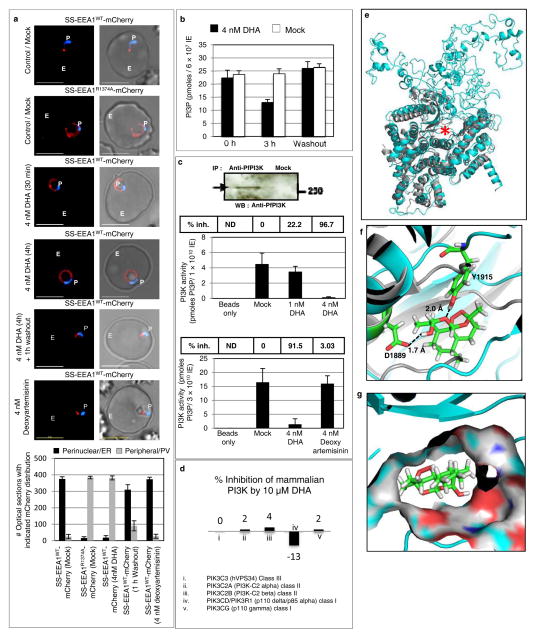
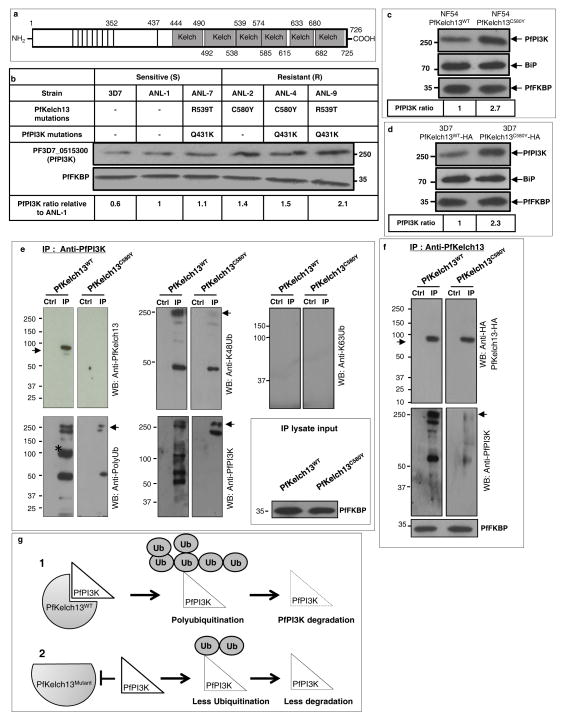
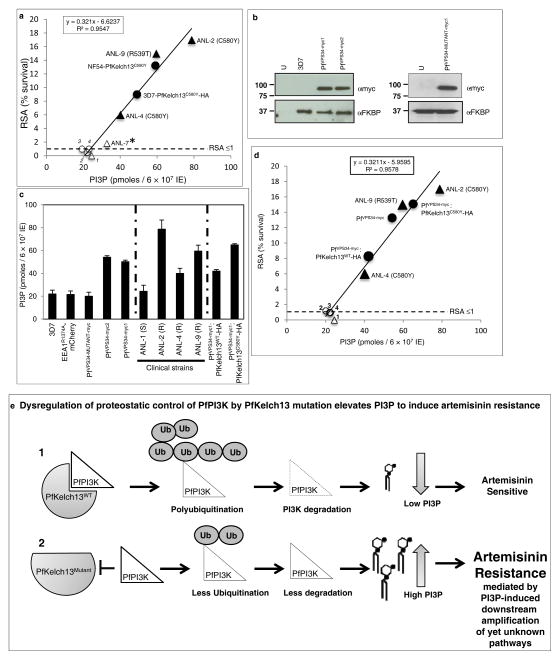
Artemisinins are the cornerstone of anti-malarial drugs. Emergence and spread of resistance to them raises risk of wiping out recent gains achieved in reducing worldwide malaria burden and threatens future malaria control and elimination on a global level. Genome-wide association studies (GWAS) have revealed parasite genetic loci associated with artemisinin resistance. However, there is no consensus on biochemical targets of artemisinin. Whether and how these targets interact with genes identified by GWAS, remains unknown. Here we provide biochemical and cellular evidence that artemisinins are potent inhibitors of Plasmodium falciparum phosphatidylinositol-3-kinase (PfPI3K), revealing an unexpected mechanism of action. In resistant clinical strains, increased PfPI3K was associated with the C580Y mutation in P. falciparum Kelch13 (PfKelch13), a primary marker of artemisinin resistance. Polyubiquitination of PfPI3K and its binding to PfKelch13 were reduced by the PfKelch13 mutation, which limited proteolysis of PfPI3K and thus increased levels of the kinase, as well as its lipid product phosphatidylinositol-3-phosphate (PI3P). We find PI3P levels to be predictive of artemisinin resistance in both clinical and engineered laboratory parasites as well as across non-isogenic strains. Elevated PI3P induced artemisinin resistance in absence of PfKelch13 mutations, but remained responsive to regulation by PfKelch13. Evidence is presented for PI3P-dependent signalling in which transgenic expression of an additional kinase confers resistance. Together these data present PI3P as the key mediator of artemisinin resistance and the sole PfPI3K as an important target for malaria elimination.
青蒿素是抗疟药物的基石。对其耐药性的出现和传播增加了消除全球疟疾负担方面近期所取得成果的风险,并威胁到全球层面未来的疟疾控制与消除。全基因组关联研究(GWAS)已揭示了与青蒿素耐药性相关的寄生虫基因位点。然而,关于青蒿素的生化靶点尚无共识。这些靶点是否以及如何与GWAS鉴定出的基因相互作用,仍然未知。在此,我们提供生化和细胞证据表明,青蒿素是恶性疟原虫磷脂酰肌醇-3-激酶(PfPI3K)的强效抑制剂,揭示了一种意想不到的作用机制。在耐药临床菌株中,PfPI3K的增加与恶性疟原虫Kelch13(PfKelch13)中的C580Y突变相关,PfKelch13是青蒿素耐药性的主要标志物。PfKelch13突变减少了PfPI3K的多聚泛素化及其与PfKelch13的结合,这限制了PfPI3K的蛋白水解,从而增加了该激酶及其脂质产物磷脂酰肌醇-3-磷酸(PI3P)的水平。我们发现PI3P水平可预测临床和工程化实验室寄生虫以及非等基因菌株中的青蒿素耐药性。在没有PfKelch13突变的情况下,升高的PI3P诱导青蒿素耐药性,但仍对PfKelch13的调节有反应。有证据表明存在PI3P依赖性信号传导,其中额外一种激酶的转基因表达赋予耐药性。这些数据共同表明PI3P是青蒿素耐药性的关键介质,而唯一的PfPI3K是消除疟疾的重要靶点。