Li Chen-Yu, Lin Chia-Pin, Lin Yu-Sheng, Wu Lung-Sheng, Chang Chee-Jen, Chu Pao-Hsien
Clinical Informatics and Medical Statistics Research Center, College of Medicine, Chang Gung University, Taipei, Taiwan.
Department of Cardiology, Chang Gung Memorial Hospital, Chang Gung University College of Medicine, Taipei, Taiwan; Healthcare Center, Chang Gung Memorial Hospital, Chang Gung University College of Medicine, Taipei, Taiwan.
PLoS One. 2015 Apr 15;10(4):e0123211. doi: 10.1371/journal.pone.0123211. eCollection 2015.
This study aims to investigate the impact of newly diagnosed atrial fibrillation (AF) on future major adverse cardiac events (MACE). AF is the most common form of cardiac arrhythmia and is associated with several other cardiovascular (CV) events. Little is known about whether newly diagnosed AF is an independent factor for future MACE, especially in patients without such a history.
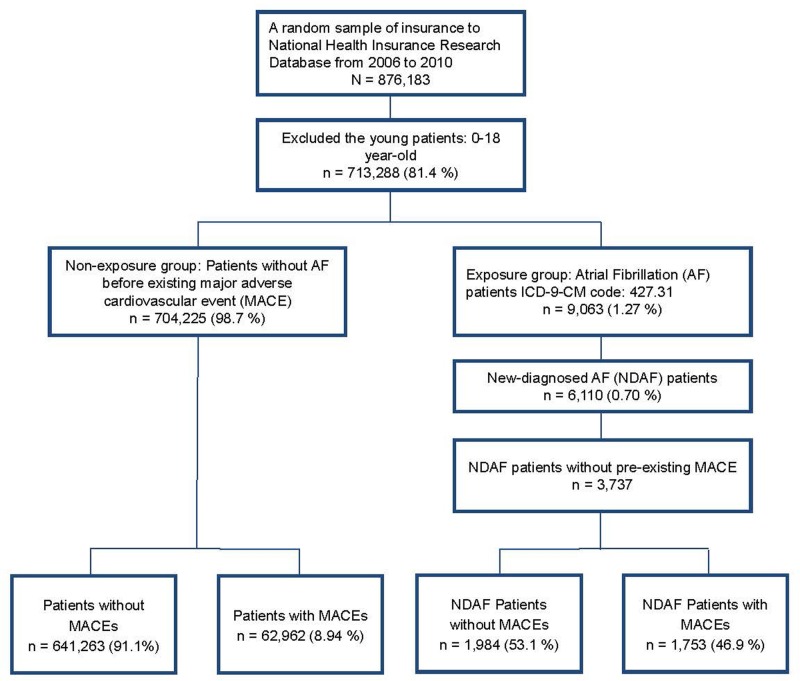
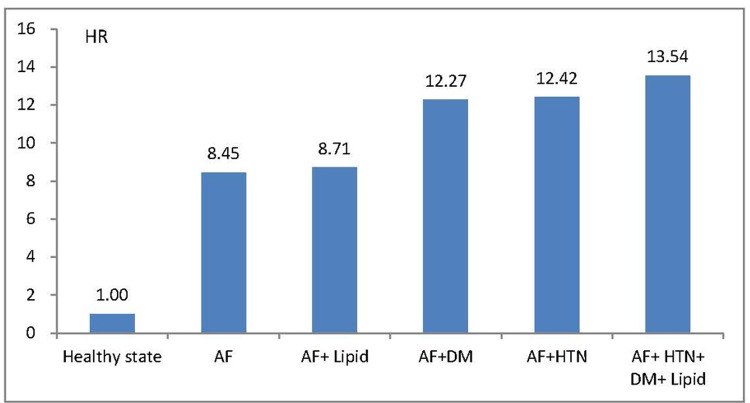
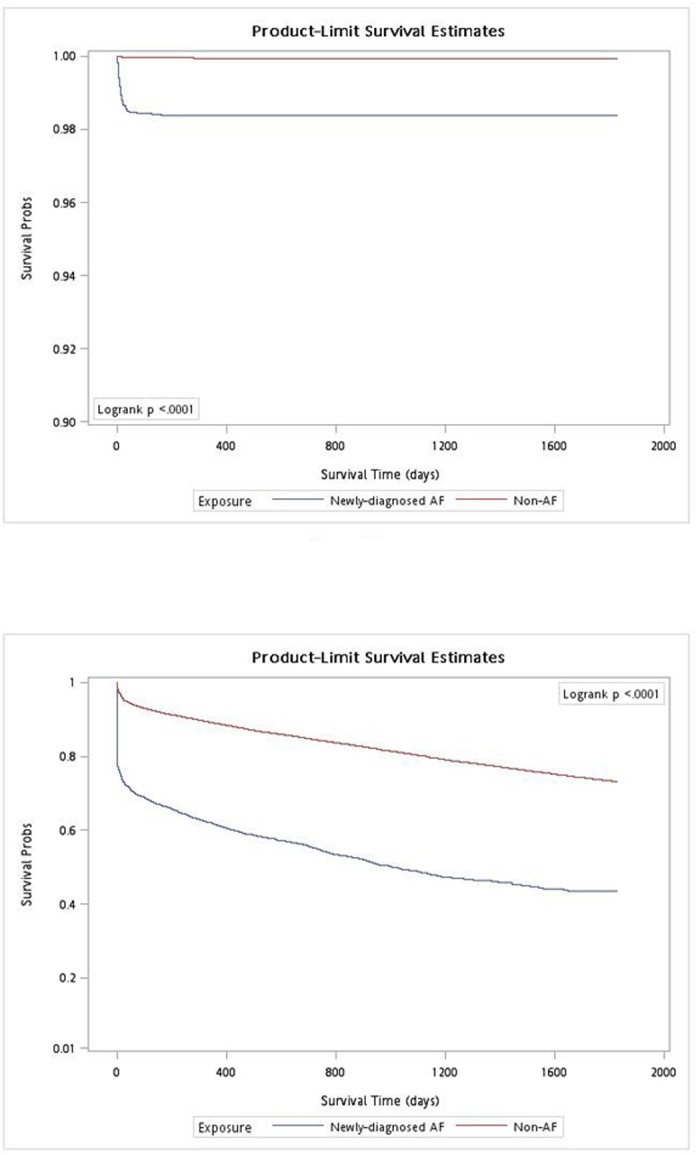
We evaluated data from the National Health Insurance Research Database, which represented a retrospective cohort of 713,288 adults in Taiwan from 2006 to 2010. Individuals with previous MACE were excluded. Newly diagnosed AF patients were identified by assigning International Classification of Diseases codes. Propensity score matching adjusted for gender, age, hypertension, diabetes mellitus and dyslipidemia. Cox proportional hazard models estimated future MACE ratios. We compared a total of 3,737 patients with newly diagnosed AF and 704,225 patients without. After matching, there was no difference in baseline demographic characteristics in patients across newly diagnosed AF and non-AF groups. The result showed that newly diagnosed AF in multivariate analysis were associated with increased incidents of MACE (hazard ratio: 3.11-3.51 in different models) and mortality. Newly diagnosed AF without other CV risk factors had 8.45 times the risk of developing future MACE than healthy adults. The more associated CV risk factors in addition to AF, the increased rate of future CV events.
Newly diagnosed AF is an independent factor that leads to future CV events after gender, age, hypertension, diabetes mellitus and dyslipidemia matching. AF is associated with a higher mortality rate.
本研究旨在调查新诊断的心房颤动(AF)对未来主要不良心脏事件(MACE)的影响。AF是最常见的心律失常形式,与其他几种心血管(CV)事件相关。对于新诊断的AF是否是未来MACE的独立因素,尤其是在没有此类病史的患者中,人们了解甚少。
我们评估了来自国民健康保险研究数据库的数据,该数据库代表了2006年至2010年台湾713288名成年人的回顾性队列。排除既往有MACE的个体。通过指定国际疾病分类代码来识别新诊断的AF患者。倾向评分匹配对性别、年龄、高血压、糖尿病和血脂异常进行了调整。Cox比例风险模型估计未来MACE比率。我们共比较了3737例新诊断的AF患者和704225例无AF患者。匹配后,新诊断的AF组和非AF组患者的基线人口统计学特征没有差异。结果显示,多变量分析中新诊断的AF与MACE事件发生率增加(不同模型中的风险比:3.11 - 3.51)和死亡率相关。无其他CV危险因素的新诊断AF发生未来MACE的风险是健康成年人的8.45倍。除AF外,相关的CV危险因素越多,未来CV事件的发生率越高。
在对性别、年龄、高血压、糖尿病和血脂异常进行匹配后,新诊断的AF是导致未来CV事件的独立因素。AF与较高的死亡率相关。