Ishikawa Junya, Hayashi Naoki, Yamaguchi Masaru, Monzen Satoru, Kashiwakura Ikuo
Department of Radiological Life Sciences, Hirosaki University Graduate School of Health Sciences, 66-1 Hon-cho, Hirosaki, Aomori 036-8203, Japan.
Department of Radiological Life Sciences, Hirosaki University Graduate School of Health Sciences, 66-1 Hon-cho, Hirosaki, Aomori 036-8203, Japan
J Radiat Res. 2015 Jul;56(4):678-90. doi: 10.1093/jrr/rrv024. Epub 2015 Apr 15.
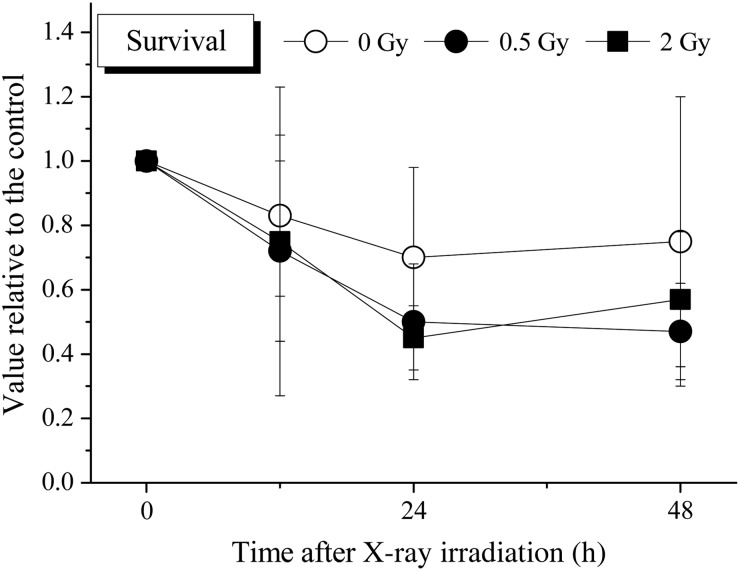
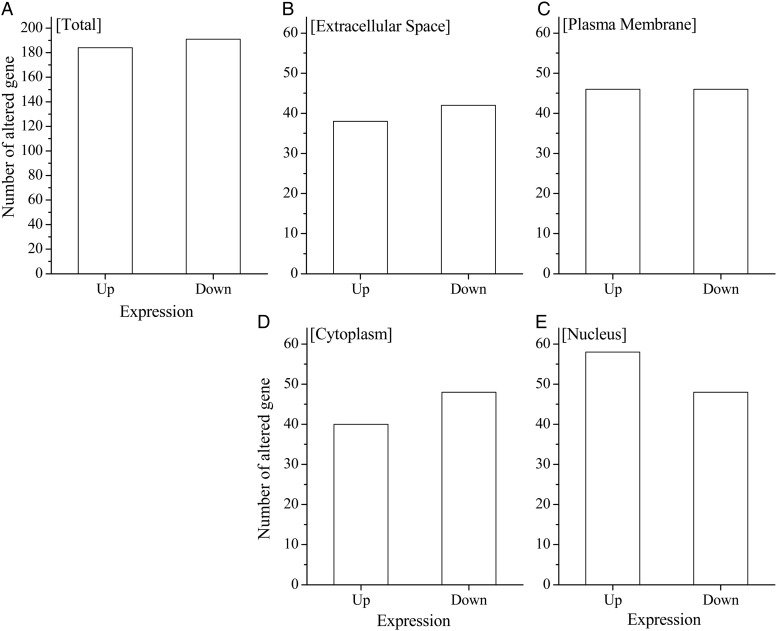
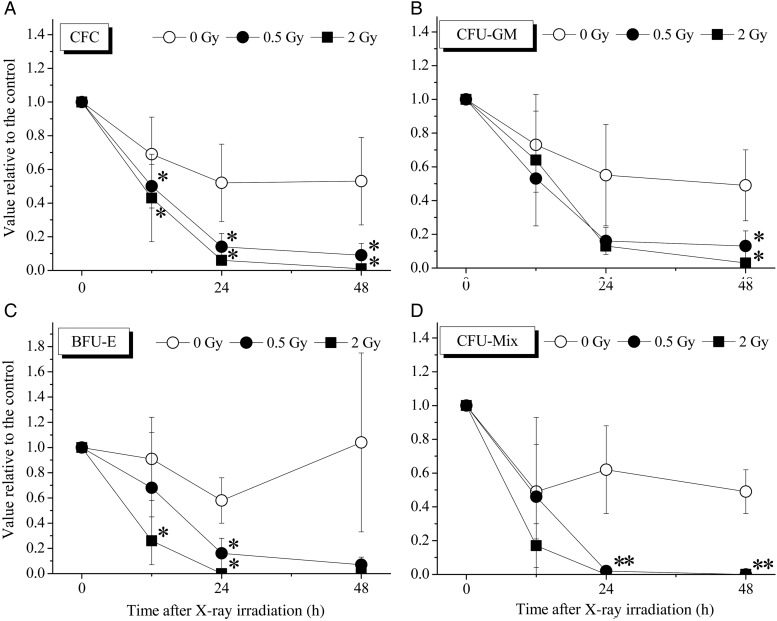
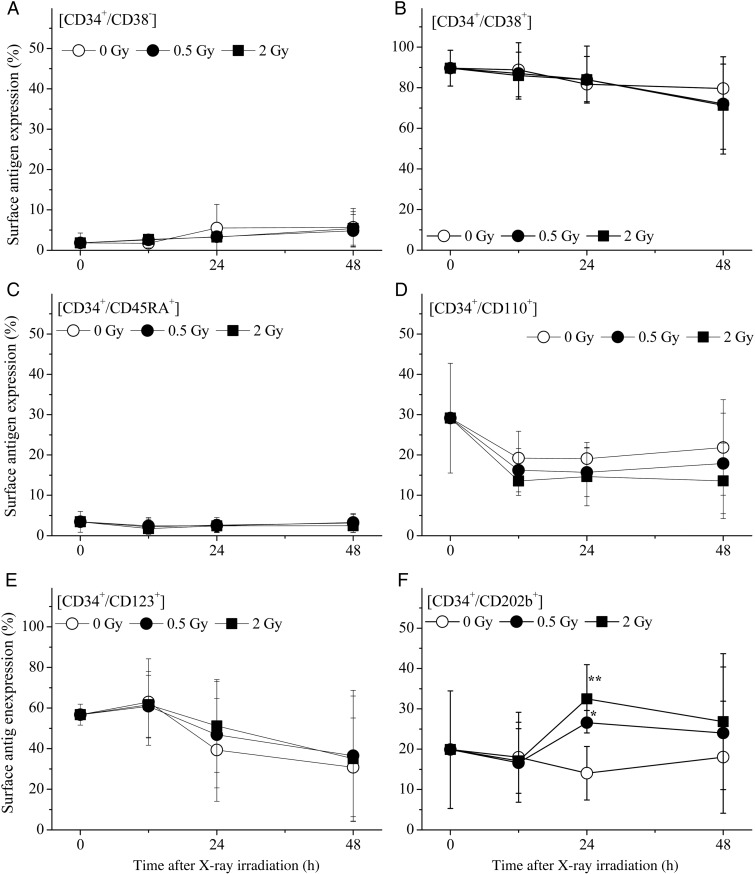
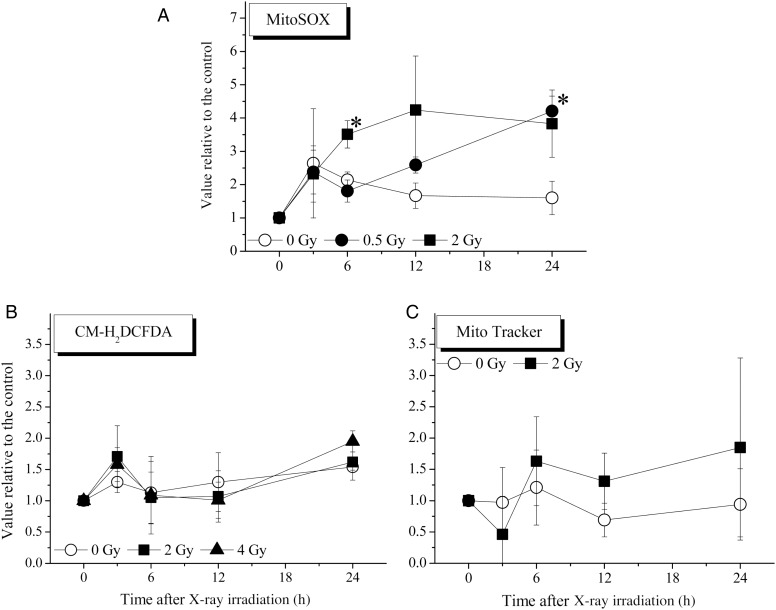
To clarify the mechanisms underlying radiation-induced hematopoietic stem cell death, we investigated the effects of excessive ionizing radiation on the clonogenic potential of CD34(+) cells obtained from human umbilical cord blood under cytokine-free conditions. The CD34(+) cells were X-ray-irradiated (up to 2 Gy) and were cultured for 0-48 h under cytokine-free conditions. At various time-points, the CD34(+) cells were investigated for survival, clonogenic potential and the generation of mitochondrial superoxide. At 12 h after X-ray irradiation, the number of viable cells had decreased to ∼70-80% compared with the 0-h non-irradiated control, whereas the clonogenic potential in the X-ray-irradiated cells had decreased to ∼50%-60% compared with the 0-h non-irradiated control. Furthermore, significant generation of mitochondrial superoxide was observed at 6 h, and reached a maximum value between 12 and 24 h after X-ray irradiation. However, no significant differences were observed between non-irradiated and X-ray-irradiated cells in terms of the generation of reactive oxygen species or in the intracellular mitochondrial contents. In addition, a cDNA microarray analysis showed that the majority of the altered genes in the CD34(+) cells at 6 h after X-ray irradiation were apoptosis-related genes. These results suggest the possibility that the elimination of the clonogenic potentials of CD34(+) cells involves the generation of mitochondrial superoxide induced by ionizing radiation.
为阐明辐射诱导造血干细胞死亡的潜在机制,我们研究了过量电离辐射对在无细胞因子条件下从人脐带血获得的CD34(+)细胞克隆形成潜力的影响。对CD34(+)细胞进行X射线照射(最高2 Gy),并在无细胞因子条件下培养0 - 48小时。在不同时间点,对CD34(+)细胞的存活、克隆形成潜力和线粒体超氧化物的产生进行研究。X射线照射后12小时,与0小时未照射对照组相比,活细胞数量减少至约70 - 80%,而X射线照射细胞的克隆形成潜力与0小时未照射对照组相比减少至约50% - 60%。此外,在6小时时观察到线粒体超氧化物的显著产生,并在X射线照射后12至24小时达到最大值。然而,在活性氧产生或细胞内线粒体含量方面,未照射细胞和X射线照射细胞之间未观察到显著差异。此外,cDNA微阵列分析表明,X射线照射后6小时CD34(+)细胞中大多数改变的基因是凋亡相关基因。这些结果提示,CD34(+)细胞克隆形成潜力的消除可能涉及电离辐射诱导的线粒体超氧化物的产生。