Playford Denese E, Nicholson Asha, Riley Geoffrey J, Puddey Ian B
School of Primary, Aboriginal and Rural Health Care, Faculty of Medicine, Dentistry and Health Sciences, University of Western Australia, 35 Stirling Hwy, Crawley, WA, 6009, Australia.
Faculty Office, Faculty of Medicine, Dentistry and Health Sciences, University of Western Australia, 35 Stirling Hwy, Crawley, WA, 6009, Australia.
BMC Med Educ. 2015 Mar 21;15:55. doi: 10.1186/s12909-015-0332-3.
Extended rural clerkships clearly increase the likelihood of rural practice post-graduation. What has not been determined is whether such rural interventions increase the likelihood of graduates practicing in more remote, versus inner regional, locations.
The Australian Health Practitioner Regulation Agency database was used to identify the current workplace of every graduate of the Medical School of Western Australia, 1980 to 2011. There were 324 graduates working in a primary practice location defined by the Australian Standard Geographical Classification as inner regional to very remote. They were divided into 3 groups - 200 graduates who entered medical school before commencement of the Rural Clinical School of Western Australia (RCSWA), 63 who entered after the RCSWA had started, but not participated in RCSWA, and 61 who participated in the RCSWA. The RCSWA offers a longitudinal rural clinical clerkship throughout level 5 of the MBBS course.
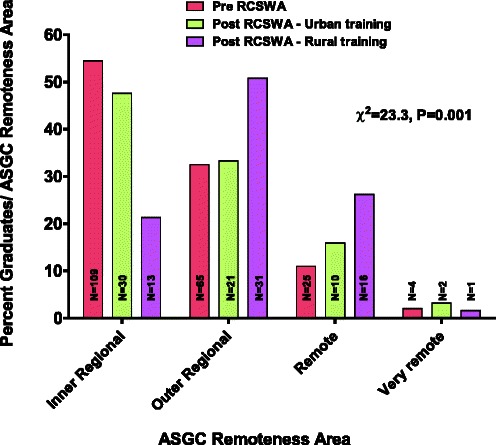
The two groups not participating in the RCSWA had 45.5% and 52.4% of subjects in outer regional/very remote locations, respectively. In comparison, 78.7% of those who had participated in the RCSWA were currently practicing in outer regional/very remote locations. When the 3 groups were compared, the significant predictors of working in a more remote practice compared to working in an inner regional area were being female (OR 1.75 95% CI 1.13, 2.72, P = 0.013) and participating in the RCSWA (OR 4.42, 95% CI 2.26, 8.67, P < 0.001). In multivariate logistic regression that corrected for gender and remoteness of rural address before entry to medical school, participation in the RCSWA still predicted a more than 4-fold increase in the odds of practicing in a more remote area (OR 4.11, 95% CI 2.04, 8.30, P < 0.001).
Extended rural clinical clerkship during an undergraduate MBBS course is related to a much greater likelihood of practicing in more remote, under-serviced rural locations.
延长农村实习时间显然会增加毕业后从事农村医疗工作的可能性。但尚未确定的是,这种农村干预措施是否会增加毕业生在更偏远地区而非内陆地区执业的可能性。
利用澳大利亚健康从业者监管局的数据库,确定了1980年至2011年西澳大利亚医学院每位毕业生的当前工作地点。有324名毕业生在澳大利亚标准地理分类定义为内陆地区到非常偏远地区的基层医疗地点工作。他们被分为3组——200名在西澳大利亚农村临床学院(RCSWA)成立之前进入医学院的毕业生,63名在RCSWA开始后进入但未参加RCSWA的毕业生,以及61名参加了RCSWA的毕业生。RCSWA在MBBS课程的整个五年级提供纵向农村临床实习。
未参加RCSWA的两组中,分别有45.5%和52.4%的受试者在内陆地区/非常偏远地区工作。相比之下,参加了RCSWA的毕业生中有78.7%目前在内陆地区/非常偏远地区执业。当对这3组进行比较时,与在内陆地区工作相比,在更偏远地区执业的显著预测因素是女性(比值比1.75,95%置信区间1.13,2.72,P = 0.013)和参加RCSWA(比值比4.42,95%置信区间2.26,8.67,P < 0.001)。在对入学前性别和农村住址偏远程度进行校正的多因素逻辑回归分析中,参加RCSWA仍然预测在更偏远地区执业的几率增加4倍以上(比值比4.11,95%置信区间2.04,8.30,P < 0.001)。
本科MBBS课程期间延长农村临床实习与在更偏远、服务不足的农村地区执业的可能性大大增加有关。