Semrau Maya, Evans-Lacko Sara, Alem Atalay, Ayuso-Mateos Jose Luis, Chisholm Dan, Gureje Oye, Hanlon Charlotte, Jordans Mark, Kigozi Fred, Lempp Heidi, Lund Crick, Petersen Inge, Shidhaye Rahul, Thornicroft Graham
King's College London, Institute of Psychiatry, Psychology and Neuroscience, 16 De Crespigny Park, London, SE5 8AF, UK.
Addis Ababa University, College of Health Sciences, School of Medicine, Department of Psychiatry, 6th Floor, College of Health Sciences Building, Tikur Anbessa Hospital, PO 9086, Addis Ababa, Ethiopia.
BMC Med. 2015 Apr 10;13:79. doi: 10.1186/s12916-015-0309-4.
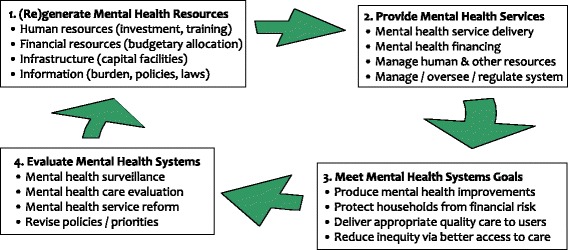
There is a large treatment gap for mental health care in low- and middle-income countries (LMICs), with the majority of people with mental, neurological, and substance use (MNS) disorders receiving no or inadequate care. Health system factors are known to play a crucial role in determining the coverage and effectiveness of health service interventions, but the study of mental health systems in LMICs has been neglected. The 'Emerging mental health systems in LMICs' (Emerald) programme aims to improve outcomes of people with MNS disorders in six LMICs (Ethiopia, India, Nepal, Nigeria, South Africa, and Uganda) by generating evidence and capacity to enhance health system performance in delivering mental health care. A mixed-methods approach is being applied to generate evidence on: adequate, fair, and sustainable resourcing for mental health (health system inputs); integrated provision of mental health services (health system processes); and improved coverage and goal attainment in mental health (health system outputs). Emerald has a strong focus on capacity-building of researchers, policymakers, and planners, and on increasing service user and caregiver involvement to support mental health systems strengthening. Emerald also addresses stigma and discrimination as one of the key barriers for access to and successful delivery of mental health services.
低收入和中等收入国家(LMICs)在精神卫生保健方面存在巨大的治疗差距,大多数患有精神、神经和物质使用(MNS)障碍的人未得到任何治疗或治疗不足。众所周知,卫生系统因素在决定卫生服务干预措施的覆盖范围和有效性方面起着关键作用,但低收入和中等收入国家的精神卫生系统研究一直被忽视。“低收入和中等收入国家新兴精神卫生系统”(Emerald)项目旨在通过提供证据和能力,提高六个低收入和中等收入国家(埃塞俄比亚、印度、尼泊尔、尼日利亚、南非和乌干达)患有MNS障碍者的治疗效果,以增强卫生系统提供精神卫生保健的绩效。目前正在采用混合方法来提供关于以下方面的证据:精神卫生的充足、公平和可持续资源(卫生系统投入);精神卫生服务的综合提供(卫生系统过程);以及精神卫生方面改善的覆盖范围和目标达成情况(卫生系统产出)。Emerald项目非常注重研究人员、政策制定者和规划者的能力建设,并提高服务使用者和护理者的参与度,以支持精神卫生系统的加强。Emerald项目还将耻辱感和歧视作为获得和成功提供精神卫生服务的关键障碍之一加以解决。