Yamamoto Takuro, Mori Taisuke, Sawada Morio, Matsushima Hiroshi, Ito Fumitake, Akiyama Makoto, Kitawaki Jo
Department of Obstetrics and Gynecology, Kyoto Prefectural University of Medicine, 465 Kajii-cho, Kawaramachi Hirokoji, Kamigyo-ku, Kyoto, 602-8566, Japan.
BMC Cancer. 2015 Apr 12;15:275. doi: 10.1186/s12885-015-1286-x.
AF-6/afadin plays an important role in the formation of adherence junctions. In breast and colon cancer, loss of AF-6/afadin induces cell migration and cell invasion. We aimed to elucidate the role of AF-6/afadin in human endometrial cancer.
Morphology and AF-6/afadin expression in endometrial cancer cell lines was investigated by 3-dimensional culture. We used Matrigel invasion assay to demonstrate AF-6/afadin knockdown induced invasive capability. Cell proliferation assay was performed to estimate chemoresistance to doxorubicin, paclitaxel and cisplatin induced by AF-6/afadin knockdown. The associations between AF-6/afadin expression and clinicopathological status were determined by immunohistochemical analysis in endometrial cancer tissues. Informed consent was obtained from all patients before the study.
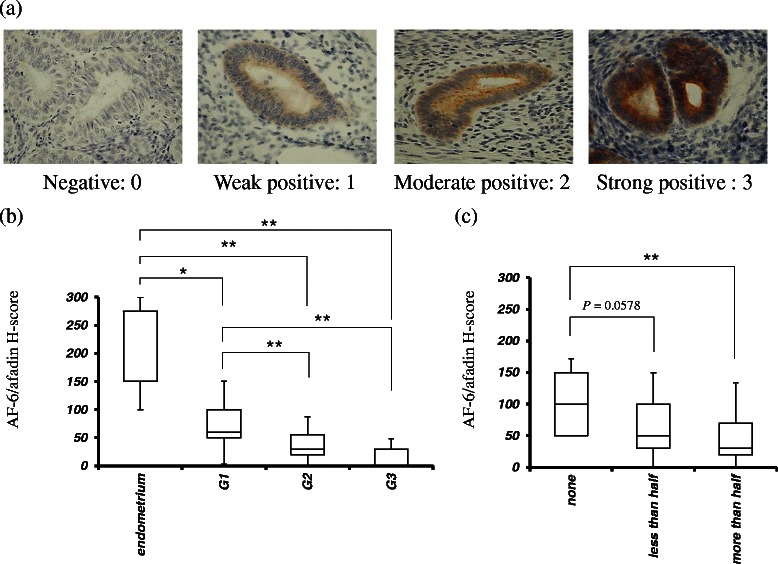
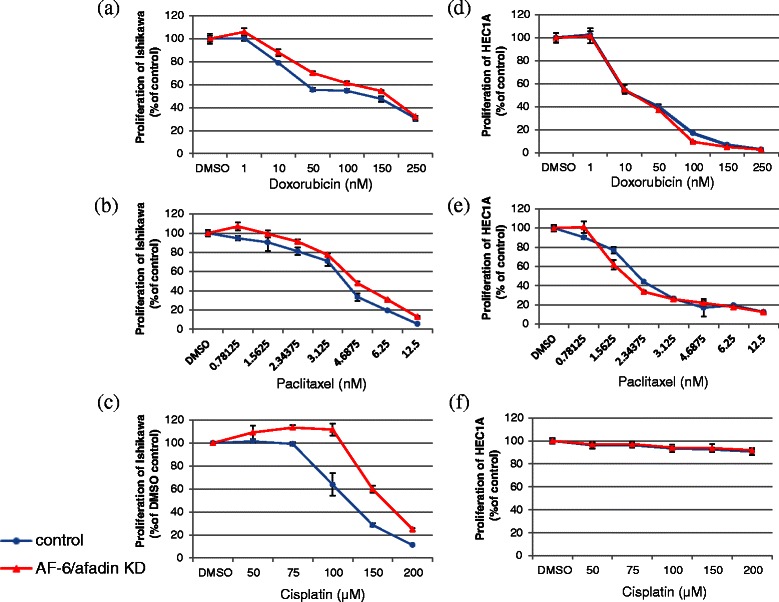
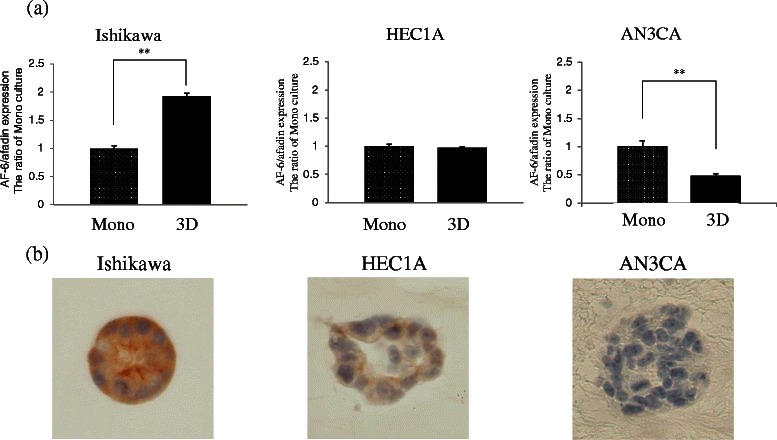
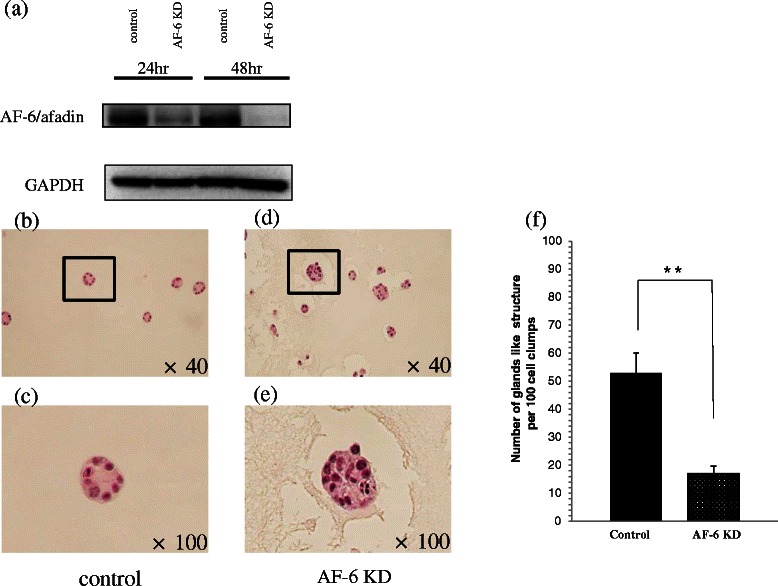
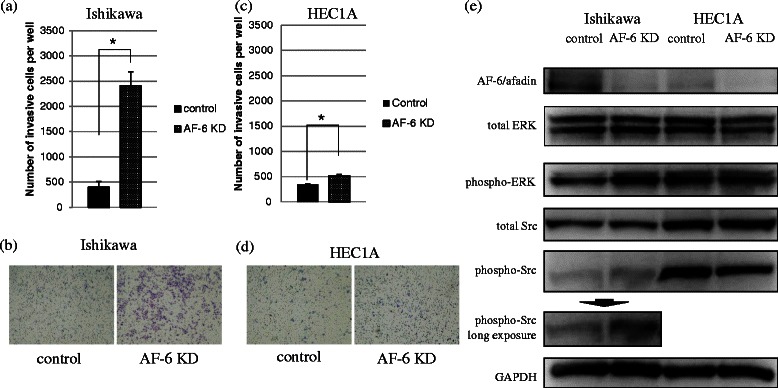
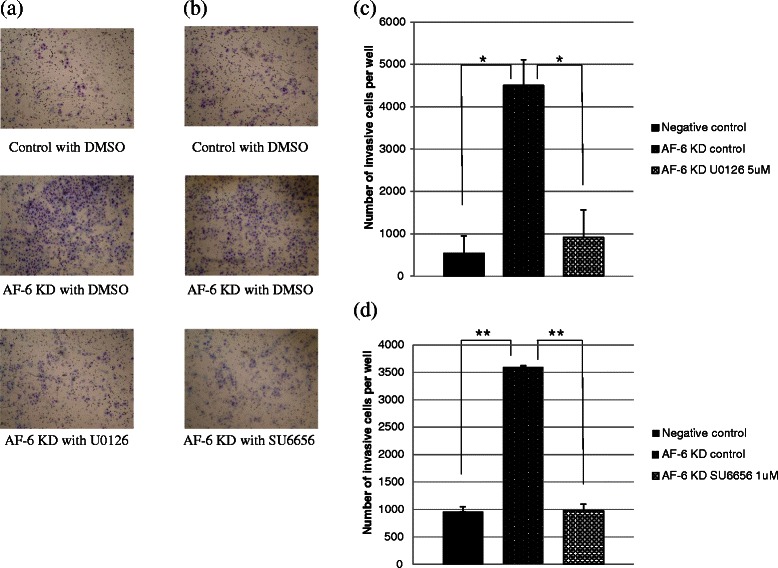
The majority of cell clumps in 3-dimensional cultures of Ishikawa cells that strongly expressed AF-6/afadin showed round gland-like structures. In contrast, the cell clumps in 3-dimensional cultures of HEC1A and AN3CA cells-both weakly expressing AF-6/afadin-showed irregular gland-like structures and disorganized colonies with no gland-like structures, respectively. AF-6/afadin knockdown resulted in reduced number of gland-like structures in 3-dimensional cultures and enhancement of cell invasion and phosphorylation of ERK1/2 and Src in the highly AF-6/afadin-expressing endometrial cancer cell line. Inhibitors of MAPK/ERK kinase (MEK) (U0126) and Src (SU6656) suppressed the AF-6/afadin knockdown-induced invasive capability. AF-6/afadin knockdown induced chemoresistance to doxorubicin, paclitaxel and cisplatin in Ishikawa cells, not in HEC1A. Immunohistochemical analysis showed that AF-6/afadin expression was significantly associated with myometrial invasion and high histological grade.
AF-6/afadin regulates cell morphology and invasiveness. Invasive capability is partly regulated through the ERK and Src pathway. The inhibitors to these pathways might be molecular-targeted drugs which suppress myometrial invasion in endometrial cancer. AF-6/afadin could be a useful selection marker for fertility-sparing therapy for patients with atypical hyperplasia or grade 1 endometrioid adenocarcinoma with no myometrial invasion. AF-6/afadin knockdown induced chemoresistance especially to cisplatin. Therefore, loss of AF-6/afadin might be a predictive marker of chemoresistance to cisplatin.
AF-6/afadin在黏着连接的形成中起重要作用。在乳腺癌和结肠癌中,AF-6/afadin的缺失会诱导细胞迁移和侵袭。我们旨在阐明AF-6/afadin在人子宫内膜癌中的作用。
通过三维培养研究子宫内膜癌细胞系的形态和AF-6/afadin表达。我们使用基质胶侵袭试验来证明AF-6/afadin敲低诱导的侵袭能力。进行细胞增殖试验以评估AF-6/afadin敲低诱导的对阿霉素、紫杉醇和顺铂的化疗耐药性。通过对子宫内膜癌组织进行免疫组化分析来确定AF-6/afadin表达与临床病理状态之间的关联。在研究前获得了所有患者的知情同意。
在强烈表达AF-6/afadin的Ishikawa细胞的三维培养中,大多数细胞团显示出圆形腺样结构。相比之下,在HEC1A和AN3CA细胞(均弱表达AF-6/afadin)的三维培养中,细胞团分别显示出不规则腺样结构和无腺样结构的无序集落。AF-6/afadin敲低导致高度表达AF-6/afadin的子宫内膜癌细胞系三维培养中腺样结构数量减少,细胞侵袭增强,以及ERK1/2和Src磷酸化增加。丝裂原活化蛋白激酶/细胞外信号调节激酶(MEK)抑制剂(U0126)和Src抑制剂(SU6656)抑制了AF-6/afadin敲低诱导的侵袭能力。AF-6/afadin敲低在Ishikawa细胞中诱导了对阿霉素、紫杉醇和顺铂的化疗耐药性,但在HEC1A细胞中未诱导。免疫组化分析表明,AF-6/afadin表达与肌层浸润和高组织学分级显著相关。
AF-6/afadin调节细胞形态和侵袭性。侵袭能力部分通过ERK和Src途径调节。这些途径的抑制剂可能是抑制子宫内膜癌肌层浸润的分子靶向药物。AF-6/afadin可能是不伴有肌层浸润的非典型增生或1级子宫内膜样腺癌患者保留生育功能治疗的有用选择标志物。AF-6/afadin敲低诱导了化疗耐药性,尤其是对顺铂的耐药性。因此,AF-6/afadin的缺失可能是对顺铂化疗耐药的预测标志物。