Vondráčková Stanislava, Száková Jiřina, Drábek Ondřej, Tejnecký Václav, Hejcman Michal, Müllerová Vladimíra, Tlustoš Pavel
Department of Agroenvironmental Chemistry and Plant Nutrition, Faculty of Agrobiology, Food and Natural Resources, Czech University of Life Sciences, Kamýcká 129, 165 21 Prague 6, Suchdol, Czech Republic.
Department of Soil Science and Soil Protection, Faculty of Agrobiology, Food and Natural Resources, Czech University of Life Sciences, Kamýcká 129, 165 21 Prague 6, Suchdol, Czech Republic.
PLoS One. 2015 Apr 16;10(4):e0123351. doi: 10.1371/journal.pone.0123351. eCollection 2015.
High Al resistance of Rumex obtusifolius together with its ability to accumulate Al has never been studied in weakly acidic conditions (pH > 5.8) and is not sufficiently described in real soil conditions. The potential elucidation of the role of organic acids in plant can explain the Al tolerance mechanism.
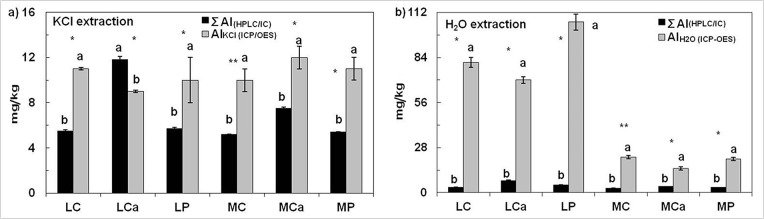
We established a pot experiment with R. obtusifolius planted in slightly acidic and alkaline soils. For the manipulation of Al availability, both soils were untreated and treated by lime and superphosphate. We determined mobile Al concentrations in soils and concentrations of Al and organic acids in organs.
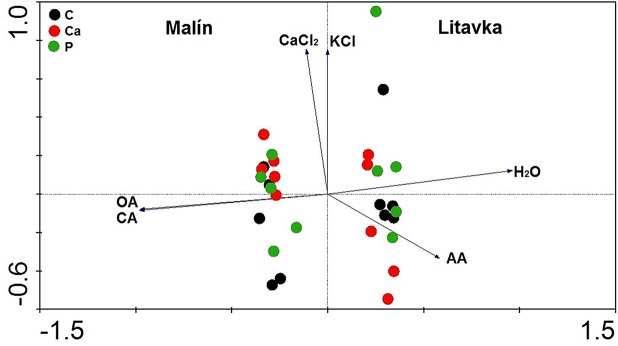
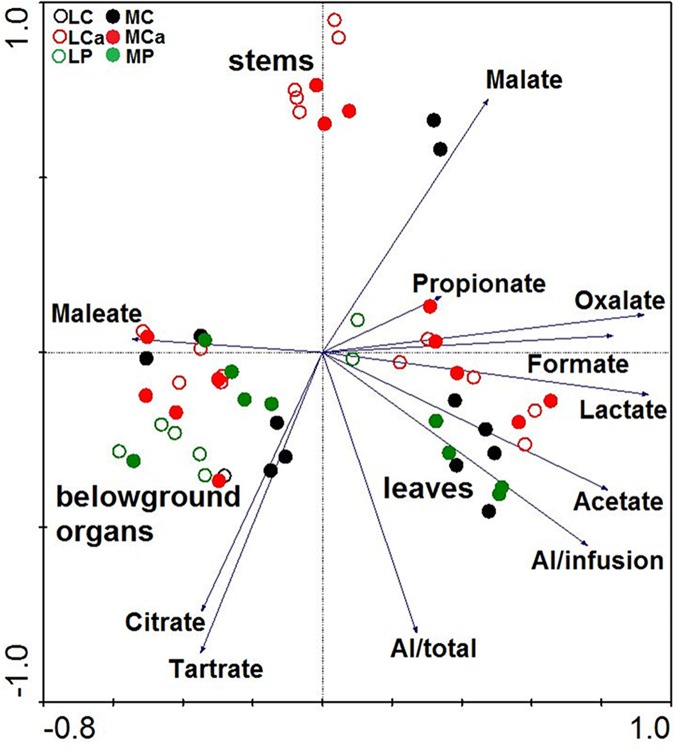
Al availability correlated positively to the extraction of organic acids (citric acid < oxalic acid) in soils. Monovalent Al cations were the most abundant mobile Al forms with positive charge in soils. Liming and superphosphate application were ambiguous measures for changing Al mobility in soils. Elevated transport of total Al from belowground organs into leaves was recorded in both lime-treated soils and in superphosphate-treated alkaline soil as a result of sufficient amount of Ca available from soil solution as well as from superphosphate that can probably modify distribution of total Al in R. obtusifolius as a representative of "oxalate plants." The highest concentrations of Al and organic acids were recorded in the leaves, followed by the stem and belowground organ infusions.
In alkaline soil, R. obtusifolius is an Al-hyperaccumulator with the highest concentrations of oxalate in leaves, of malate in stems, and of citrate in belowground organs. These organic acids form strong complexes with Al that can play a key role in internal Al tolerance but the used methods did not allow us to distinguish the proportion of total Al-organic complexes to the free organic acids.
钝叶酸模对铝具有高抗性且具备积累铝的能力,然而在弱酸性条件(pH > 5.8)下从未被研究过,并且在实际土壤条件下也未得到充分描述。对植物中有机酸作用的潜在阐释能够解释铝耐受机制。
我们开展了一项盆栽试验,将钝叶酸模种植在微酸性和碱性土壤中。为了控制铝的有效性,两种土壤均未处理以及分别用石灰和过磷酸钙进行处理。我们测定了土壤中可移动铝的浓度以及各器官中铝和有机酸的浓度。
土壤中铝的有效性与有机酸(柠檬酸<草酸)的提取呈正相关。单价铝阳离子是土壤中带正电荷的最丰富的可移动铝形态。施用石灰和过磷酸钙对于改变土壤中铝的移动性是不明确的措施。在石灰处理的土壤以及过磷酸钙处理的碱性土壤中,均记录到地下器官中总铝向叶片的转运增加,这是由于土壤溶液以及过磷酸钙中可利用的钙含量充足,这可能改变了作为“草酸植物”代表的钝叶酸模中总铝的分布。叶片中铝和有机酸的浓度最高,其次是茎和地下器官浸出液。
在碱性土壤中,钝叶酸模是一种铝超积累植物,叶片中草酸浓度最高,茎中苹果酸浓度最高,地下器官中柠檬酸浓度最高。这些有机酸与铝形成强络合物,这可能在内部铝耐受中起关键作用,但所采用的方法不允许我们区分总铝 - 有机络合物与游离有机酸的比例。