del Cerro Pablo, Rolla-Santos Amanda Alves Paiva, Gomes Douglas Fabiano, Marks Bettina Berquó, Pérez-Montaño Francisco, Rodríguez-Carvajal Miguel Ángel, Nakatani André Shigueyoshi, Gil-Serrano Antonio, Megías Manuel, Ollero Francisco Javier, Hungria Mariangela
Departamento de Microbiología, Facultad de Biología, Universidad de Sevilla, Avda. Reina Mercedes, 6 Apdo Postal 41012, Sevilla, Spain.
Embrapa Soja, C.P. 231, 86001-970, Londrina, Paraná, Brazil.
BMC Genomics. 2015 Mar 28;16(1):251. doi: 10.1186/s12864-015-1458-8.
Nodulation and symbiotic nitrogen fixation are mediated by several genes, both of the host legume and of the bacterium. The rhizobial regulatory nodD gene plays a critical role, orchestrating the transcription of the other nodulation genes. Rhizobium tropici strain CIAT 899 is an effective symbiont of several legumes-with an emphasis on common bean (Phaseolus vulgaris)-and is unusual in carrying multiple copies of nodD, the roles of which remain to be elucidated.
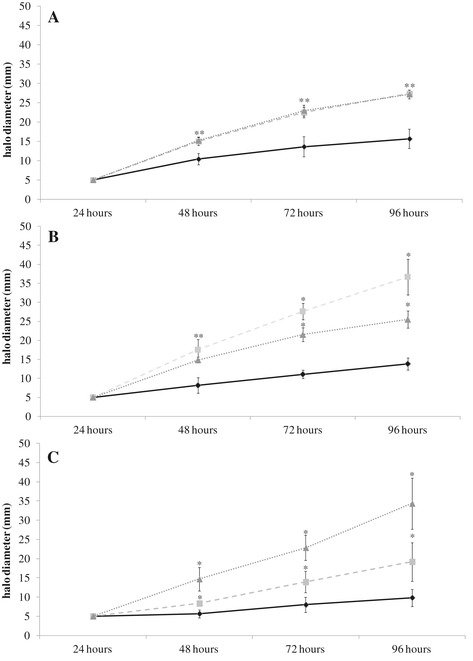
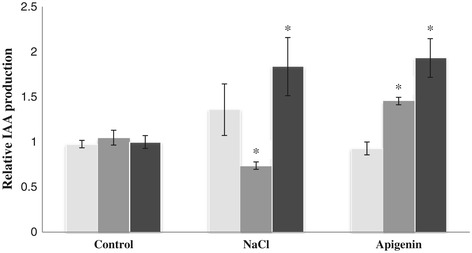
Phenotypes, Nod factors and gene expression of nodD1 and nodD2 mutants of CIAT 899 were compared with those of the wild type strain, both in the presence and in the absence of the nod-gene-inducing molecules apigenin and salt (NaCl). Differences between the wild type and mutants were observed in swimming motility and IAA (indole acetic acid) synthesis. In the presence of both apigenin and salt, large numbers of Nod factors were detected in CIAT 899, with fewer detected in the mutants. nodC expression was lower in both mutants; differences in nodD1 and nodD2 expression were observed between the wild type and the mutants, with variation according to the inducing molecule, and with a major role of apigenin with nodD1 and of salt with nodD2. In the nodD1 mutant, nodulation was markedly reduced in common bean and abolished in leucaena (Leucaena leucocephala) and siratro (Macroptilium atropurpureum), whereas a mutation in nodD2 reduced nodulation in common bean, but not in the other two legumes.
Our proposed model considers that full nodulation of common bean by R. tropici requires both nodD1 and nodD2, whereas, in other legume species that might represent the original host, nodD1 plays the major role. In general, nodD2 is an activator of nod-gene transcription, but, in specific conditions, it can slightly repress nodD1. nodD1 and nodD2 play other roles beyond nodulation, such as swimming motility and IAA synthesis.
结瘤和共生固氮由宿主豆科植物和细菌的多个基因介导。根瘤菌调控基因nodD起着关键作用,协调其他结瘤基因的转录。热带根瘤菌CIAT 899菌株是几种豆科植物的有效共生体——尤其针对菜豆(Phaseolus vulgaris)——其不同寻常之处在于携带多个nodD拷贝,其作用仍有待阐明。
在存在和不存在结瘤基因诱导分子芹菜素和盐(NaCl)的情况下,将CIAT 899的nodD1和nodD2突变体的表型、根瘤菌因子和基因表达与野生型菌株进行了比较。在游泳运动性和吲哚乙酸(IAA)合成方面观察到野生型和突变体之间的差异。在同时存在芹菜素和盐的情况下,在CIAT 899中检测到大量根瘤菌因子,而在突变体中检测到的较少。两个突变体中nodC的表达均较低;在野生型和突变体之间观察到nodD1和nodD2表达的差异,根据诱导分子而有所变化,芹菜素对nodD1起主要作用,盐对nodD2起主要作用。在nodD1突变体中,菜豆的结瘤明显减少,在银合欢(Leucaena leucocephala)和大翼豆(Macroptilium atropurpureum)中结瘤被消除,而nodD2突变则减少了菜豆的结瘤,但在其他两种豆科植物中没有。
我们提出的模型认为,热带根瘤菌对菜豆的完全结瘤需要nodD1和nodD2,而在可能代表原始宿主的其他豆科植物物种中,nodD1起主要作用。一般来说,nodD2是结瘤基因转录的激活剂,但在特定条件下,它可以轻微抑制nodD1。nodD1和nodD2在结瘤之外还发挥其他作用,如游泳运动性和IAA合成。