Vickers Richard, Robinson Neil, Best Emma, Echols Roger, Tillotson Glenn, Wilcox Mark
Summit PLC, 85b Park Drive, Milton Park, Abingdon, Oxford, OX14 4RY, UK.
Microbiology, Leeds Teaching Hospitals & University of Leeds, Old Medical School, Leeds General Infirmary, Leeds, LS1 3EX, UK.
BMC Infect Dis. 2015 Feb 25;15:91. doi: 10.1186/s12879-015-0759-5.
Clostridium difficile infection (CDI) is a leading cause of diarrhoea in health care settings with symptoms ranging from mild and self-limiting to life threatening. SMT19969 is a novel, non-absorbable antibiotic currently under development for the treatment of CDI. Here we report the results from a Phase I study.
A double-blind, randomized, placebo-controlled study assessing safety and tolerability of single and multiple oral doses of SMT19969 in healthy volunteers. Pharmacokinetic assessments included blood and faecal sampling. The effect of food on systemic exposure and analysis of the gut microbiota were also included.
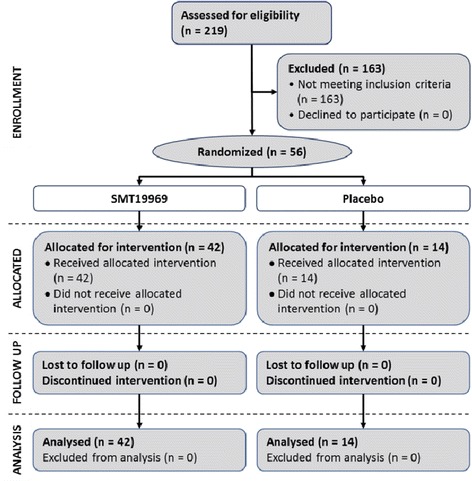
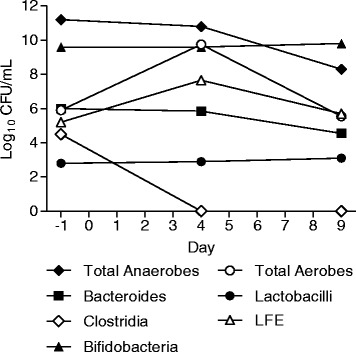
Fifty-six healthy male subjects were enrolled. Following single oral doses of up to 2,000 mg in the fasted state, plasma concentrations of SMT19969 were generally below the lower limit of quantification. In the fed state levels ranged from 0.102 to 0.296 ng/mL after single dosing and after repeat dosing at Day 10 from 0.105 to 0.305 ng/mL. Following single and multiple oral doses of SMT19969, mean daily faecal concentrations increased with increasing dose level and were significantly above the typical MIC range for C. difficile (0.06-0.5 μg/mL). At 200 mg BID, mean (± SD) faecal concentrations of 1,466 (±547) μg/g and 1,364 (±446) μg/g were determined on days 5 and 10 of dosing respectively. No notable metabolites were detected in faeces. Overall, all doses of SMT19969 were well tolerated both as single oral doses or BID oral doses for 10 days. The majority (88%) of adverse events (AEs) were classified as gastrointestinal disorders and were mild in severity, resolving without treatment. The gut microbiota was analysed in the multiple dose groups with minimal changes observed in the bacterial groups analysed except for total clostridia which were reduced to below the limit of detection by day 4 of dosing.
Oral administration of SMT19969 was considered safe and well tolerated and was associated with negligible plasma concentrations after single and multiple doses. In addition, minimal disruption of normal gut microbiota was noted, confirming the highly selective spectrum of the compound. These results support the further clinical development of SMT19969 as an oral therapy for CDI.
Current Controlled Trials. ISRCTN10858225 .
艰难梭菌感染(CDI)是医疗机构中腹泻的主要原因,症状从轻度自限性到危及生命不等。SMT19969是一种正在开发用于治疗CDI的新型非吸收性抗生素。在此我们报告一项I期研究的结果。
一项双盲、随机、安慰剂对照研究,评估健康志愿者单次和多次口服SMT19969的安全性和耐受性。药代动力学评估包括血液和粪便采样。还包括食物对全身暴露的影响以及肠道微生物群分析。
招募了56名健康男性受试者。在禁食状态下单次口服高达2000mg后,SMT19969的血浆浓度通常低于定量下限。在进食状态下,单次给药后浓度范围为0.102至0.296ng/mL,第10天重复给药后为0.105至0.305ng/mL。单次和多次口服SMT19969后,平均每日粪便浓度随剂量水平增加而升高,且显著高于艰难梭菌的典型最低抑菌浓度范围(0.06 - 0.5μg/mL)。在200mg bid给药时,给药第5天和第10天的平均(±标准差)粪便浓度分别测定为1466(±547)μg/g和1364(±446)μg/g。粪便中未检测到明显的代谢物。总体而言,所有剂量的SMT19969作为单次口服剂量或bid口服剂量连续服用10天均耐受性良好。大多数(88%)不良事件(AE)被归类为胃肠道疾病,且严重程度为轻度,无需治疗即可缓解。在多剂量组中对肠道微生物群进行分析,除总梭菌在给药第4天降至检测限以下外,所分析的细菌组中观察到的变化最小。
口服SMT19969被认为是安全且耐受性良好的,单次和多次给药后血浆浓度可忽略不计。此外,注意到对正常肠道微生物群的干扰最小,证实了该化合物的高选择性谱。这些结果支持SMT19969作为CDI口服疗法的进一步临床开发。
当前对照试验。ISRCTN10858225 。