
孕酮、雌二醇、花生四烯酸、催产素、福斯高林和环磷酸腺苷对发情周期黄体中期和黄体溶解期间猪子宫外植体中水通道蛋白1和5表达的影响:一项体外研究。
Progesterone, estradiol, arachidonic acid, oxytocin, forskolin and cAMP influence on aquaporin 1 and 5 expression in porcine uterine explants during the mid-luteal phase of the estrous cycle and luteolysis: an in vitro study.
作者信息
Skowronska Agnieszka, Młotkowska Patrycja, Wojciechowicz Bartosz, Okrasa Stanisław, Nielsen Soren, Skowronski Mariusz T
机构信息
Department of Human Physiology, Faculty of Medical Sciences, University of Warmia and Mazury in Olsztyn, Olsztyn, Poland.
Department of Animal Physiology, Faculty of Biology and Biotechnology, University of Warmia and Mazury in Olsztyn, Olsztyn, Poland.
出版信息
Reprod Biol Endocrinol. 2015 Feb 18;13:7. doi: 10.1186/s12958-015-0004-5.
BACKGROUND
The cell membrane water channel protein, aquaporins (AQPs), regulate cellular water transport and cell volume and play a key role in water homeostasis. Recently, AQPs are considered as important players in the field of reproduction. In previous studies, we have established the presence of AQP1 and 5 in porcine uterus. Their expression at protein level altered in distinct tissues of the female reproductive system depending on the phase of the estrous cycle. However, the regulation of aquaporin genes and proteins expression has not been examined in porcine uterine tissue. Therefore, we have designed an in vitro experiment to explain whether steroid hormones, progesterone (P4) and estradiol (E2), and other factors: oxytocine (OT), arachidonic acid (AA; substrate for prostaglandins synthesis) as well as forskolin (FSK; adenylate cyclase activator) and cAMP (second messenger, cyclic adenosine monophosphate) may impact AQPs expression.
METHODS
Uterine tissues were collected on Days 10-12 and 14-16 of the estrous cycle representing the mid-luteal phase and luteolysis. Real-time PCR and Western blot analysis were performed to examine the expression of porcine AQP1 and AQP5. Their expression in the uterine explants was also evaluated by immunohistochemistry.
RESULTS
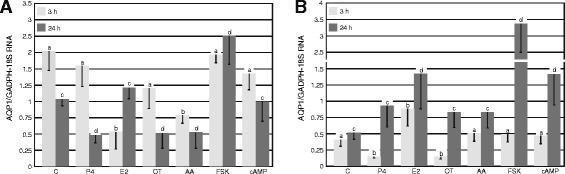
The results indicated that uterine expression of AQP1 and AQP5 potentially remains under control of steroid hormones and AA-derived compounds (e.g. prostaglandins). P4, E2, AA, FSK and cAMP cause translocation of AQP5 from apical to the basolateral plasma membrane of the epithelial cells, which might affect the transcellular water movement (through epithelial cells) between uterine lumen and blood vessels. The AC/cAMP pathway is involved in the intracellular signals transduction connected with the regulation of AQPs expression in the pig uterus.
CONCLUSIONS
This study documented specific patterns of AQP1 and AQP5 expression in response to P4, E2, AA, FSK and cAMP, thereby providing new indirect evidence of their role in maintaining the local fluid balance within the uterus during the mid-luteal phase of the estrous cycle and luteolysis in pigs.
背景
细胞膜水通道蛋白,即水通道蛋白(AQPs),调节细胞的水运输和细胞体积,在水稳态中起关键作用。最近,水通道蛋白被认为是生殖领域的重要参与者。在先前的研究中,我们已证实猪子宫中存在水通道蛋白1和5。它们在蛋白质水平的表达在雌性生殖系统的不同组织中会根据发情周期的阶段而改变。然而,尚未在猪子宫组织中研究水通道蛋白基因和蛋白质表达的调控。因此,我们设计了一项体外实验,以解释甾体激素、孕酮(P4)和雌二醇(E2)以及其他因素:催产素(OT)、花生四烯酸(AA;前列腺素合成的底物)以及福斯可林(FSK;腺苷酸环化酶激活剂)和cAMP(第二信使,环磷酸腺苷)是否会影响水通道蛋白的表达。
方法
在发情周期的第10 - 12天和14 - 16天收集子宫组织,分别代表黄体中期和黄体溶解期。进行实时PCR和蛋白质印迹分析以检测猪水通道蛋白1和水通道蛋白5的表达。还通过免疫组织化学评估它们在子宫外植体中的表达。
结果
结果表明,水通道蛋白1和5在子宫中的表达可能受甾体激素和AA衍生化合物(如前列腺素)的控制。P4、E2、AA、FSK和cAMP导致水通道蛋白5从上皮细胞的顶端质膜转运至基底外侧质膜,这可能会影响子宫腔与血管之间的跨细胞水运动(通过上皮细胞)。AC/cAMP途径参与了与猪子宫中水通道蛋白表达调控相关的细胞内信号转导。
结论
本研究记录了水通道蛋白1和5对P4、E2、AA、FSK和cAMP反应的特定表达模式,从而为它们在猪发情周期黄体中期和黄体溶解期维持子宫局部液体平衡中的作用提供了新的间接证据。



 Zotero 插件