Dwyer Julie, Azzi Sandy, Leclair Héloïse M, Georges Steven, Carlotti Agnès, Treps Lucas, Galan-Moya Eva M, Alexia Catherine, Dupin Nicolas, Bidère Nicolas, Gavard Julie
CNRS, UMR8104, 22 rue Mechain, 75014, Paris, France.
INSERM, U1016, 22 rue Mechain, 75014, Paris, France.
Cell Commun Signal. 2015 Feb 15;13:11. doi: 10.1186/s12964-015-0090-1.
The viral G protein-coupled receptor (vGPCR) is proposed to act as one of the predominant mediators of Kaposi's sarcoma (KS), a human herpes virus 8 (HHV8)-elicited disease. The actions of vGPCR manifest pathogenesis, in part, through increased permeability of endothelial cells. Endothelial cell-cell junctions have indeed emerged as an instrumental target involved in the vasculature defects observed within the tumor microenvironment. The pathway leading to adherens junction destabilization has been shown to involve the activation of the small GTPase Rac, in the context of either latent infection or the sole expression of vGPCR. However, the precise molecular mechanisms governed by vGPCR in vascular leakage require further elucidation.
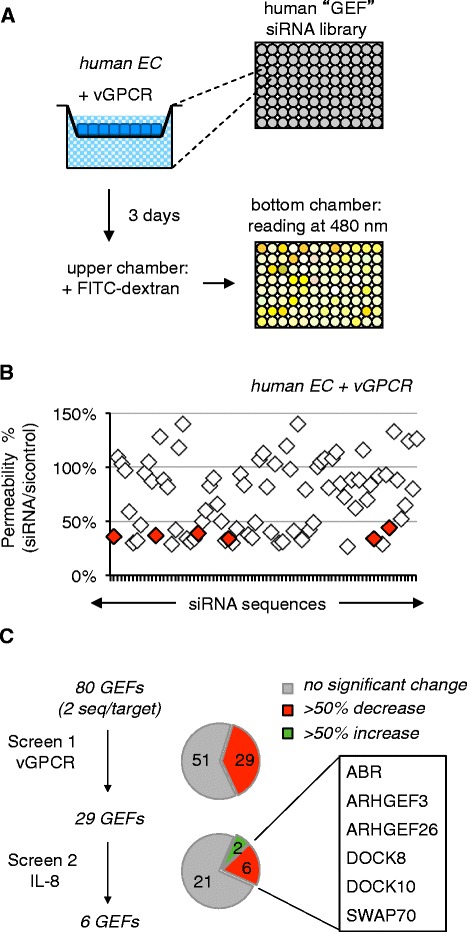
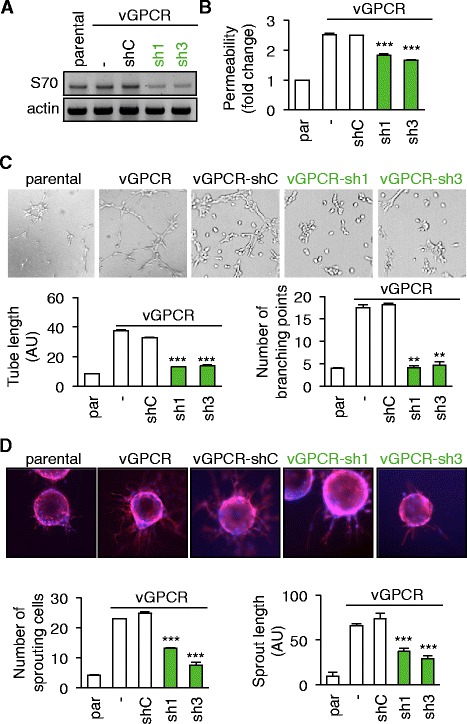
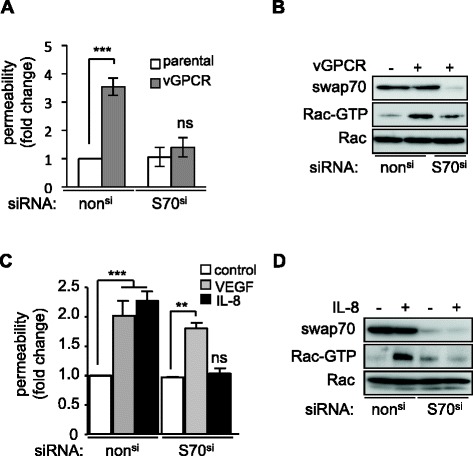
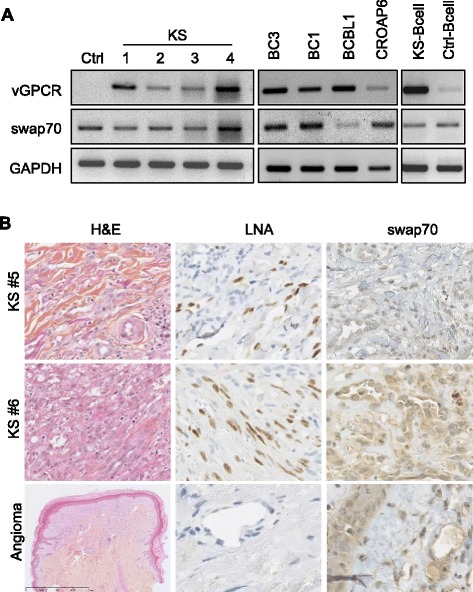
Guanine exchange factors (GEFs) function as critical molecular switches that control the activation of small GTPases. We therefore screened the effects of 80 siRNAs targeting GEFs on vGPCR-driven endothelial permeability and identified switch-associated protein 70 (SWAP70) as necessary for its elevating effects. Pull-down experiments further showed that Rac activation by vGPCR was dependent on SWAP70. Examination of tissues and cells from HHV8-positive patients revealed that SWAP70 was ubiquitously expressed. Furthermore, SWAP70 was found to be crucial for vGPCR-driven endothelial tube formation and endothelial sprouting in vitro.
SWAP70 appears to act as a molecular intermediate between vGPCR and endothelial activation. Because of the important role of vGPCR-mediated endothelial plasticity in KS pathogenesis, inhibition of SWAP70 function could be of interest for blocking vGPCR-driven activities in HHV8-defined diseases.
病毒G蛋白偶联受体(vGPCR)被认为是卡波西肉瘤(KS)的主要介质之一,KS是一种由人类疱疹病毒8型(HHV8)引发的疾病。vGPCR的作用部分通过增加内皮细胞的通透性来体现其致病机制。内皮细胞间连接确实已成为肿瘤微环境中观察到的血管缺陷所涉及的重要靶点。在潜伏感染或仅vGPCR表达的情况下,导致黏附连接不稳定的途径已被证明涉及小GTP酶Rac的激活。然而,vGPCR在血管渗漏中所调控的精确分子机制仍需进一步阐明。
鸟嘌呤交换因子(GEFs)作为控制小GTP酶激活的关键分子开关发挥作用。因此,我们筛选了80种靶向GEFs的小干扰RNA(siRNAs)对vGPCR驱动的内皮通透性的影响,并确定交换相关蛋白70(SWAP70)是其增强作用所必需的。下拉实验进一步表明,vGPCR对Rac的激活依赖于SWAP70。对HHV8阳性患者的组织和细胞检查显示,SWAP70普遍表达。此外,发现SWAP70对于vGPCR驱动的体外内皮管形成和内皮芽生至关重要。
SWAP70似乎作为vGPCR与内皮激活之间的分子中间体发挥作用。由于vGPCR介导的内皮可塑性在KS发病机制中的重要作用,抑制SWAP70功能可能对于阻断HHV8相关疾病中vGPCR驱动的活性具有意义。