Park So-Yeon, Park Jong Min, Sung Wonmo, Kim Il Han, Ye Sung-Joon
Interdiciplinary Program in Radiation Applied Life Science, Seoul National University College of Medicine, Seoul, Republic of Korea.
Department of Radiation Oncology, Seoul National University Hospital, Seoul, Republic of Korea.
Radiat Oncol. 2015 Apr 1;10:74. doi: 10.1186/s13014-015-0382-z.
Textural features of edge-enhanced fluence were analysed to quantify modulation degree of volumetric modulated arc therapy (VMAT) plans.
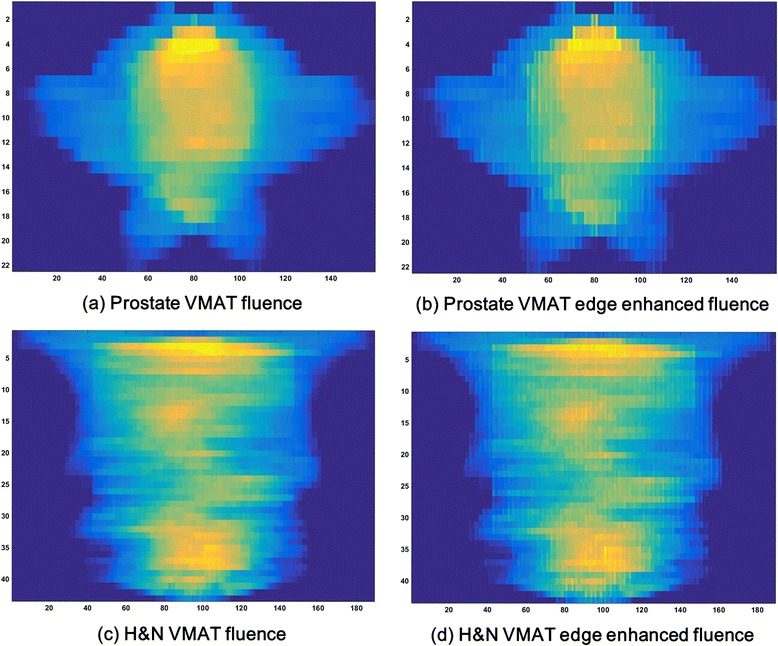
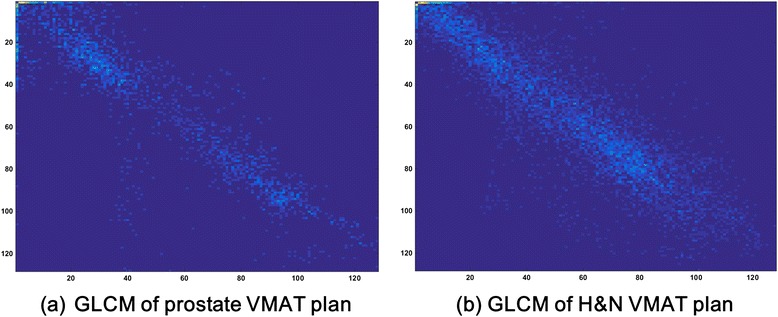
Twenty prostate and twenty head and neck VMAT plans were retrospectively selected. Fluences of VMAT plans were generated by integration of monitor units shaped by multi-leaf collimators (MLCs) at each control point. When generating fluences, the values of pixels representing MLC tips were doubled to prevent smearing out of small or irregular fields (edge-enhancement). Six kinds of textural features, including angular second moment, inverse difference moment, contrast, variance, correlation and entropy, were calculated with particular displacement distances (d) of 1, 5 and 10. Plan delivery accuracy was evaluated by gamma-index method, mechanical parameter differences between plan and delivery and differences in dose-volumetric parameters between plan and delivery. Spearman's correlation coefficients (r s ) were calculated between the values of textural features and VMAT delivery accuracy.
The r s values of contrast (d = 1) with edge-enhancement to global gamma passing rates with 2%/2 mm, 1%/2 mm and 2%/1 mm were 0.546 (p < 0.001), 0.744 (p < 0.001) and 0.487 (p = 0.001), respectively. Those with local 2%/2 mm, 1%/2 mm and 2%/1 mm were 0.588, 0.640 and 0.644, respectively (all with p < 0.001). The r s values of contrast (d = 1) to MLC and gantry angle errors were -0.853 and 0.655, respectively (all with p < 0.001). The contrast (d = 1) showed statistically significant r s values in 11 dose-volumetric parameter differences from a total of 35 cases, and generally showed better correlations to plan delivery accuracy than did previously suggested textural features with non-edge-enhanced fluences, as well as conventional modulation indices.
Contrast (d = 1) with edge-enhanced fluences could be used as modulation index for VMAT.
分析边缘增强注量的纹理特征以量化容积调强弧形治疗(VMAT)计划的调制度。
回顾性选取20例前列腺和20例头颈部VMAT计划。VMAT计划的注量通过在每个控制点对由多叶准直器(MLC)形成的监测单位进行积分生成。生成注量时,将代表MLC尖端的像素值加倍以防止小的或不规则野模糊(边缘增强)。计算六种纹理特征,包括角二阶矩、逆差矩、对比度、方差、相关性和熵,特定位移距离(d)分别为1、5和10。通过伽马指数法、计划与照射之间的机械参数差异以及计划与照射之间的剂量体积参数差异评估计划照射精度。计算纹理特征值与VMAT照射精度之间的Spearman相关系数(r s)。
对比度(d = 1)边缘增强与全局伽马通过率在2%/2 mm、1%/2 mm和2%/1 mm时的r s值分别为0.546(p < 0.001)、0.744(p < 0.001)和0.487(p = 0.001)。局部2%/2 mm、1%/2 mm和2%/1 mm时分别为0.588、0.640和0.644(均p < 0.001)。对比度(d = 1)与MLC和机架角度误差的r s值分别为 -0.853和0.655(均p < 0.001)。对比度(d = 1)在总共35例中的11个剂量体积参数差异中显示出具有统计学意义的r s值,并且总体上与计划照射精度的相关性比先前提出的非边缘增强注量的纹理特征以及传统调制度指数更好。
边缘增强注量的对比度(d = 1)可作为VMAT的调制度指数。