Li Yongchao, Wang Pei-Shan, Lucas George, Li Rong, Yao Li
Department of Biological Sciences, Wichita State University, Fairmount 1845, Wichita, KS, 67260, USA.
Stowers Institute for Medical Research, 1000 E 50th Street, Kansas City, MO, 64110, USA.
Stem Cell Res Ther. 2015 Mar 21;6(1):41. doi: 10.1186/s13287-015-0042-0.
The loss of oligodendrocytes in a lesion of the central nervous system causes demyelination and therefore impairs axon function and survival. Transplantation of neural stem cell-derived oligodendrocyte precursor cells (NSC-OPCs) results in increased oligodendrocyte formation and enhanced remyelination. The directional migration of grafted cells to the target can promote the establishment of functional reconnection and myelination in the process of neural regeneration. Endogenous electric fields (EFs) that were detected in the development of the central nervous system can regulate cell migration.
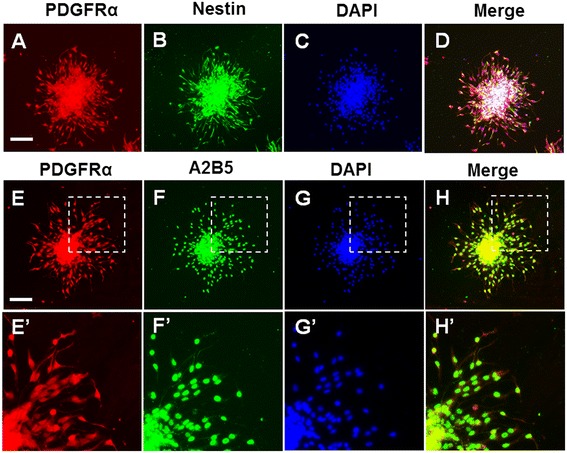
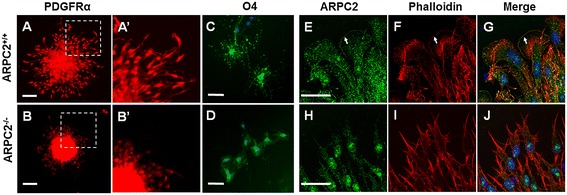
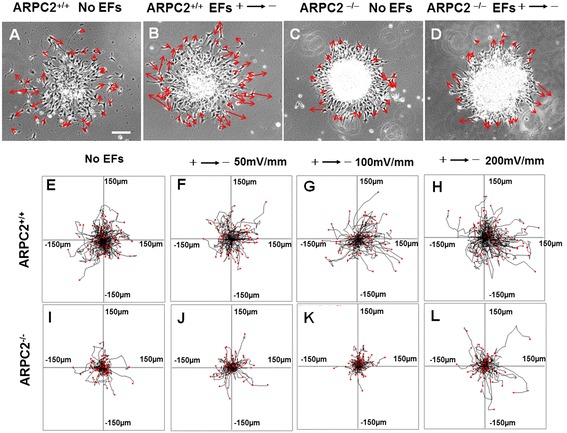
NSCs were isolated from the brains of ARPC2+/+ and ARPC2-/- mouse embryo and differentiated into OPCs. After differentiation, the cultured oligospheres were stimulated with EFs (50, 100, or 200 mV/mm). The migration of OPCs from oligospheres was recorded using time-lapse microscopy. The cell migration directedness and speed were analyzed and quantified.
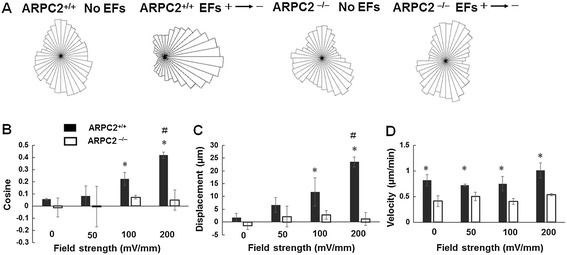
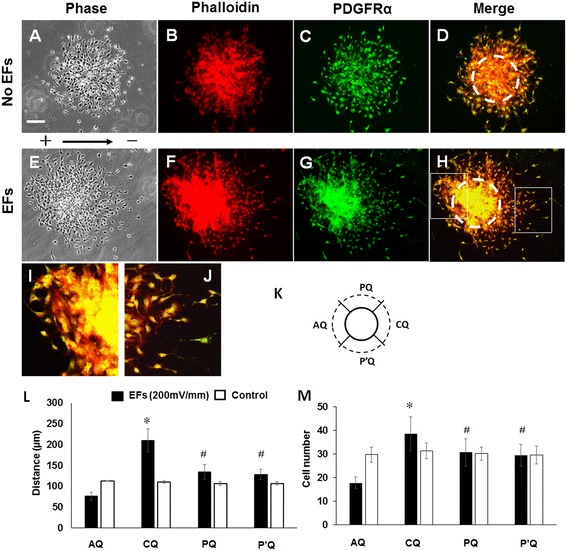
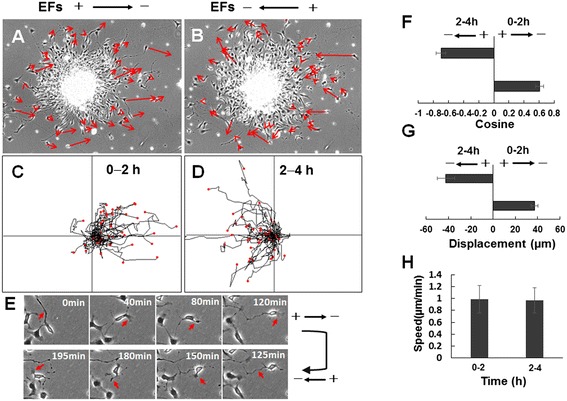
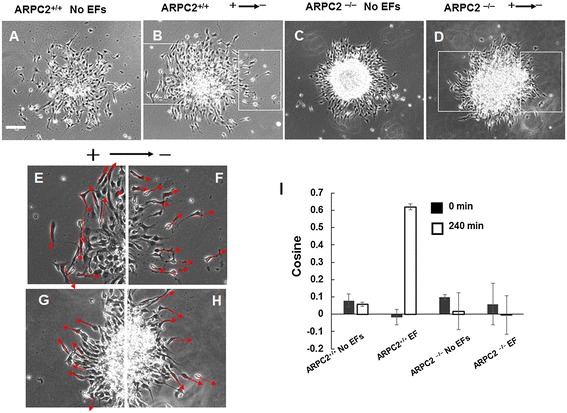
In this study, we found that NSC-OPCs migrated toward the cathode pole in EFs. The directedness and displacement of cathodal migration increased significantly when the EF strength increased from 50 to 200 mV/mm. However, the EF did not significantly change the cell migration speed. We also showed that the migration speed of ARPC2-/- OPCs, deficient in the actin-related proteins 2 and 3 (ARP2/3) complex, was significantly lower than that of wild type of OPCs. ARPC2-/- OPCs migrated randomly in EFs.
The migration direction of NSC-OPCs can be controlled by EFs. The function of the ARP complex is required for the cathodal migration of NSC-OPCs in EFs. EF-guided cell migration is an effective model to understanding the intracellular signaling pathway in the regulation of cell migration directness and motility.
中枢神经系统损伤中少突胶质细胞的丢失会导致脱髓鞘,进而损害轴突功能和存活。移植神经干细胞来源的少突胶质前体细胞(NSC-OPCs)可增加少突胶质细胞的形成并增强髓鞘再生。移植细胞向靶标的定向迁移可促进神经再生过程中功能性重新连接和髓鞘形成的建立。在中枢神经系统发育过程中检测到的内源性电场(EFs)可调节细胞迁移。
从ARPC2+/+和ARPC2-/-小鼠胚胎的大脑中分离神经干细胞并将其分化为少突胶质前体细胞。分化后,用EFs(50、100或200 mV/mm)刺激培养的寡球。使用延时显微镜记录寡球中少突胶质前体细胞的迁移。分析并量化细胞迁移的方向性和速度。
在本研究中,我们发现NSC-OPCs在EFs中向阴极极迁移。当EF强度从50 mV/mm增加到200 mV/mm时,阴极迁移的方向性和位移显著增加。然而,EF并未显著改变细胞迁移速度。我们还表明,缺乏肌动蛋白相关蛋白2和3(ARP2/3)复合物的ARPC2-/-少突胶质前体细胞的迁移速度明显低于野生型少突胶质前体细胞。ARPC2-/-少突胶质前体细胞在EFs中随机迁移。
NSC-OPCs的迁移方向可由EFs控制。ARP复合物的功能是NSC-OPCs在EFs中阴极迁移所必需的。EF引导的细胞迁移是理解细胞迁移方向性和运动性调节中细胞内信号通路的有效模型。