Ma Gang, He Jianjun, Yu Yang, Xu Yixiang, Yu Xiaobin, Martinez Jarrod, Lonard David M, Xu Jianming
1. Department of Breast and Thyroid Cancer Surgery, The First Affiliated Hospital of Xi'an Jiaotong University Medical School, Xi'an, China; ; 2. Department of Molecular and Cellular Biology, Baylor College of Medicine, Houston, TX, USA;
1. Department of Breast and Thyroid Cancer Surgery, The First Affiliated Hospital of Xi'an Jiaotong University Medical School, Xi'an, China;
Int J Biol Sci. 2015 Apr 11;11(5):618-28. doi: 10.7150/ijbs.11380. eCollection 2015.
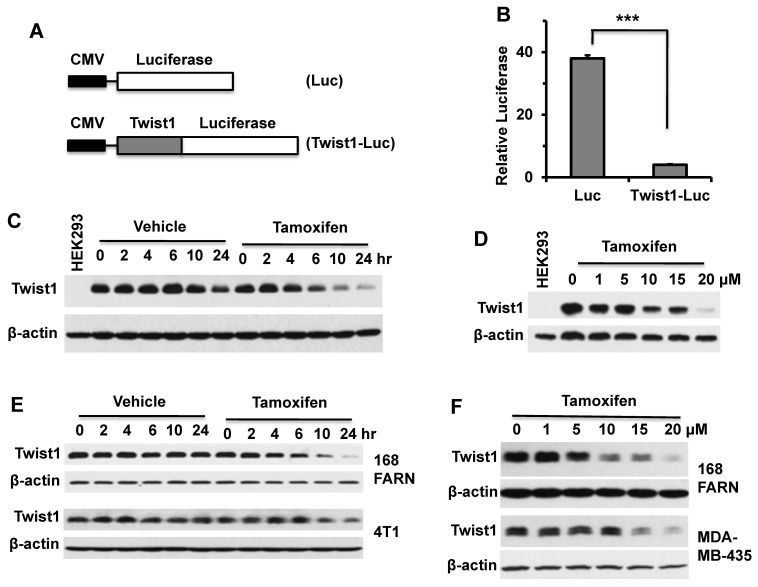
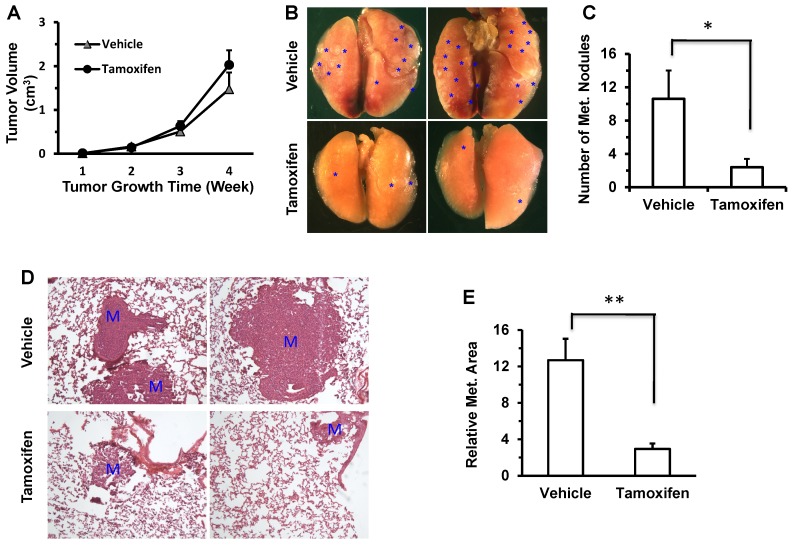
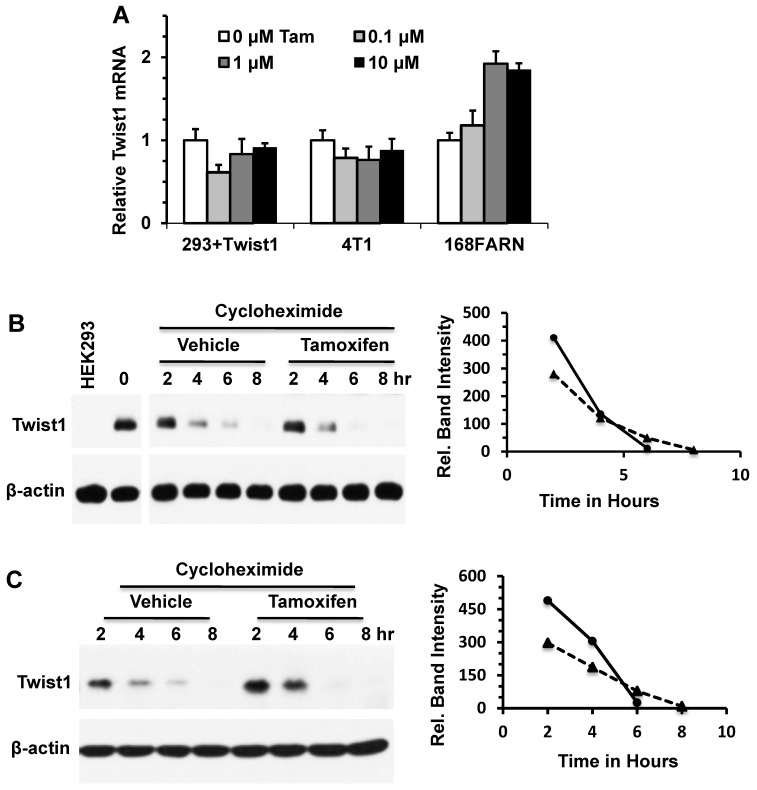
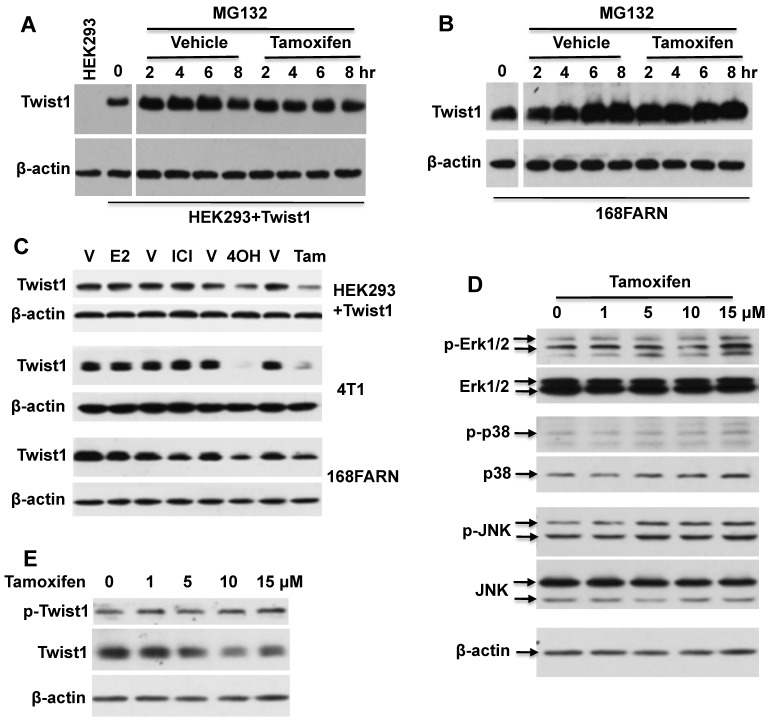
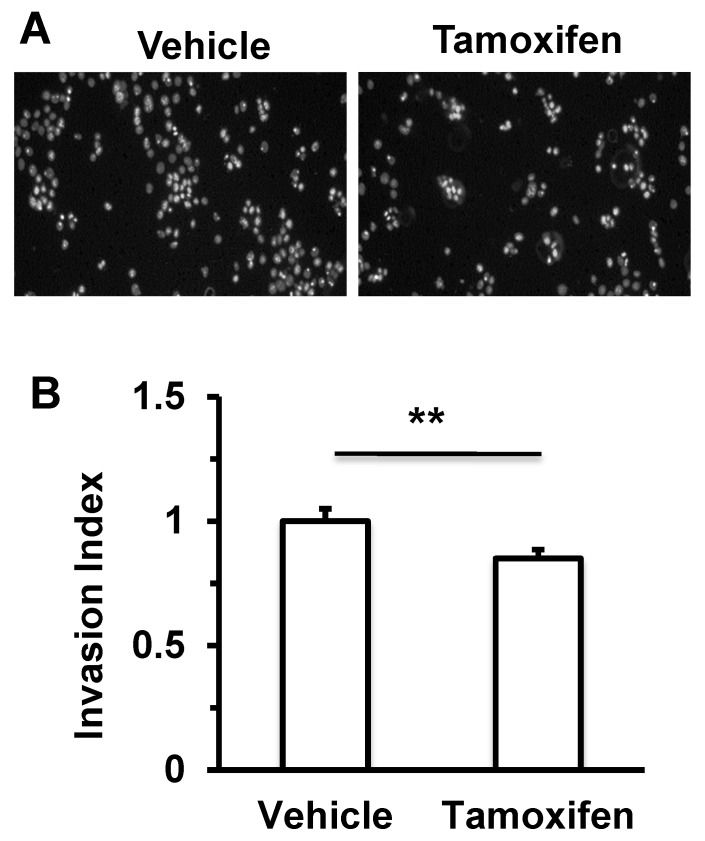
Twist1 is a transcription factor driving epithelial-mesenchymal transition, invasion and metastasis of breast cancer cells. Mice with germ-line Twist1 knockout are embryonic lethal, while adult mice with inducible Twist1 knockout have no obvious health problems, suggesting that Twist1 is a viable therapeutic target for the inhibition of invasion and metastasis of breast cancer in adult patients. In this study, we expressed a luciferase protein or a Twist1-luciferase fusion protein in HeLa cells as part of a high throughput system to screen 1280 compounds in the Library of Pharmacologically Active Compounds (LOPAC) from Sigma-Aldrich for their effects on Twist1 protein expression. One of the most interesting compounds identified is tamoxifen, a selective estrogen receptor (ER) modulator used to treat ER-positive breast cancer. Tamoxifen treatment significantly accelerated Twist1 degradation in multiple cell lines including HEK293 human kidney cells, 4T1 and 168FARN mouse mammary tumor cells with either ectopically or endogenously expressed Twist1. Tamoxifen-induced Twist1 degradation could be blocked by the MG132 proteasome inhibitor, suggesting that tamoxifen induces Twist1 degradation through the ubiquitination-proteasome pathway. However, tamoxifen-induced Twist1 degradation was independent of Twist1 mRNA expression, estrogen signaling and MAPK-mediated Twist1 phosphorylation in these cells. Importantly, tamoxifen also significantly inhibited invasive behavior in Matrigel and lung metastasis in SCID-bg mice of ER-negative 4T1 mammary tumor cells, which depend on endogenous Twist1 to invade and metastasize. These results indicate that tamoxifen can significantly accelerate Twist1 degradation to suppress cancer cell invasion and metastasis, suggesting that tamoxifen can be used not only to treat ER-positive breast cancers but also to reduce Twist1-mediated invasion and metastasis in ER-negative breast cancers.
Twist1是一种驱动乳腺癌细胞上皮-间质转化、侵袭和转移的转录因子。种系Twist1基因敲除的小鼠胚胎致死,而可诱导Twist1基因敲除的成年小鼠没有明显的健康问题,这表明Twist1是抑制成年乳腺癌患者侵袭和转移的一个可行治疗靶点。在本研究中,我们在HeLa细胞中表达荧光素酶蛋白或Twist1-荧光素酶融合蛋白,作为高通量系统的一部分,以筛选西格玛奥德里奇公司的药理活性化合物库(LOPAC)中的1280种化合物对Twist1蛋白表达的影响。鉴定出的最有趣的化合物之一是他莫昔芬,一种用于治疗雌激素受体(ER)阳性乳腺癌的选择性雌激素受体调节剂。他莫昔芬处理显著加速了包括HEK293人肾细胞、4T1和168FARN小鼠乳腺肿瘤细胞在内的多种细胞系中Twist1的降解,这些细胞系中Twist1为异位或内源性表达。他莫昔芬诱导的Twist1降解可被MG132蛋白酶体抑制剂阻断,这表明他莫昔芬通过泛素化-蛋白酶体途径诱导Twist1降解。然而,他莫昔芬诱导的Twist1降解与这些细胞中Twist1 mRNA表达、雌激素信号传导及丝裂原活化蛋白激酶(MAPK)介导的Twist1磷酸化无关。重要的是,他莫昔芬还显著抑制了ER阴性的4T1乳腺肿瘤细胞在基质胶中的侵袭行为以及在重症联合免疫缺陷(SCID)-bg小鼠中的肺转移,这些细胞依赖内源性Twist1进行侵袭和转移。这些结果表明,他莫昔芬可显著加速Twist1降解以抑制癌细胞侵袭和转移,这表明他莫昔芬不仅可用于治疗ER阳性乳腺癌,还可减少ER阴性乳腺癌中Twist1介导的侵袭和转移。