Zhao Cui-Mei, Peng Lu-Ying, Li Li, Liu Xing-Yuan, Wang Juan, Zhang Xian-Ling, Yuan Fang, Li Ruo-Gu, Qiu Xing-Biao, Yang Yi-Qing
Department of Cardiology, Tongji Hospital, Tongji University School of Medicine, Shanghai, China; Division of Medical Genetics, Tongji University School of Medicine, Shanghai, China.
Division of Medical Genetics, Tongji University School of Medicine, Shanghai, China.
PLoS One. 2015 Apr 20;10(4):e0124409. doi: 10.1371/journal.pone.0124409. eCollection 2015.
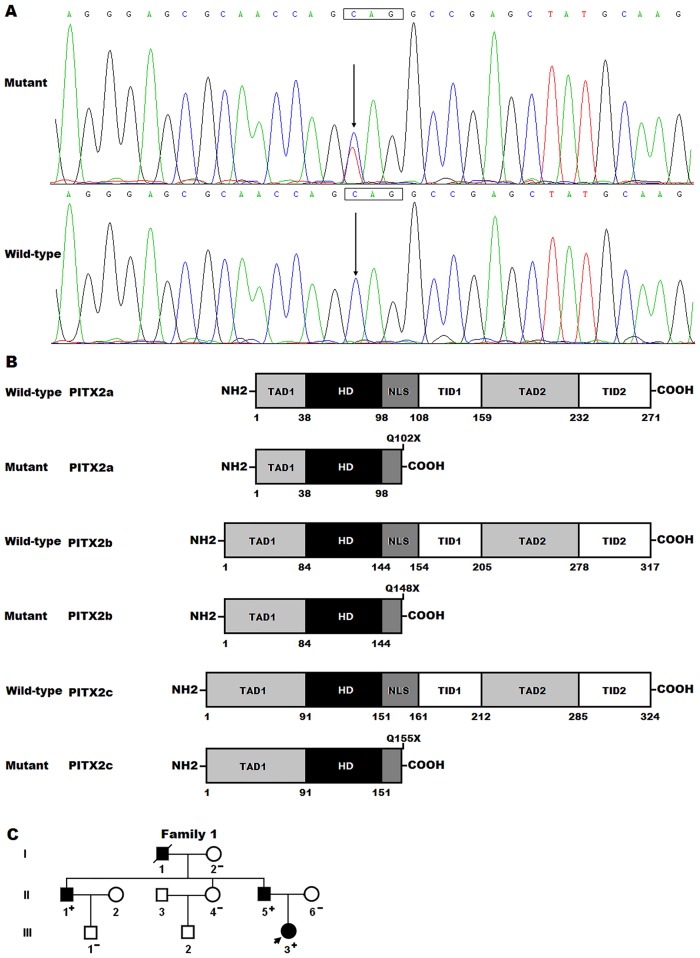
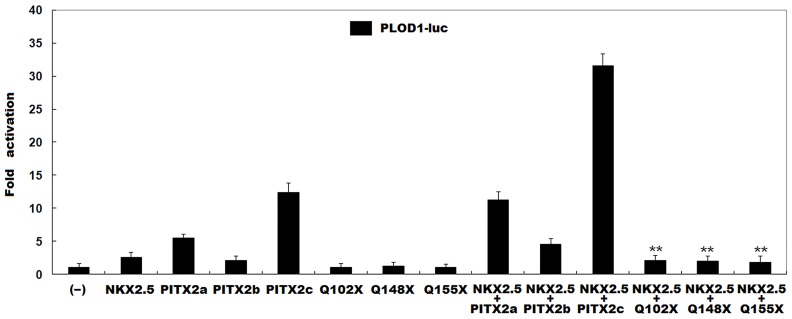
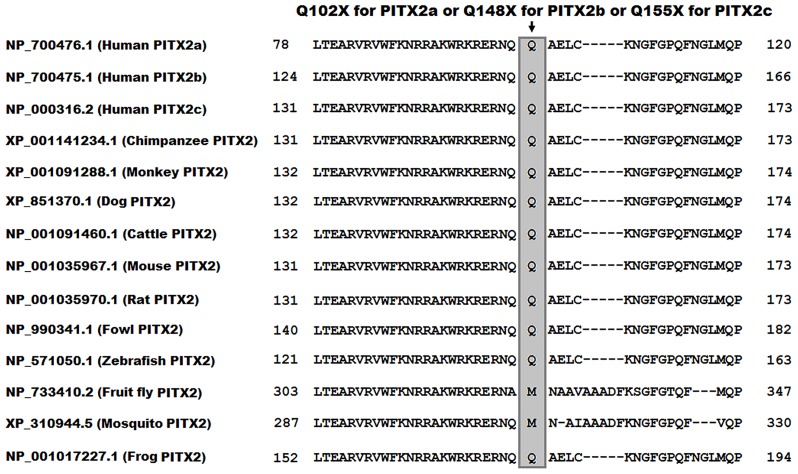
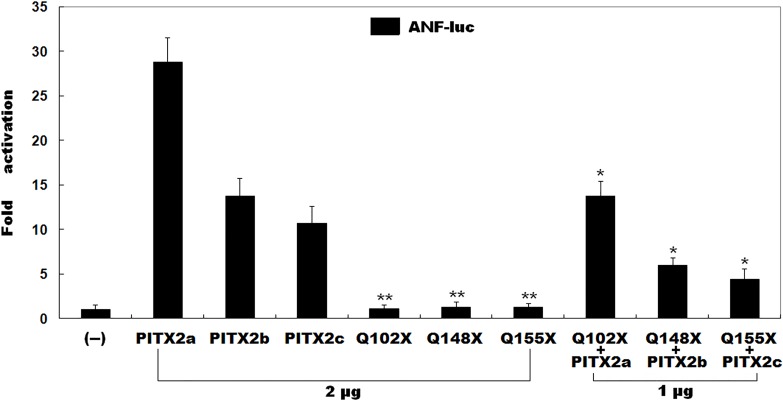
Congenital heart disease (CHD), the most common type of birth defect, is still the leading non-infectious cause of infant morbidity and mortality in humans. Aggregating evidence demonstrates that genetic defects are involved in the pathogenesis of CHD. However, CHD is genetically heterogeneous and the genetic components underpinning CHD in an overwhelming majority of patients remain unclear. In the present study, the coding exons and flanking introns of the PITX2 gene, which encodes a paired-like homeodomain transcription factor 2essential for cardiovascular morphogenesis as well as maxillary facial development, was sequenced in 196 unrelated patients with CHD and subsequently in the mutation carrier's family members available. As a result, a novel heterozygous PITX2 mutation, p.Q102X for PITX2a, or p.Q148X for PITX2b, or p.Q155X for PITX2c, was identified in a family with endocardial cushion defect (ECD) and Axenfeld-Rieger syndrome (ARS). Genetic analysis of the pedigree showed that the nonsense mutation co-segregated with ECD and ARS transmitted in an autosomal dominant pattern with complete penetrance. The mutation was absent in 800 control chromosomes from an ethnically matched population. Functional analysis by using a dual-luciferase reporter assay system revealed that the mutant PITX2 had no transcriptional activity and that the mutation eliminated synergistic transcriptional activation between PITX2 and NKX2.5, another transcription factor pivotal for cardiogenesis. To our knowledge, this is the first report on the association of PITX2 loss-of-function mutation with increased susceptibility to ECD and ARS. The findings provide novel insight into the molecular mechanisms underpinning ECD and ARS, suggesting the potential implications for the antenatal prophylaxis and personalized treatment of CHD and ARS.
先天性心脏病(CHD)是最常见的出生缺陷类型,仍是人类婴儿发病和死亡的主要非传染性原因。越来越多的证据表明,基因缺陷参与了CHD的发病机制。然而,CHD具有遗传异质性,绝大多数患者中CHD的遗传成分仍不清楚。在本研究中,对196名无亲缘关系的CHD患者的PITX2基因的编码外显子和侧翼内含子进行了测序,该基因编码一种对心血管形态发生以及上颌面部发育至关重要的配对样同源结构域转录因子2,随后对可获得的突变携带者家庭成员进行了测序。结果,在一个患有心内膜垫缺损(ECD)和Axenfeld-Rieger综合征(ARS)的家族中发现了一种新的杂合PITX2突变,PITX2a的p.Q102X,或PITX2b的p.Q148X,或PITX2c的p.Q155X。家系的遗传分析表明,该无义突变与ECD和ARS共分离,以完全显性的常染色体显性模式遗传。在来自种族匹配人群的800条对照染色体中未发现该突变。使用双荧光素酶报告基因检测系统进行的功能分析表明,突变型PITX2没有转录活性,并且该突变消除了PITX2与NKX2.5(另一种对心脏发生至关重要的转录因子)之间的协同转录激活作用。据我们所知,这是关于PITX2功能丧失突变与ECD和ARS易感性增加之间关联的首次报道。这些发现为ECD和ARS的分子机制提供了新的见解,提示了对CHD和ARS产前预防和个性化治疗的潜在意义。