Oliveira Amanda, Beyer Georg, Chugh Rohit, Skube Steven J, Majumder Kaustav, Banerjee Sulagna, Sangwan Veena, Li Lihua, Dawra Rajinder, Subramanian Subbaya, Saluja Ashok, Dudeja Vikas
Division of Basic and Translational Research, Department of Surgery, University of Minnesota, Minneapolis, MN 55455.
Lab Invest. 2015 Jun;95(6):648-659. doi: 10.1038/labinvest.2015.46. Epub 2015 Apr 20.
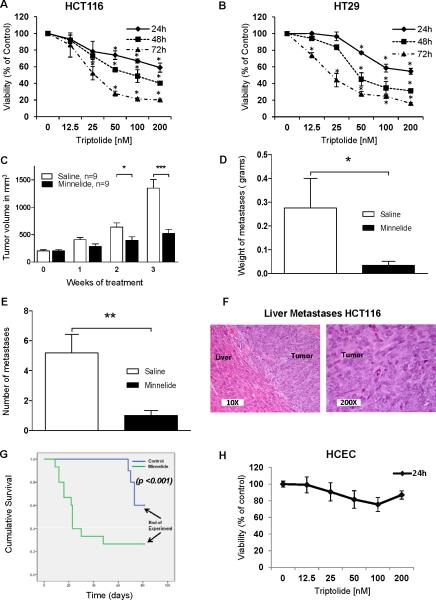
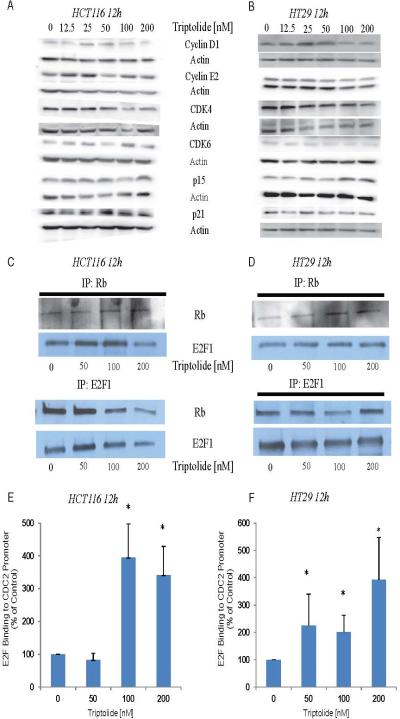
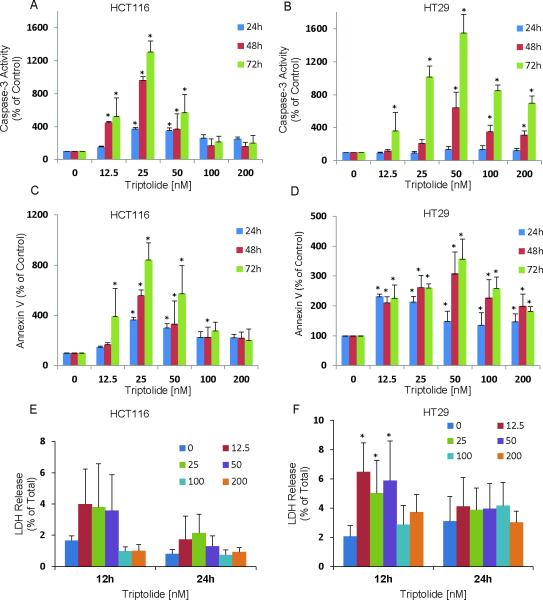
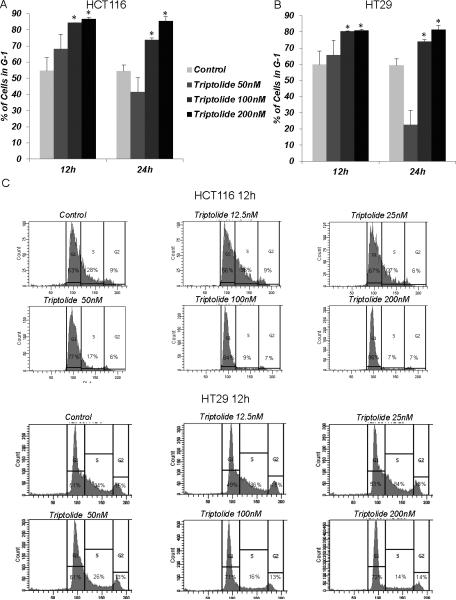
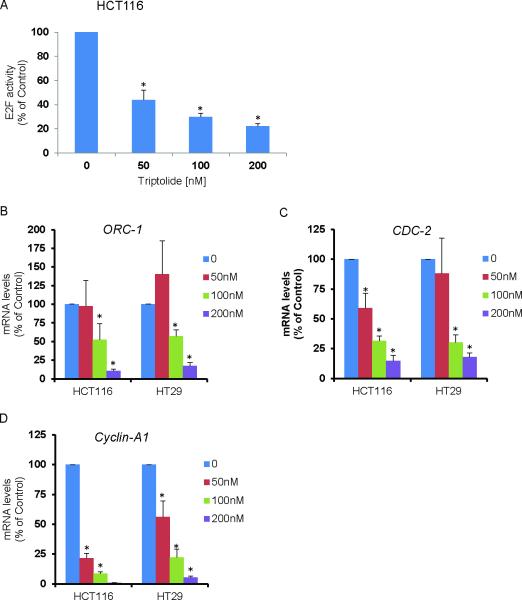
Despite significant progress in diagnostics and therapeutics, over 50 thousand patients die from colorectal cancer annually. Hence, there is urgent need for new lines of treatment. Triptolide, a natural compound isolated from the Chinese herb Tripterygium wilfordii, is effective against multiple cancers. We have synthesized a water soluble analog of triptolide, named Minnelide, which is currently in phase I trial against pancreatic cancer. The aims of the current study were to evaluate whether triptolide/Minnelide is effective against colorectal cancer and to elucidate the mechanism by which triptolide induces cell death in colorectal cancer. Efficacy of Minnelide was evaluated in subcutaneous xenograft and liver metastasis model of colorectal cancer. For mechanistic studies, colon cancer cell lines HCT116 and HT29 were treated with triptolide and the effect on viability, caspase activation, annexin positivity, lactate dehydrogenase release, and cell cycle progression was evaluated. Effect of triptolide on E2F transcriptional activity, mRNA levels of E2F-dependent genes, E2F1- retinoblastoma protein (Rb) binding, and proteins levels of regulator of G1-S transition was also measured. DNA binding of E2F1 was evaluated by chromatin immunoprecipitation assay. Triptolide decreased colon cancer cell viability in a dose- and time-dependent fashion. Minnelide markedly inhibited the growth of colon cancer in the xenograft and liver metastasis model of colon cancer and more than doubles the median survival of animals with liver metastases from colon cancer. Mechanistically, we demonstrate that at low concentrations triptolide induces apoptotic cell death but at higher concentrations it induces cell cycle arrest. Our data suggest that triptolide is able to induce G1 cell cycle arrest by inhibiting transcriptional activation of E2F1. Our data also show that triptolide downregulates E2F activity by potentially modulating events downstream of DNA binding. Therefore, we conclude that Triptolide and Minnelide are effective against colon cancer in multiple pre-clinical models.
尽管在诊断和治疗方面取得了重大进展,但每年仍有超过5万名患者死于结直肠癌。因此,迫切需要新的治疗方法。雷公藤甲素是从中药雷公藤中分离出的一种天然化合物,对多种癌症有效。我们合成了一种雷公藤甲素的水溶性类似物,名为米内立德,目前正在进行针对胰腺癌的I期试验。本研究的目的是评估雷公藤甲素/米内立德是否对结直肠癌有效,并阐明雷公藤甲素诱导结直肠癌细胞死亡的机制。在结直肠癌的皮下异种移植和肝转移模型中评估了米内立德的疗效。为了进行机制研究,用雷公藤甲素处理结肠癌细胞系HCT116和HT29,并评估其对细胞活力、半胱天冬酶激活、膜联蛋白阳性、乳酸脱氢酶释放和细胞周期进程的影响。还测定了雷公藤甲素对E2F转录活性、E2F依赖性基因的mRNA水平、E2F1-视网膜母细胞瘤蛋白(Rb)结合以及G1-S转换调节蛋白水平的影响。通过染色质免疫沉淀试验评估E2F1的DNA结合情况。雷公藤甲素以剂量和时间依赖性方式降低结肠癌细胞活力。米内立德在结肠癌的异种移植和肝转移模型中显著抑制结肠癌的生长,并使结肠癌肝转移动物的中位生存期延长一倍以上。从机制上讲,我们证明低浓度的雷公藤甲素诱导凋亡性细胞死亡,但高浓度时它诱导细胞周期停滞。我们的数据表明,雷公藤甲素能够通过抑制E2F1的转录激活来诱导G1期细胞周期停滞。我们的数据还表明,雷公藤甲素可能通过调节DNA结合下游的事件来下调E2F活性。因此,我们得出结论,雷公藤甲素和米内立德在多种临床前模型中对结肠癌有效。