Thawer Narjis G, Ngondi Jeremiah M, Mugalura Frances E, Emmanuel Isaac, Mwalimu Charles D, Morou Evangelia, Vontas John, Protopopoff Natacha, Rowland Mark, Mutagahywa Joshua, Lalji Shabbir, Molteni Fabrizio, Ramsan Mahdi M, Willilo Ritha, Wright Alexandra, Kafuko Jessica M, Ndong Isaiah, Reithinger Richard, Magesa Stephen Masingili
RTI International, Dar es Salaam, Tanzania.
Sengerema Health Institute, Sengerema, Tanzania.
Parasit Vectors. 2015 Apr 22;8:242. doi: 10.1186/s13071-015-0859-5.
Bendiocarb was introduced for the first time for Indoor Residual Spraying (IRS) in Tanzania in 2012 as part of the interim national insecticide resistance management plan. This move followed reports of increasingly alarming levels of pyrethroid resistance across the country. This study used the insecticide quantification kit (IQK) to investigate the intra-operational IRS coverage and quality of spraying, and decay rate of bendiocarb on different wall surfaces in Kagera region.
To assess intra-operational IRS coverage and quality of spraying, 104 houses were randomly selected out of 161,414 sprayed houses. A total of 509 samples (218 in Muleba and 291 in Karagwe) were obtained by scraping the insecticide samples from wall surfaces. To investigate decay rate, 66 houses (36 in Muleba and 30 in Karagwe) were selected and samples were collected monthly for a period of five months. Laboratory testing of insecticide concentration was done using IQK(TM) [Innovative Vector Control Consortium].
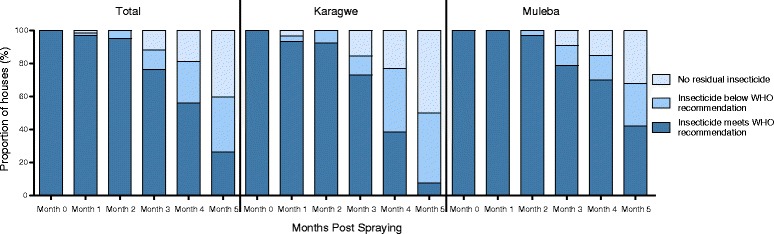
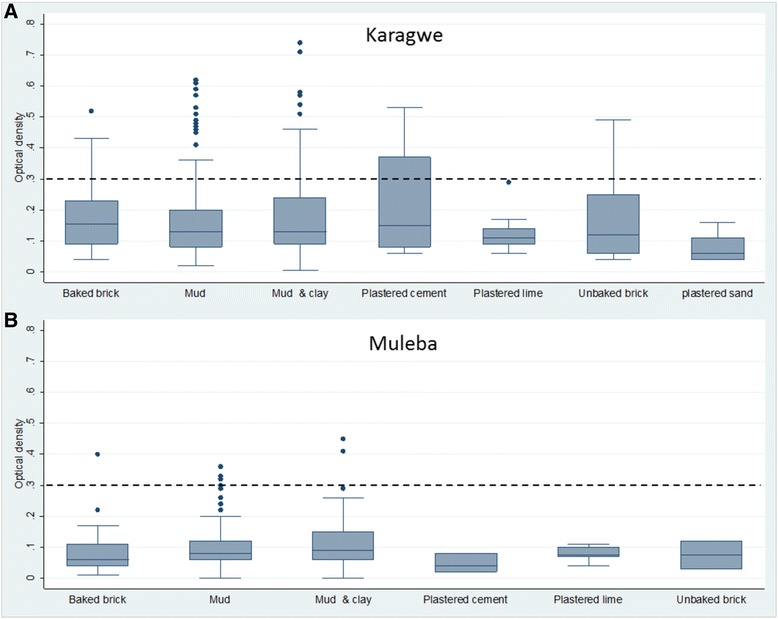
Of the 509 samples, 89.5% met the World Health Organization (WHO) recommended concentration (between 100-400 mg/m(2)) for IRS target dosage. The proportion of samples meeting WHO standards varied between Karagwe (84.3%) and Muleba (96.3%) (p < 0.001). Assessment of quality of spraying at house level revealed that Muleba (84.8%) had a significantly higher proportion of households that met the expected target dosage (100-400 mg/m(2)) compared to Karagwe (68.9%) (p < 0.001). The quality of spraying varied across different wall substrates in both districts. Evaluation of bendiocarb decay showed that the proportion of houses with recommended concentration declined from 96.9%, 93.5% and 76.2% at months one, two, and three post IRS, respectively (p-trend = 0.03). The rate of decay increased in the fourth and fifth month post spraying with only 55.9% and 26.3% houses meeting the WHO recommendations, respectively.
IQK is an important tool for assessing IRS coverage and quality of spraying. The study found adequate coverage of IRS; however, residual life of bendiocarb was observed to be three months. Results suggest that in order to maintain the recommended concentrations with bendiocarb, a second spray cycle should be carried out after three months.
2012年,作为国家杀虫剂抗性管理临时计划的一部分,恶虫威首次在坦桑尼亚用于室内滞留喷洒(IRS)。此举是在全国拟除虫菊酯抗性水平日益令人担忧的报告之后做出的。本研究使用杀虫剂定量试剂盒(IQK)调查了卡盖拉地区IRS的作业内覆盖率、喷洒质量以及恶虫威在不同墙面的衰减率。
为评估IRS的作业内覆盖率和喷洒质量,在161,414间已喷洒房屋中随机抽取104间。通过刮取墙面的杀虫剂样本,共获得509个样本(穆莱巴218个,卡拉圭291个)。为调查衰减率,选取了66间房屋(穆莱巴36间,卡拉圭30间),并在五个月的时间里每月收集样本。使用IQK(创新病媒控制联盟)对杀虫剂浓度进行实验室检测。
在509个样本中,89.5%符合世界卫生组织(WHO)推荐的IRS目标剂量浓度(100 - 400毫克/平方米)。符合WHO标准的样本比例在卡拉圭(84.3%)和穆莱巴(96.3%)之间有所不同(p < 0.001)。在房屋层面评估喷洒质量发现,与卡拉圭(68.9%)相比,穆莱巴(84.8%)达到预期目标剂量(100 - 400毫克/平方米)的家庭比例显著更高(p < 0.001)。两个地区不同墙面基底的喷洒质量各不相同。恶虫威衰减评估显示,IRS后第1、2和3个月,浓度符合推荐标准的房屋比例分别从96.9%、93.5%和76.2%下降(p趋势 = 0.03)。喷洒后第4和第5个月衰减率增加,分别只有55.9%和26.3%的房屋符合WHO建议。
IQK是评估IRS覆盖率和喷洒质量的重要工具。该研究发现IRS覆盖率充足;然而,观察到恶虫威的残留寿命为三个月。结果表明,为保持恶虫威的推荐浓度,应在三个月后进行第二轮喷洒。