Department of Vector Biology and Control, Rajendra Memorial Research Institute of Medical Sciences (ICMR), Agamkuan, Patna, Bihar, India.
Department of Microbiology, All India Institute of Medical Sciences, Patna, Bihar, India.
PLoS Negl Trop Dis. 2020 May 4;14(5):e0008254. doi: 10.1371/journal.pntd.0008254. eCollection 2020 May.
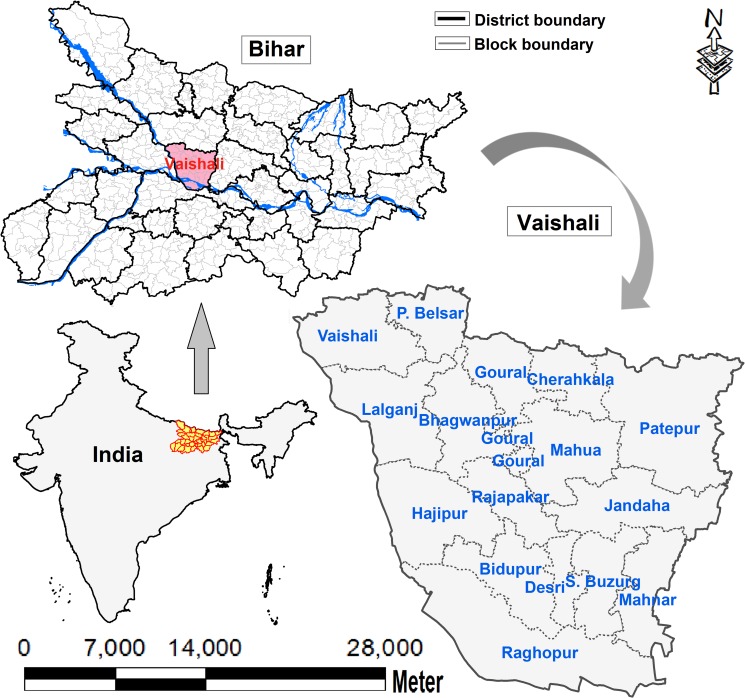
Visceral leishmaniasis (VL) or Kala-azar has been a major public health problem in Bihar, India, for several decades. A few VL infected districts including Vaishali have reported >600 cases annually. Hence, in 2015, the Government of India entrusted ICMR-Rajendra Memorial Research Institute of Medical Sciences, Patna, to implement an integrated control strategy for achieving the VL elimination target (<1 case per 10,000 people at the block level) in the Vaishali District of Bihar.
This study was conducted between January 2015 and December 2016. An integrated control strategy including the spatio-temporal mapping of VL-case distribution, active case detection, chemical-based vector control using indoor residual spraying (IRS), community awareness campaigns, the training of IRS members, the training of medical doctors for effective treatment, daily monitoring and the supervision of IRS activities, logistic management, post-IRS quality assurance, epidemiological surveillance, and entomological monitoring was performed. An insecticide quantification test was performed for evaluating the IRS quality on sprayed walls. A modern compression pump was used to maintain spray quality on different wall surfaces. The impact of IRS was assessed through sand fly collection in human dwellings and cattle sheds in pre- and post-IRS. The insecticide susceptibility of local P. argentipes was performed before each IRS round (in February and June) during 2015-2016. Statistical analysis such as the mean, percentage, and 95% CI were used to summarize the results.
All 16 blocks of the Vaishali District achieved the VL elimination target in 2016. The integrated VL control strategy helped reduce the number of VL cases from 664 in 2014 to 163 in 2016 and the number of endemic villages from 282 in 2014 to 142 in 2016. The case reduction rate was increased from 22.6% in 2014 to 58.8% in 2016. On average, 74 VL infected villages became Kala-azar free each year from 2015 to 2016.
The results of this study suggest that the elimination of VL is possible from all endemic blocks of Bihar if the integrated Vaishali VL control strategy is applied under strong monitoring and supervision.
内脏利什曼病(VL)或黑热病在印度比哈尔邦已存在数十年,是一个主要的公共卫生问题。包括瓦伊沙利在内的少数几个 VL 感染区每年报告超过 600 例病例。因此,2015 年,印度政府委托 ICMR-Rajendra Memorial 医学科学研究所在比哈尔邦的瓦伊沙利区实施综合控制战略,以实现 VL 消除目标(在街区层面,每 10000 人<1 例)。
本研究于 2015 年 1 月至 2016 年 12 月进行。采用综合控制策略,包括 VL 病例分布的时空映射、主动病例检测、使用室内滞留喷洒(IRS)的化学媒介控制、社区宣传活动、IRS 成员培训、医生培训以进行有效治疗、每日监测和 IRS 活动监督、后勤管理、IRS 后质量保证、流行病学监测和昆虫学监测。进行了杀虫剂定量测试,以评估喷洒墙壁上的 IRS 质量。使用现代压缩泵在不同的墙壁表面上保持喷雾质量。通过在 IRS 前后在居民住宅和牛棚中收集沙蝇来评估 IRS 的影响。在 2015-2016 年期间,在每次 IRS 回合(2 月和 6 月)之前,对当地 P. argentipes 的杀虫剂敏感性进行了测试。使用平均值、百分比和 95%置信区间等统计分析来总结结果。
瓦伊沙利区的 16 个街区均在 2016 年达到 VL 消除目标。综合 VL 控制策略有助于将 2014 年的 VL 病例数从 664 例减少到 2016 年的 163 例,将地方性村庄数量从 2014 年的 282 个减少到 2016 年的 142 个。病例减少率从 2014 年的 22.6%增加到 2016 年的 58.8%。2015 年至 2016 年,平均每年有 74 个 VL 感染村庄摆脱黑热病。
本研究结果表明,如果在强有力的监测和监督下应用综合瓦伊沙利 VL 控制策略,则有可能从比哈尔邦的所有地方性疫区消除 VL。