Matza Louis S, Stewart Katie D, Gandra Shravanthi R, Delio Philip R, Fenster Brett E, Davies Evan W, Jordan Jessica B, Lothgren Mickael, Feeny David H
Outcomes Research, Evidera, 7101 Wisconsin Avenue, Suite 1400, Bethesda, MD, USA.
Global Health Economics, Amgen Inc, One Amgen Center Drive, Thousand Oaks, CA, USA.
BMC Health Serv Res. 2015 Apr 22;15:173. doi: 10.1186/s12913-015-0772-9.
Cost-utility models are frequently used to compare treatments intended to prevent or delay the onset of cardiovascular events. Most published utilities represent post-event health states without incorporating the disutility of the event or reporting the time between the event and utility assessment. Therefore, this study estimated health state utilities representing cardiovascular conditions while distinguishing between acute impact including the cardiovascular event and the chronic post-event impact.
Health states were drafted and refined based on literature review, clinician interviews, and a pilot study. Three cardiovascular conditions were described: stroke, acute coronary syndrome (ACS), and heart failure. One-year acute health states represented the event and its immediate impact, and post-event health states represented chronic impact. UK general population respondents valued the health states in time trade-off tasks with time horizons of one year for acute states and ten years for chronic states.
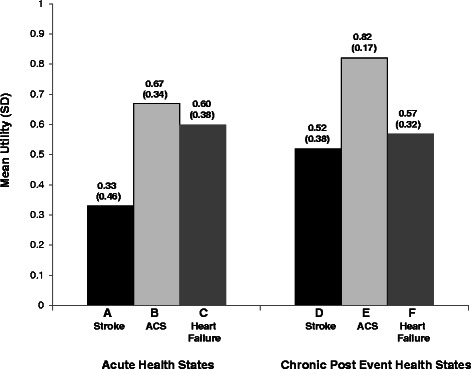
A total of 200 participants completed interviews (55% female; mean age = 46.6 y). Among acute health states, stroke had the lowest utility (0.33), followed by heart failure (0.60) and ACS (0.67). Utility scores for chronic health states followed the same pattern: stroke (0.52), heart failure (0.57), and ACS (0.82). For stroke and ACS, acute utilities were significantly lower than chronic post-event utilities (difference = 0.20 and 0.15, respectively; both p < 0.0001).
Results add to previously published utilities for cardiovascular events by distinguishing between chronic post-event health states and acute health states that include the event and its immediate impact. Findings suggest that acute versus chronic impact should be considered when selecting scores for use in cost-utility models. Thus, the current utilities provide a unique option that may be used to represent the acute and chronic impact of cardiovascular conditions in economic models comparing treatments that may delay or prevent the onset of cardiovascular events.
成本效用模型经常用于比较旨在预防或延缓心血管事件发生的治疗方法。大多数已发表的效用值代表事件发生后的健康状态,未纳入事件的负效用,也未报告事件与效用评估之间的时间间隔。因此,本研究估计了代表心血管疾病的健康状态效用值,同时区分了包括心血管事件在内的急性影响和事件发生后的慢性影响。
基于文献综述、临床医生访谈和一项试点研究,起草并完善了健康状态。描述了三种心血管疾病:中风、急性冠状动脉综合征(ACS)和心力衰竭。一年期急性健康状态代表事件及其直接影响,事件发生后的健康状态代表慢性影响。英国普通人群受访者在时间权衡任务中对健康状态进行估值,急性状态的时间跨度为一年,慢性状态的时间跨度为十年。
共有200名参与者完成了访谈(55%为女性;平均年龄=46.6岁)。在急性健康状态中,中风的效用值最低(0.33),其次是心力衰竭(0.60)和ACS(0.67)。慢性健康状态的效用得分遵循相同模式:中风(0.52)、心力衰竭(0.57)和ACS(0.82)。对于中风和ACS,急性效用值显著低于事件发生后的慢性效用值(差异分别为0.20和0.15;p均<0.0001)。
通过区分事件发生后的慢性健康状态和包括事件及其直接影响的急性健康状态,本研究结果补充了先前发表的心血管事件效用值。研究结果表明,在选择用于成本效用模型的得分时应考虑急性与慢性影响。因此,当前的效用值提供了一种独特的选择,可用于在比较可能延缓或预防心血管事件发生的治疗方法的经济模型中代表心血管疾病的急性和慢性影响。