Bloom Ryan J, Winkler Sally M, Smolke Christina D
Department of Bioengineering, Stanford University, 443 Via Ortega, MC 4245, Stanford, CA 94305 USA.
J Biol Eng. 2015 Apr 14;9:5. doi: 10.1186/s13036-015-0002-3. eCollection 2015.
Homeostasis within mammalian cells is achieved through complex molecular networks that can respond to changes within the cell or the environment and regulate the expression of the appropriate genes in response. The development of biological components that can respond to changes in the cellular environment and interface with endogenous molecules would enable more sophisticated genetic circuits and greatly advance our cellular engineering capabilities.
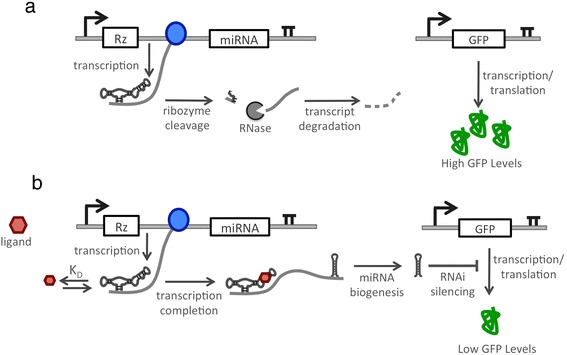
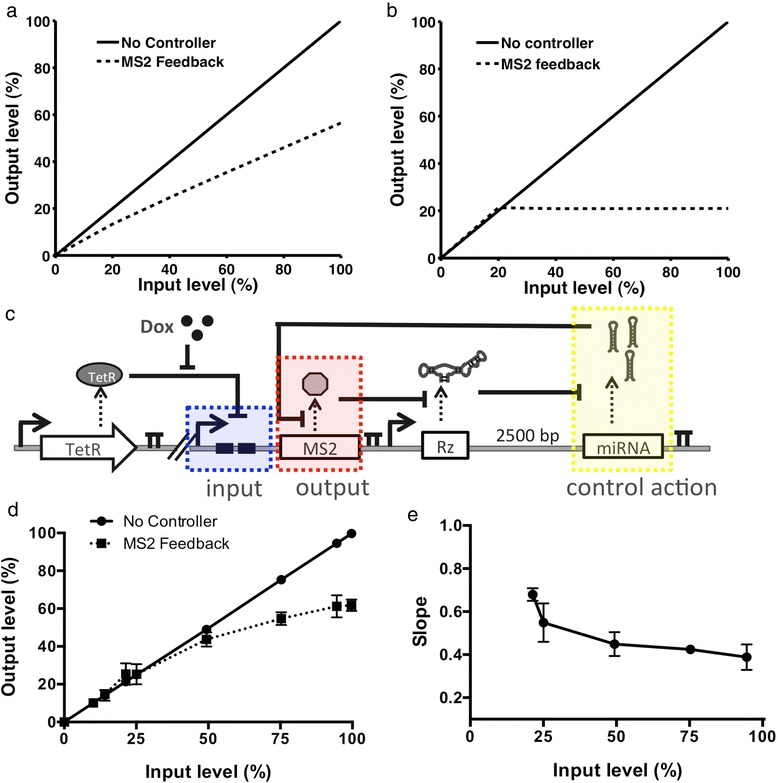
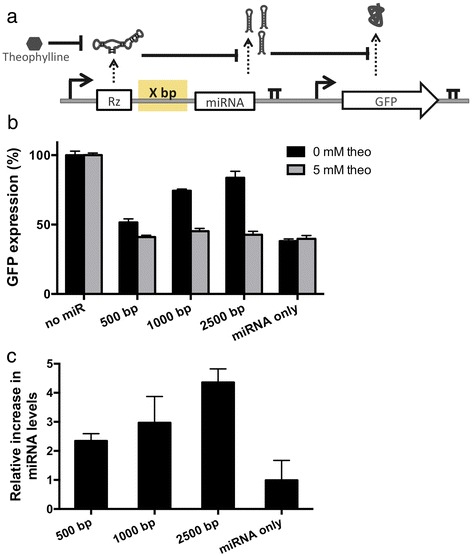
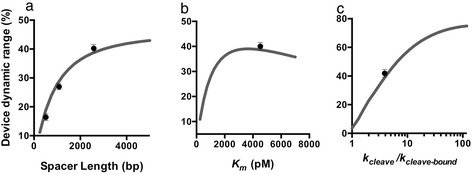
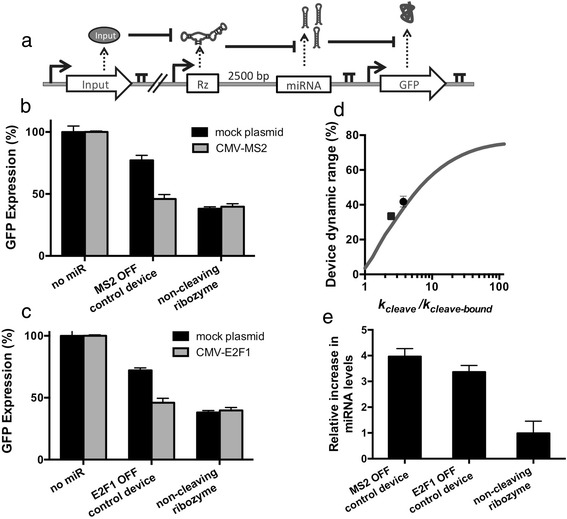
Here we describe a platform that combines a ligand-responsive ribozyme switch and synthetic miRNA regulators to create an OFF genetic control device based on RNA interference (RNAi). We developed a mathematical model to highlight important design parameters in programming the quantitative performance of RNAi-based OFF control devices. By modifying the ribozyme switch integrated into the system, we demonstrated RNAi-based OFF control devices that respond to small molecule and protein ligands, including the oncogenic protein E2F1. We utilized the OFF control device platform to build a negative feedback control system that acts as a proportional controller and maintains target intracellular protein levels in response to increases in transcription rate.
Our work describes a novel genetic device that increases the level of silencing from a miRNA in the presence of a ligand of interest, effectively creating an RNAi-based OFF control device. The OFF switch platform has the flexibility to be used to respond to both small molecule and protein ligands. Finally, the RNAi-based OFF switch can be used to implement a negative feedback control system, which maintains target protein levels around a set point level. The described RNAi-based OFF control device presents a powerful tool that will enable researchers to engineer homeostasis in mammalian cells.
哺乳动物细胞内的稳态是通过复杂的分子网络实现的,这些网络能够响应细胞内或环境中的变化,并相应地调节适当基因的表达。开发能够响应细胞环境变化并与内源性分子相互作用的生物组件,将使更复杂的遗传电路成为可能,并极大地提升我们的细胞工程能力。
在此,我们描述了一个平台,该平台结合了配体响应性核酶开关和合成微小RNA(miRNA)调节剂,以创建基于RNA干扰(RNAi)的关闭型遗传控制装置。我们开发了一个数学模型,以突出在对基于RNAi的关闭型控制装置的定量性能进行编程时的重要设计参数。通过修改整合到系统中的核酶开关,我们展示了能够响应小分子和蛋白质配体(包括致癌蛋白E2F1)的基于RNAi的关闭型控制装置。我们利用该关闭型控制装置平台构建了一个负反馈控制系统,该系统作为比例控制器,可响应转录速率的增加来维持目标细胞内蛋白质水平。
我们的工作描述了一种新型遗传装置,该装置在存在感兴趣的配体时可提高miRNA的沉默水平,有效地创建了基于RNAi的关闭型控制装置。该关闭型开关平台具有灵活性,可用于响应小分子和蛋白质配体。最后,基于RNAi的关闭型开关可用于实现负反馈控制系统,该系统可将目标蛋白质水平维持在设定点水平附近。所描述的基于RNAi的关闭型控制装置提供了一个强大的工具,将使研究人员能够在哺乳动物细胞中设计稳态。