Zheng Zhong, Liu Bingya, Wu Xiaohua
Department of Gynecologic Oncology, Fudan University Shanghai Cancer Center, Department of Oncology, Shanghai Medical College, Fudan University, 270 Dongan Road, Shanghai, 200032 People's Republic of China.
Department of Surgery, Shanghai Key Laboratory of Gastric Neoplasms, Shanghai Institute of Digestive Surgery, and Gastroenterology, Ruijin Hospital, Jiaotong University School of Medicine, Shanghai, China.
Cancer Cell Int. 2015 Apr 15;15:41. doi: 10.1186/s12935-015-0190-4. eCollection 2015.
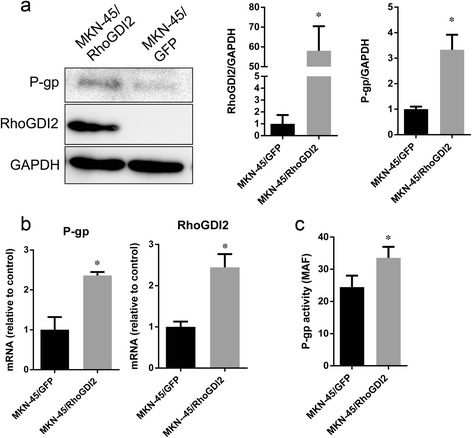
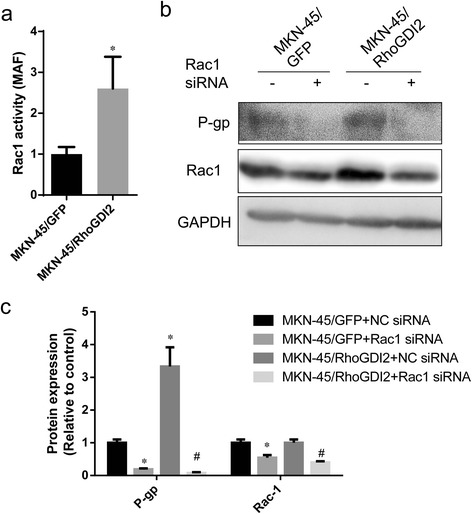
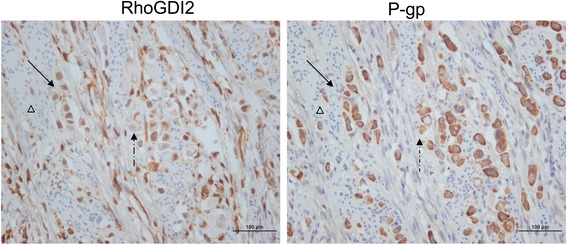
Multidrug resistance (MDR) is a major clinical obstacle in treatment of gastric cancer. Previously, using 2D electrophoresis-mass spectrometry, we identified RhoGDI2 as a contributor to 5-FU resistance in colon cancer cells, and also confer gastric cancer cells resistance to 5-FU. Here, we reported RhoGDI2 also induced MDR in gastric cancer cell line (MKN-45). To explore the underlining mechanism, we detected the mRNA, protein expression, activity of P-glycoprotein (P-gp) in MKN-45 stably transfected with RhoGDI2 expressing or control vector. All the mRNA, protein level, activity were increased by 130%, 230%, 35% respectively after ectopic expression of RhoGDI2. RhoGDI2 was correlated with P-gp expression in gastric cancer tissues as detected by immunohistochemistry. To further study how RhoGDI2 up-regulates P-gp expression, we tested the activity of Rac1 in MKN-45/RhoGDI2 and MKN-45/GFP. Ectopic expression of RhoGDI2 increased Rac1 activity (P < 0.05). For more important, silencing of Rac1 expression by siRNA decreased P-gp expression to undetectable level. Overall, these findings suggest that RhoGDI2 up-regulates P-gp expression via Rac1 to induce MDR.
多药耐药(MDR)是胃癌治疗中的一个主要临床障碍。此前,我们通过二维电泳-质谱法鉴定出RhoGDI2是结肠癌细胞对5-氟尿嘧啶(5-FU)耐药的一个促成因素,并且它也赋予胃癌细胞对5-FU的耐药性。在此,我们报道RhoGDI2还能诱导胃癌细胞系(MKN-45)产生多药耐药。为了探究其潜在机制,我们检测了稳定转染了表达RhoGDI2的载体或对照载体的MKN-45细胞中P-糖蛋白(P-gp)的mRNA、蛋白表达及活性。RhoGDI2异位表达后,所有的mRNA、蛋白水平及活性分别增加了130%、230%、35%。免疫组织化学检测显示,RhoGDI2与胃癌组织中P-gp的表达相关。为了进一步研究RhoGDI2如何上调P-gp的表达,我们检测了MKN-45/RhoGDI2和MKN-45/GFP细胞中Rac1的活性。RhoGDI2异位表达增加了Rac1的活性(P < 0.05)。更重要的是,通过小干扰RNA(siRNA)沉默Rac1的表达可使P-gp表达降低至检测不到的水平。总体而言,这些发现表明RhoGDI2通过Rac1上调P-gp的表达从而诱导多药耐药。