Kierny Michael R, Cunningham Thomas D, Bouhenni Rachida A, Edward Deepak P, Kay Brian K
Department of Biological Sciences, University of Illinois at Chicago (UIC), 845 W. Taylor St, 3240 SES-MC 066, Chicago, IL 60607-7060, United States of America.
PLoS One. 2015 Apr 22;10(4):e0124492. doi: 10.1371/journal.pone.0124492. eCollection 2015.
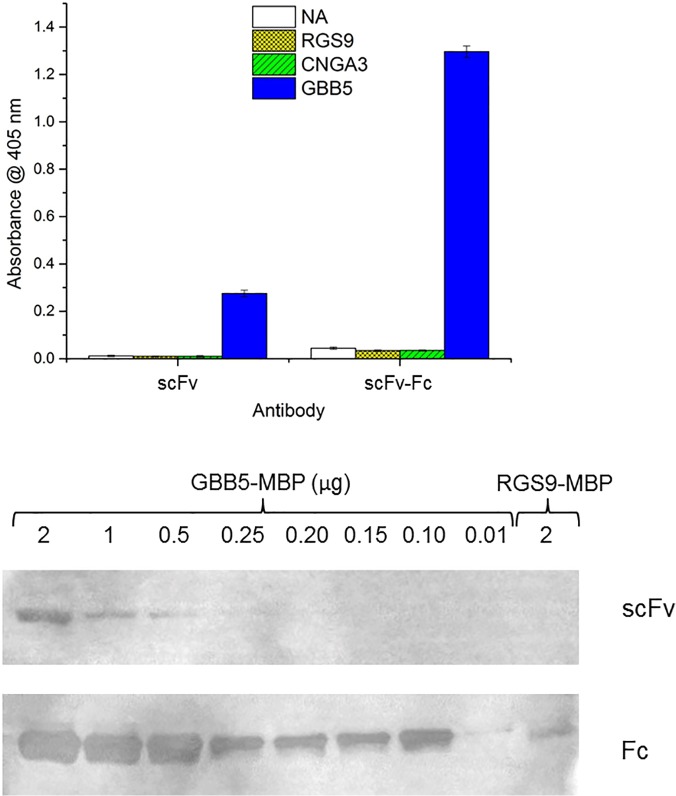
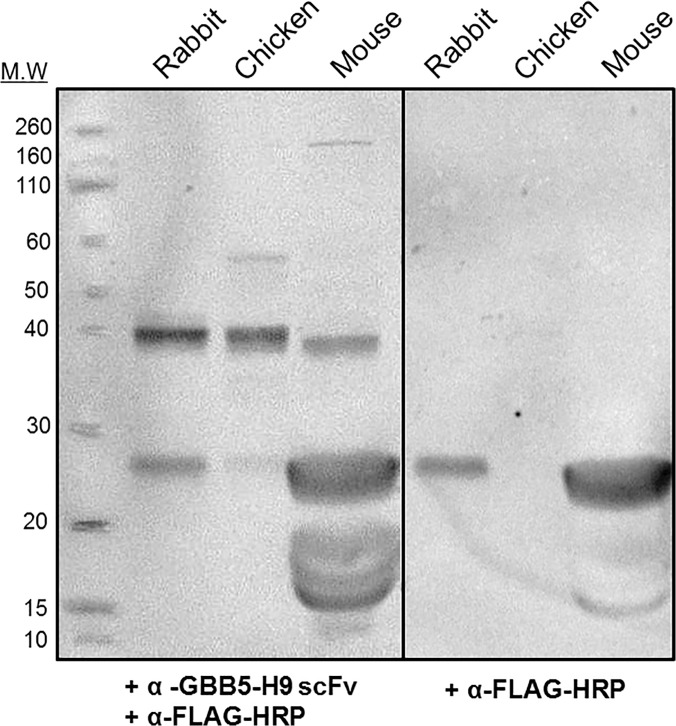
Candidate biomarkers, indicative of disease or injury, are beginning to overwhelm the process of validation through immunological means. Recombinant antibodies developed through phage-display offer an alternative means of generating monoclonal antibodies faster than traditional immunization of animals. Peptide segments of putative biomarkers of laser induced injury in the rabbit, discovered through mass spectrometry, were used as targets for a selection against a library of phage-displayed human single-chain variable fragment (scFv) antibodies. Highly specific antibodies were isolated to four of these unique peptide sequences. One antibody against the retinal protein, Guanine Nucleotide-Binding Protein Beta 5 (GBB5), had a dissociation constant ~300 nM and recognized the full-length endogenous protein in retinal homogenates of three different animal species by western blot. Alanine scanning of the peptide target identified three charged and one hydrophobic amino acid as the critical binding residues for two different scFvs. To enhance the utility of the reagent, one scFv was dimerized through a Fragment-crystallizable hinge region (i.e., Fc) and expressed in HEK-293 cells. This dimeric reagent yielded a 25-fold lower detection limit in western blots.
指示疾病或损伤的候选生物标志物正开始使通过免疫学手段进行验证的过程不堪重负。通过噬菌体展示开发的重组抗体提供了一种比传统动物免疫更快地产生单克隆抗体的替代方法。通过质谱法发现的兔激光诱导损伤的假定生物标志物的肽段,被用作针对噬菌体展示的人单链可变片段(scFv)抗体文库进行筛选的靶标。针对其中四个独特肽序列分离出了高度特异性抗体。一种针对视网膜蛋白鸟嘌呤核苷酸结合蛋白β5(GBB5)的抗体,其解离常数约为300 nM,并通过蛋白质印迹法在三种不同动物物种的视网膜匀浆中识别全长内源性蛋白。对肽靶标的丙氨酸扫描确定了三个带电荷和一个疏水氨基酸是两种不同scFv的关键结合残基。为了提高该试剂的实用性,一种scFv通过可结晶片段铰链区(即Fc)二聚化并在HEK-293细胞中表达。这种二聚体试剂在蛋白质印迹中的检测限降低了25倍。