Li Wencheng, You Bei, Hoque Mainul, Zheng Dinghai, Luo Wenting, Ji Zhe, Park Ji Yeon, Gunderson Samuel I, Kalsotra Auinash, Manley James L, Tian Bin
Department of Microbiology, Biochemistry and Molecular Genetics, Rutgers New Jersey Medical School, Newark, New Jersey, United States of America; Rutgers Cancer Institute of New Jersey, Newark, New Jersey, United States of America.
Department of Microbiology, Biochemistry and Molecular Genetics, Rutgers New Jersey Medical School, Newark, New Jersey, United States of America.
PLoS Genet. 2015 Apr 23;11(4):e1005166. doi: 10.1371/journal.pgen.1005166. eCollection 2015 Apr.
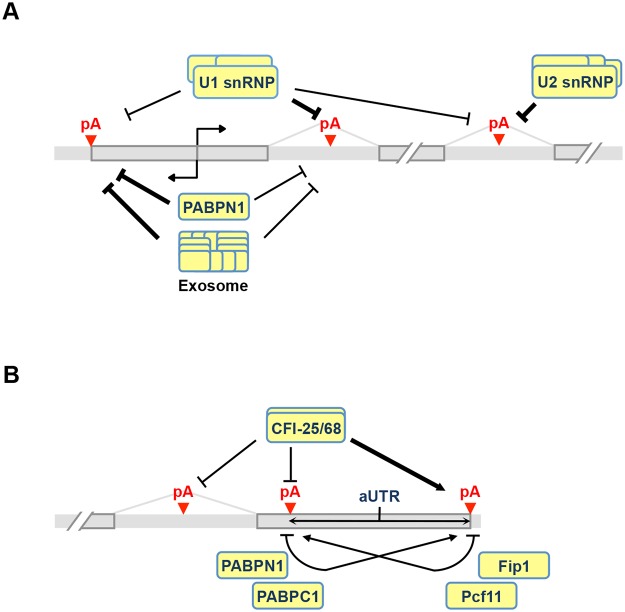
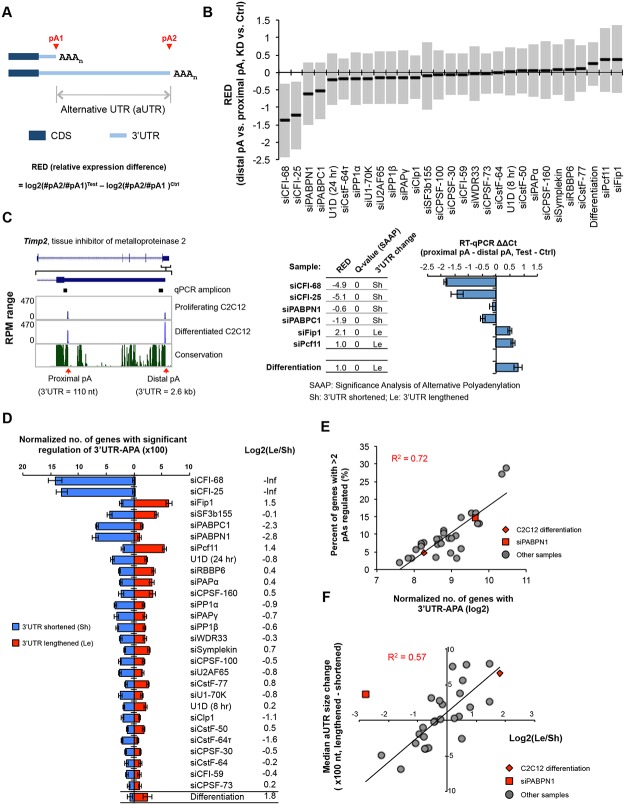
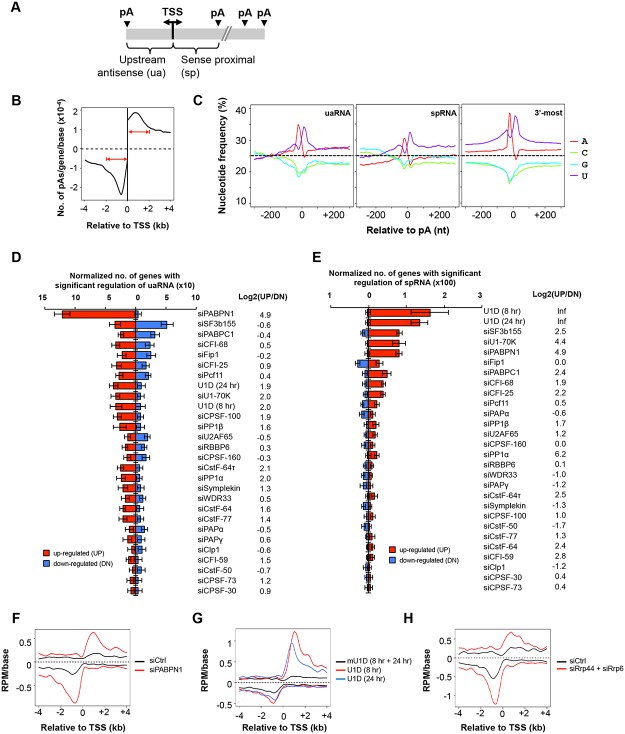
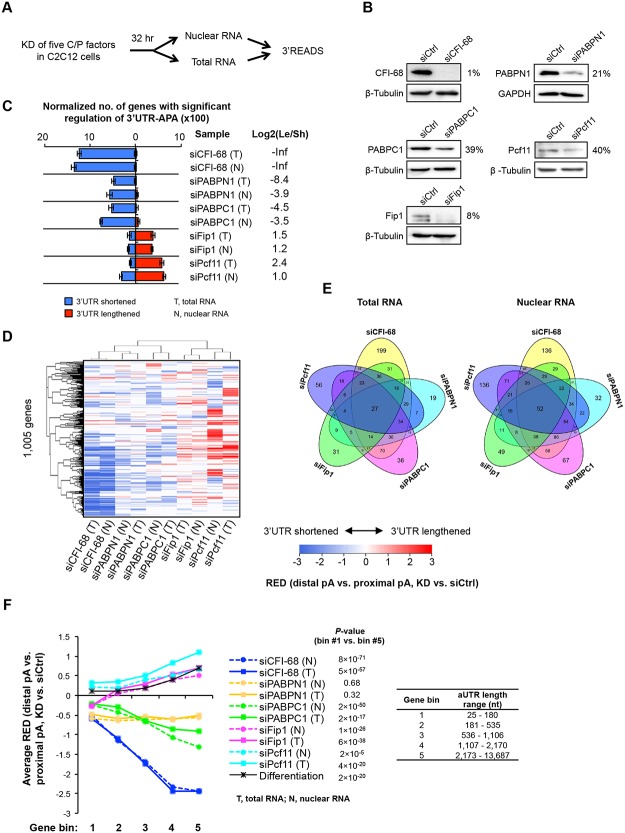
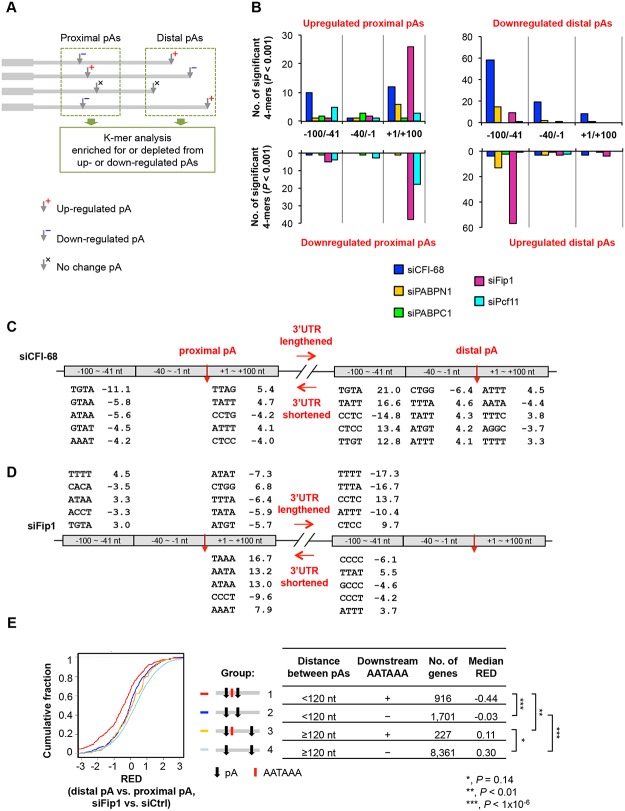
Alternative cleavage and polyadenylation (APA) results in mRNA isoforms containing different 3' untranslated regions (3'UTRs) and/or coding sequences. How core cleavage/polyadenylation (C/P) factors regulate APA is not well understood. Using siRNA knockdown coupled with deep sequencing, we found that several C/P factors can play significant roles in 3'UTR-APA. Whereas Pcf11 and Fip1 enhance usage of proximal poly(A) sites (pAs), CFI-25/68, PABPN1 and PABPC1 promote usage of distal pAs. Strong cis element biases were found for pAs regulated by CFI-25/68 or Fip1, and the distance between pAs plays an important role in APA regulation. In addition, intronic pAs are substantially regulated by splicing factors, with U1 mostly inhibiting C/P events in introns near the 5' end of gene and U2 suppressing those in introns with features for efficient splicing. Furthermore, PABPN1 inhibits expression of transcripts with pAs near the transcription start site (TSS), a property possibly related to its role in RNA degradation. Finally, we found that groups of APA events regulated by C/P factors are also modulated in cell differentiation and development with distinct trends. Together, our results support an APA code where an APA event in a given cellular context is regulated by a number of parameters, including relative location to the TSS, splicing context, distance between competing pAs, surrounding cis elements and concentrations of core C/P factors.
可变切割与多聚腺苷酸化(APA)会产生包含不同3'非翻译区(3'UTR)和/或编码序列的mRNA异构体。核心切割/多聚腺苷酸化(C/P)因子如何调控APA尚不清楚。通过将小干扰RNA(siRNA)敲低与深度测序相结合,我们发现几个C/P因子在3'UTR-APA中发挥重要作用。Pcf11和Fip1增强近端多聚腺苷酸化位点(pA)的使用,而CFI-25/68、PABPN1和PABPC1则促进远端pA的使用。对于受CFI-25/68或Fip1调控的pA,发现了强烈的顺式元件偏好,并且pA之间的距离在APA调控中起重要作用。此外,内含子pA受剪接因子的显著调控,U1大多抑制基因5'端附近内含子中的C/P事件,而U2抑制具有高效剪接特征的内含子中的此类事件。此外,PABPN1抑制转录起始位点(TSS)附近有pA的转录本的表达,这一特性可能与其在RNA降解中的作用有关。最后,我们发现受C/P因子调控的APA事件组在细胞分化和发育过程中也有不同趋势的调节。总之,我们的结果支持一种APA编码,即在给定的细胞环境中,一个APA事件受多个参数调控,包括相对于TSS的相对位置、剪接环境、竞争性pA之间的距离、周围的顺式元件以及核心C/P因子的浓度。