Kawahara Shinya, Okazaki Ken, Matsuda Shuichi, Nakahara Hiroyuki, Okamoto Shigetoshi, Iwamoto Yukihide
Department of Orthopaedic Surgery, Graduate School of Medical Sciences, Kyushu University, 3-1-1 Maidashi, Higashi-ku, Fukuoka, 812-8582, Japan.
Department of Orthopaedic Surgery, Kyoto University Graduate School of Medicine, 54 Kawahara-cho, Shogoin, Sakyo, Kyoto, 606-8507, Japan.
J Orthop Surg Res. 2015 Apr 25;10:54. doi: 10.1186/s13018-015-0197-5.
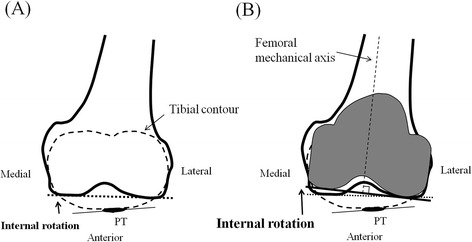
The configuration of the distal surface of the femur would be more important in terms of the patellofemoral (PF) joint contact because the patella generally contacts with the distal surface of the femur in knee flexion. Some total knee arthroplasty (TKA) designs configurate medially prominent asymmetric femoral condyles. This difference in the design of distal femoral condyle may affect the PF joint congruity in knee flexion. Furthermore, some surgeons advocate a concept aligning the symmetric components parallel to the native joint inclination, not perpendicular to the mechanical axis. This concept would also make a difference on the PF joint congruity at the distal femur in knee flexion. However, no fundamental study has been reported on the PF congruity at the distal femur to discuss the theoretical priority of these concepts. The current study investigated the angular relationship between the tibial attachment of the patellar tendon and the distal surface of the femur at 90° of flexion in normal knees.
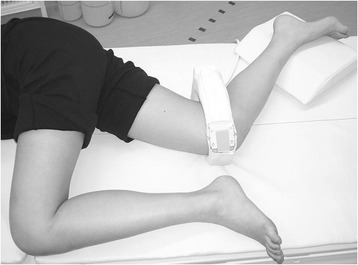
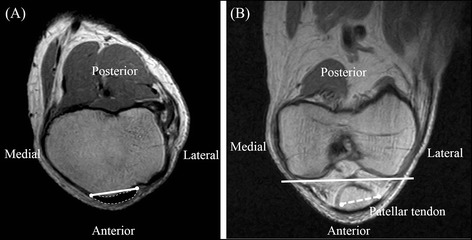
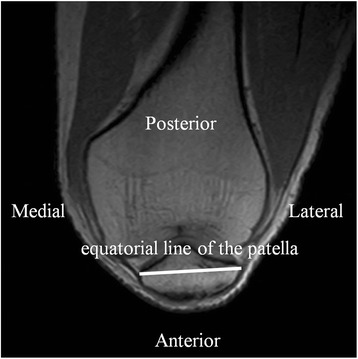
The open magnetic resonance images of 45 normal knees at 90° of flexion were used to measure the angles between the tibial attachment of the patellar tendon, the equatorial line of the patella, and the distal surface of femoral condyles.
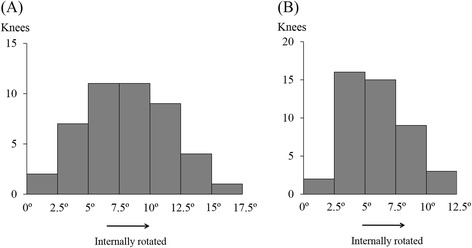
The distal surface of femoral condyles was internally rotated relative to the tibial attachment of the patellar tendon and the equatorial line of the patella in all the knees (8.2° ± 3.5° and 5.8° ± 2.5°, respectively), not parallel.
Distal femoral condyle is internally rotated to the patellar tendon at 90° of flexion in normal knees. When the symmetric femoral component is aligned perpendicular to the femoral mechanical axis, the patellar tendon would be possibly more twisted than the condition in normal knees, and the deviation of the PF contact force on the patellar component might be caused. The configuration and alignment of the distal condyle of the femoral component can affect the PF joint congruity in knee flexion. In this respect, our results provide important information in considering designs and alignment in the distal femur of TKA and the PF joint congruity in knee flexion.
就髌股(PF)关节接触而言,股骨远端表面的形态更为重要,因为在膝关节屈曲时髌骨通常与股骨远端表面接触。一些全膝关节置换术(TKA)设计采用内侧突出的不对称股骨髁。股骨远端髁设计的这种差异可能会影响膝关节屈曲时PF关节的一致性。此外,一些外科医生主张一种将对称部件与天然关节倾斜度平行对齐的概念,而非垂直于机械轴。这一概念也会对膝关节屈曲时股骨远端的PF关节一致性产生影响。然而,尚未有关于股骨远端PF一致性的基础研究报告来探讨这些概念的理论优先性。本研究调查了正常膝关节在屈曲90°时髌腱胫骨附着点与股骨远端表面之间的角度关系。
使用45个正常膝关节在屈曲90°时的开放式磁共振图像,测量髌腱胫骨附着点、髌骨赤道线与股骨髁远端表面之间的角度。
在所有膝关节中,股骨髁远端表面相对于髌腱胫骨附着点和髌骨赤道线均向内旋转(分别为8.2°±3.5°和5.8°±2.5°),并非平行。
在正常膝关节中,屈曲90°时股骨远端髁相对于髌腱向内旋转。当对称股骨部件垂直于股骨机械轴对齐时,髌腱可能比正常膝关节状态下扭转得更厉害,并且可能导致PF接触力在髌骨部件上的偏差。股骨部件远端髁的形态和对齐方式会影响膝关节屈曲时PF关节的一致性。在这方面,我们的结果为考虑TKA股骨远端的设计和对齐以及膝关节屈曲时PF关节的一致性提供了重要信息。