Hladik Wolfgang, Benech Irene, Bateganya Moses, Hakim Avi J
Division of Global HIV/AIDS, Center for Global Health, Centers for Disease Control and Prevention, Atlanta, GA, USA
Division of Global HIV/AIDS, Center for Global Health, Centers for Disease Control and Prevention, Atlanta, GA, USA.
Int J STD AIDS. 2016 Jan;27(1):5-12. doi: 10.1177/0956462415581728. Epub 2015 Apr 23.
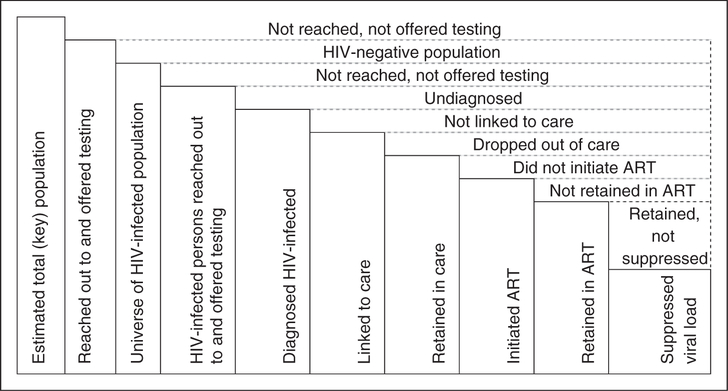
Monitoring the cascade or continuum of HIV services - ranging from outreach services to anti-retroviral treatment - has become increasingly important as the focus in prevention moves toward biomedical interventions, in particular, 'Treatment as Prevention.' The HIV continuum typically utilises clinic-based care and treatment monitoring data and helps identify gaps and inform programme improvements. This paper discusses the merits of a population-based survey-informed continuum of services. Surveys provide individual-level, population-based data by sampling persons both in and outside the continuum, which facilitate the estimation of population fractions, such as the proportion of people living with HIV in care, as well as the examination of determinants for being in or outside the continuum. Survey-informed cascades of services may especially benefit key populations at increased risk for HIV infection for who social marginalisation, criminalisation, and stigma result in barriers to access and retention in services, a low social visibility, mobility, and outreach-based services can compromise clinic-based monitoring. Adding CD4+ T-cell count and viral load measurements to such surveys may provide population-level information on viral load suppression, stage of disease, treatment needs, and population-level transmission potential. While routine clinic-based reporting will remain the mainstay of monitoring, a survey-informed service cascade can address some of its limitations and offer additional insights.
随着预防重点转向生物医学干预措施,特别是“治疗即预防”,监测从外展服务到抗逆转录病毒治疗的艾滋病病毒服务级联或连续过程变得越来越重要。艾滋病病毒连续过程通常利用基于诊所的护理和治疗监测数据,并有助于找出差距并为项目改进提供信息。本文讨论了基于人群调查的服务连续过程的优点。调查通过对连续过程内外的人员进行抽样,提供基于个体层面和人群的数据,这有助于估计人群比例,例如接受护理的艾滋病病毒感染者比例,以及对处于连续过程内或外的决定因素进行检查。基于调查的服务级联可能对艾滋病病毒感染风险增加的关键人群特别有益,因为社会边缘化、定罪和污名化导致他们在获得和保留服务方面存在障碍,较低的社会能见度、流动性以及基于外展的服务可能会影响基于诊所的监测。在此类调查中增加CD4+T细胞计数和病毒载量测量,可能会提供有关病毒载量抑制、疾病阶段、治疗需求和人群传播潜力的人群层面信息。虽然基于诊所的常规报告仍将是监测的主要方式,但基于调查的服务级联可以解决其一些局限性并提供更多见解。