Kuasne Hellen, Cólus Ilce Mara de Syllos, Busso Ariane Fidelis, Hernandez-Vargas Hector, Barros-Filho Mateus Camargo, Marchi Fabio Albuquerque, Scapulatempo-Neto Cristovam, Faria Eliney Ferreira, Lopes Ademar, Guimarães Gustavo Cardoso, Herceg Zdenko, Rogatto Silvia Regina
CIPE - International Research Center, AC Camargo Cancer Center, Rua Taguá, 440, CEP: 01508-010, Liberdade, São Paulo, SP Brazil ; Department of Biology, Londrina State University, Londrina, PR Brazil.
Department of Biology, Londrina State University, Londrina, PR Brazil.
Clin Epigenetics. 2015 Apr 18;7(1):46. doi: 10.1186/s13148-015-0082-4. eCollection 2015.
Despite penile carcinoma (PeCa) being a relatively rare neoplasm, it remains an important public health issue for poor and developing countries. Contrary to most tumors, limited data are available for markers that are capable of assisting in diagnosis, prognosis, and treatment of PeCa. We aimed to identify molecular markers for PeCa by evaluating their epigenomic and transcriptome profiles and comparing them with surrounding non-malignant tissue (SNT) and normal glans (NG).
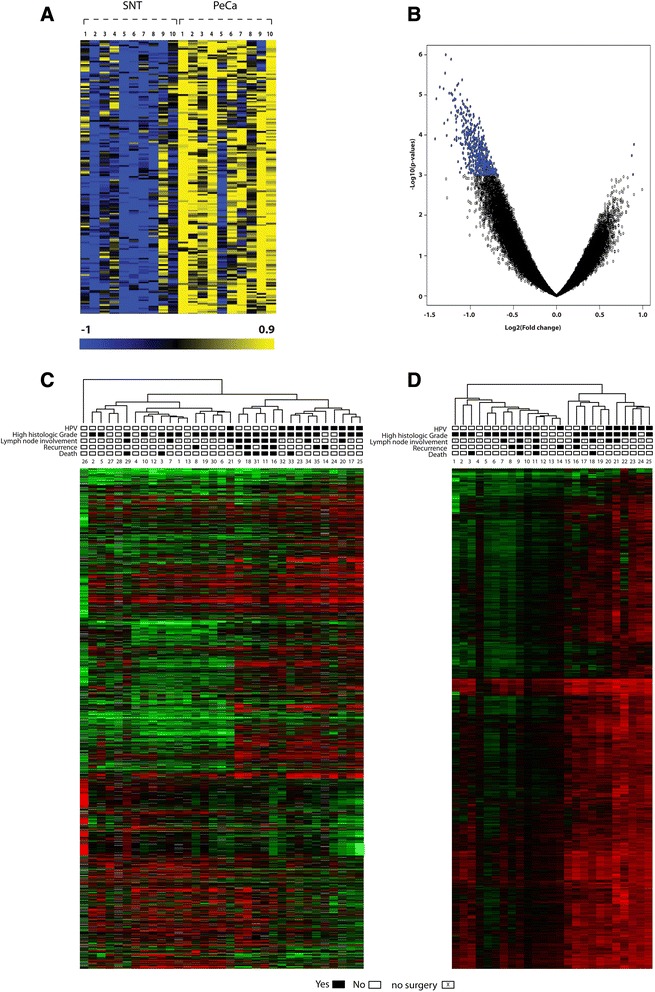
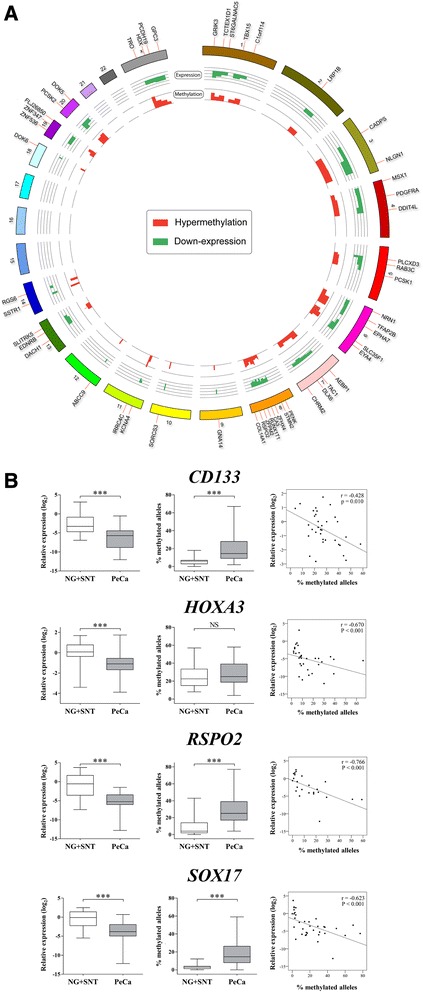
Genome-wide methylation analysis revealed 171 hypermethylated probes in PeCa. Transcriptome profiling presented 2,883 underexpressed and 1,378 overexpressed genes. Integrative analysis revealed a panel of 54 genes with an inverse correlation between methylation and gene expression levels. Distinct methylome and transcriptome patterns were found for human papillomavirus (HPV)-positive (38.6%) and negative tumors. Interestingly, grade 3 tumors showed a distinct methylation profile when compared to grade 1. In addition, univariate analysis revealed that low BDNF methylation was associated with lymph node metastasis and shorter disease-free survival. CpG hypermethylation and gene underexpression were confirmed for a panel of genes, including TWIST1, RSOP2, SOX3, SOX17, PROM1, OTX2, HOXA3, and MEIS1.
A unique methylome signature was found for PeCa compared to SNT, with aberrant DNA methylation appearing to modulate the expression of specific genes. This study describes new pathways with the potential to regulate penile carcinogenesis, including stem cell regulatory pathways and markers associated to a worse prognosis. These findings may be instrumental in the discovery and application of new genetic and epigenetic biomarkers in PeCa.
尽管阴茎癌(PeCa)是一种相对罕见的肿瘤,但对于贫穷和发展中国家而言,它仍然是一个重要的公共卫生问题。与大多数肿瘤不同,目前关于能够辅助阴茎癌诊断、预后评估及治疗的标志物的数据有限。我们旨在通过评估阴茎癌的表观基因组和转录组图谱,并将其与周围非恶性组织(SNT)和正常龟头(NG)进行比较,来鉴定阴茎癌的分子标志物。
全基因组甲基化分析显示阴茎癌中有171个高甲基化探针。转录组分析呈现出2883个低表达基因和1378个高表达基因。综合分析揭示了一组54个基因,其甲基化与基因表达水平呈负相关。在人乳头瘤病毒(HPV)阳性(38.6%)和阴性肿瘤中发现了不同的甲基组和转录组模式。有趣的是,与1级肿瘤相比,3级肿瘤表现出独特的甲基化谱。此外,单因素分析显示,低BDNF甲基化与淋巴结转移及较短的无病生存期相关。对包括TWIST1、RSOP2、SOX3、SOX17、PROM1、OTX2、HOXA3和MEIS1在内的一组基因,证实了CpG高甲基化和基因低表达。
与SNT相比,阴茎癌具有独特的甲基组特征,异常的DNA甲基化似乎可调节特定基因的表达。本研究描述了具有调控阴茎癌发生潜力的新途径,包括干细胞调控途径以及与预后较差相关的标志物。这些发现可能有助于阴茎癌新的遗传和表观遗传生物标志物的发现与应用。