Killoran Ryan C, Fan Jingsong, Yang Daiwen, Shilton Brian H, Choy Wing-Yiu
Department of Biochemistry, The University of Western Ontario, London, Ontario N6A 5C1, Canada.
Department of Biological Sciences, National University of Singapore, 14 Science Drive 4, Singapore, 117543, Singapore.
PLoS One. 2015 Apr 24;10(4):e0123934. doi: 10.1371/journal.pone.0123934. eCollection 2015.
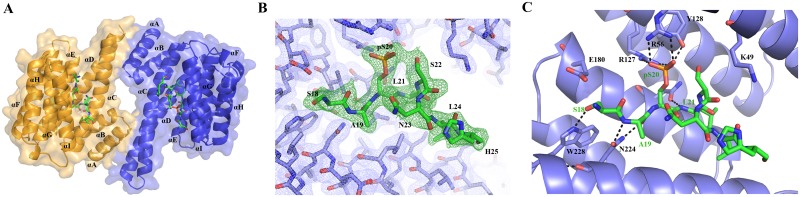
The partially disordered Chibby (Cby) is a conserved nuclear protein that antagonizes the Wnt/β-catenin signaling pathway. By competing with the Tcf/Lef family proteins for binding to β-catenin, Cby abrogates the β-catenin-mediated transcription of Wnt signaling genes. Additionally, upon phosphorylation on S20 by the kinase Akt, Cby forms a complex with 14-3-3 to facilitate the nuclear export of β-catenin, which represents another crucial mechanism for the regulation of Wnt signaling. To obtain a mechanistic understanding of the 14-3-3/Cby interaction, we have extensively characterized the complex using X-ray crystallography, nuclear magnetic resonance (NMR) spectroscopy, and isothermal titration calorimetry (ITC). The crystal structure of the human 14-3-3ζ/Cby protein-peptide complex reveals a canonical binding mode; however the residue at the +2 position from the phosphorylated serine is shown to be uniquely oriented relative to other solved structures of 14-3-3 complexes. Our ITC results illustrate that although the phosphorylation of S20 is essential for Cby to recognize 14-3-3, residues flanking the phosphorylation site also contribute to the binding affinity. However, as is commonly observed in other 14-3-3/phosphopeptide crystal structures, residues of Cby flanking the 14-3-3 binding motif lack observable electron density. To obtain a more detailed binding interface, we have completed the backbone NMR resonance assignment of 14-3-3ζ. NMR titration experiments reveal that residues outside of the 14-3-3 conserved binding cleft, namely a flexible loop consisting of residues 203-210, are also involved in binding Cby. By using a combined X-ray and NMR approach, we have dissected the molecular basis of the 14-3-3/Cby interaction.
部分无序的Chibby(Cby)是一种保守的核蛋白,可拮抗Wnt/β-连环蛋白信号通路。通过与Tcf/Lef家族蛋白竞争结合β-连环蛋白,Cby可消除β-连环蛋白介导的Wnt信号基因转录。此外,在被激酶Akt磷酸化S20后,Cby与14-3-3形成复合物,促进β-连环蛋白的核输出,这是调节Wnt信号的另一个关键机制。为了从机制上理解14-3-3/Cby的相互作用,我们使用X射线晶体学、核磁共振(NMR)光谱和等温滴定量热法(ITC)对该复合物进行了广泛表征。人14-3-3ζ/Cby蛋白-肽复合物的晶体结构揭示了一种典型的结合模式;然而,相对于其他已解析的14-3-3复合物结构,磷酸化丝氨酸下游第+2位的残基显示出独特的取向。我们的ITC结果表明,虽然S20的磷酸化对于Cby识别14-3-3至关重要,但磷酸化位点两侧的残基也有助于结合亲和力。然而,正如在其他14-3-3/磷酸肽晶体结构中常见的那样,Cby在14-3-3结合基序两侧的残基缺乏可观察到的电子密度。为了获得更详细的结合界面,我们完成了14-3-3ζ的主链NMR共振归属。NMR滴定实验表明,14-3-3保守结合裂隙之外的残基,即由残基203-210组成的柔性环,也参与结合Cby。通过结合X射线和NMR方法,我们剖析了14-3-3/Cby相互作用的分子基础。