Tripathi Shweta, Wang Guangshun, White Mitchell, Qi Li, Taubenberger Jeffery, Hartshorn Kevan L
Boston University School of Medicine, Department of Medicine, Boston, MA, United States of America.
Department of Pathology and Microbiology, University of Nebraska Medical Center, 986495 Nebraska Medical Center, Omaha, NE 68198-6495, United States of America.
PLoS One. 2015 Apr 24;10(4):e0124706. doi: 10.1371/journal.pone.0124706. eCollection 2015.
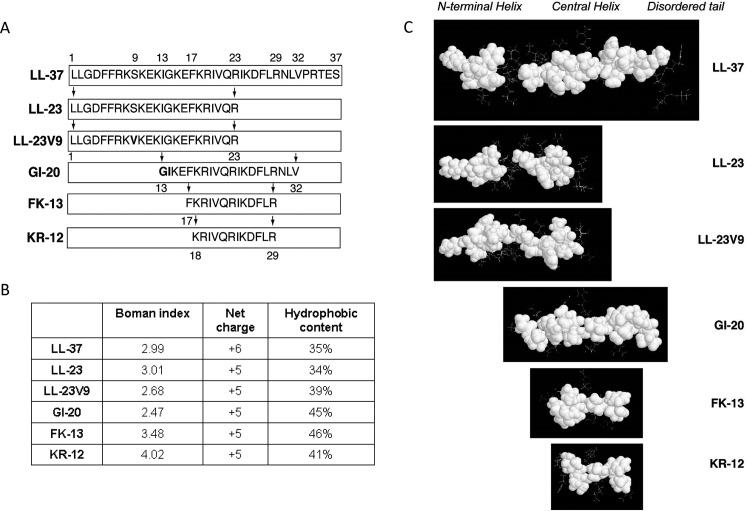
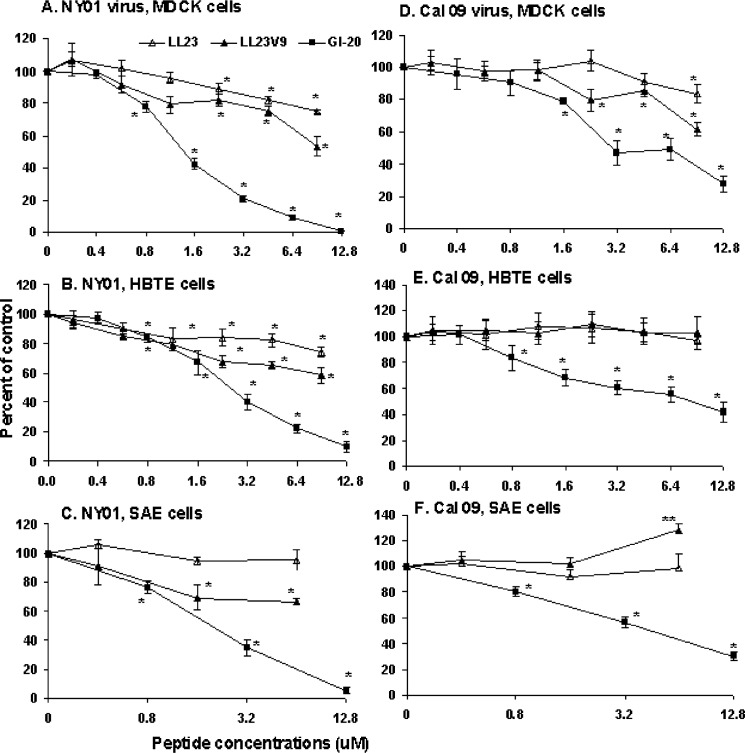
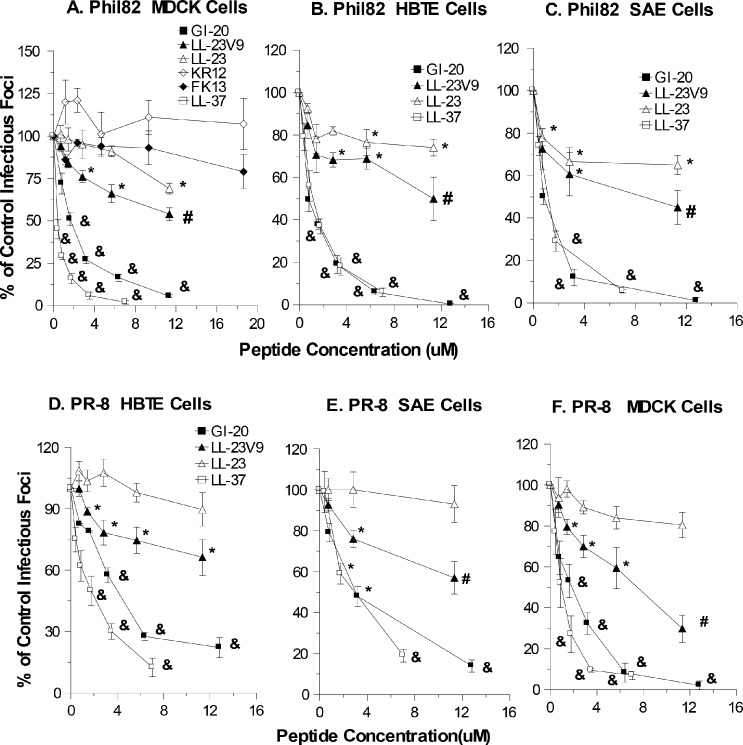
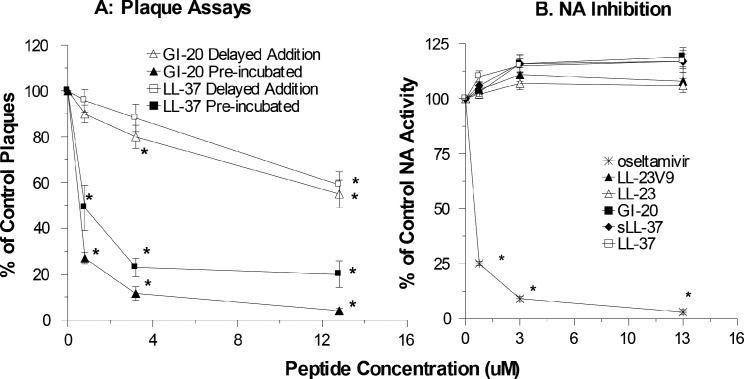
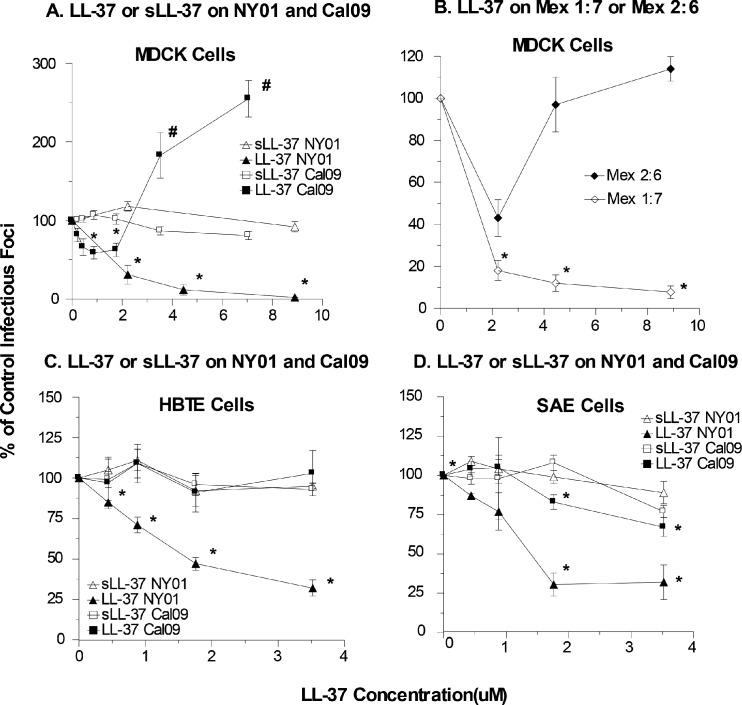
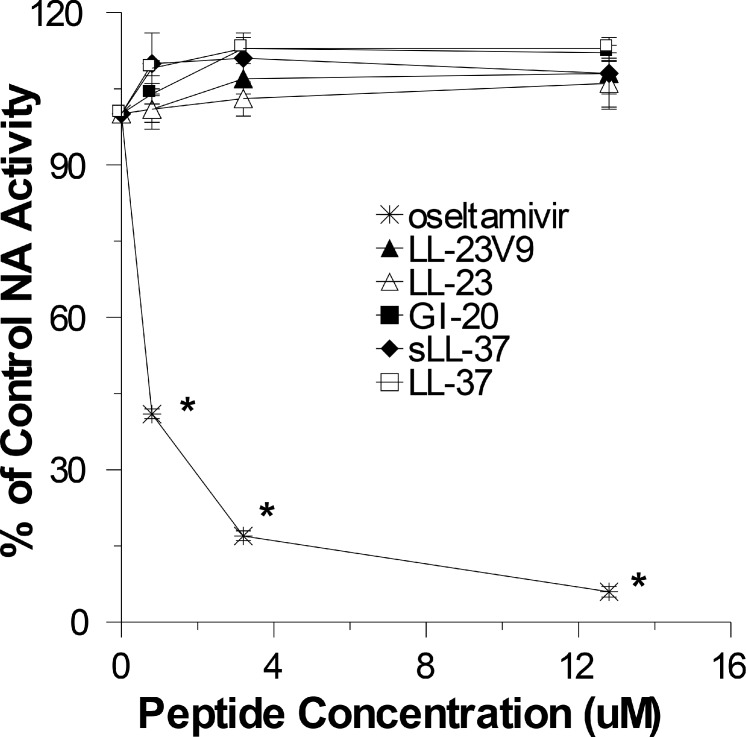
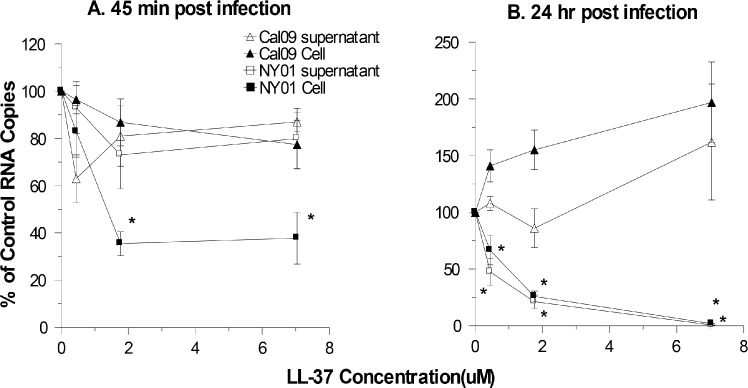
Human LL-37, a cationic antimicrobial peptide, was recently shown to have antiviral activity against influenza A virus (IAV) strains in vitro and in vivo. In this study we compared the anti-influenza activity of LL-37 with that of several fragments derived from LL-37. We first tested the peptides against a seasonal H3N2 strain and the mouse adapted H1N1 strain, PR-8. The N-terminal fragment, LL-23, had slight neutralizing activity against these strains. In LL-23V9 serine 9 is substituted by valine creating a continuous hydrophobic surface. LL-23V9 has been shown to have increased anti-bacterial activity compared to LL-23 and we now show slightly increased antiviral activity compared to LL-23 as well. The short central fragments, FK-13 and KR-12, which have anti-bacterial activity did not inhibit IAV. In contrast, a longer 20 amino acid central fragment of LL-37 (GI-20) had neutralizing activity similar to LL-37. None of the peptides inhibited viral hemagglutination or neuraminidase activity. We next tested activity of the peptides against a strain of pandemic H1N1 of 2009 (A/California/04/09/H1N1 or "Cal09"). Unexpectedly, LL-37 had markedly reduced activity against Cal09 using several cell types and assays of antiviral activity. A mutant viral strain containing just the hemagglutinin (HA) of 2009 pandemic H1N1 was inhibited by LL-37, suggested that genes other than the HA are involved in the resistance of pH1N1. In contrast, GI-20 did inhibit Cal09. In conclusion, the central helix of LL-37 incorporated in GI-20 appears to be required for optimal antiviral activity. The finding that GI-20 inhibits Cal09 suggests that it may be possible to engineer derivatives of LL-37 with improved antiviral properties.
人源LL - 37是一种阳离子抗菌肽,最近研究表明其在体外和体内均具有抗甲型流感病毒(IAV)毒株的活性。在本研究中,我们比较了LL - 37与其几个衍生片段的抗流感活性。我们首先用这些肽对季节性H3N2毒株和小鼠适应株H1N1毒株PR - 8进行测试。N端片段LL - 23对这些毒株有轻微的中和活性。在LL - 23V9中,丝氨酸9被缬氨酸取代,形成了一个连续的疏水表面。与LL - 23相比,LL - 23V9已被证明具有增强的抗菌活性,我们现在也表明其抗病毒活性相比LL - 23也略有增加。具有抗菌活性的短中心片段FK - 13和KR - 12不抑制IAV。相反,LL - 37的一个较长的20个氨基酸的中心片段(GI - 20)具有与LL - 37相似的中和活性。这些肽均未抑制病毒血凝或神经氨酸酶活性。接下来,我们测试了这些肽对2009年大流行H1N1毒株(A/California/04/09/H1N1或“Cal09”)的活性。出乎意料的是,使用几种细胞类型和抗病毒活性测定方法时,LL - 37对Cal09的活性显著降低。一个仅含有2009年大流行H1N1血凝素(HA)的突变病毒株被LL - 37抑制,这表明除HA之外的基因参与了pH1N1的抗性。相比之下,GI - 20确实抑制了Cal09。总之,并入GI - 20中的LL - 37的中心螺旋似乎是最佳抗病毒活性所必需的。GI - 20抑制Cal09这一发现表明,有可能设计出具有改进抗病毒特性的LL - 37衍生物。