Mizowaki Takashi, Aoki Manabu, Nakamura Katsumasa, Yorozu Atsunori, Kokubo Masaki, Karasawa Katsuyuki, Kozuka Takuyo, Nakajima Nobuaki, Sasai Keisuke, Akimoto Tetsuo
Department of Radiation Oncology and Image-applied Therapy, Graduate School of Medicine, Kyoto University. 54 Shogoin Kawahara-cho, Sakyo-ku, Kyoto, 606-8507, Japan
Department of Radiology, The Jikei University School of Medicine, 3-25-8 Nishishinbashi, Minato-ku, Tokyo, 105-8461, Japan.
J Radiat Res. 2015 Jul;56(4):750-6. doi: 10.1093/jrr/rrv027. Epub 2015 Apr 24.
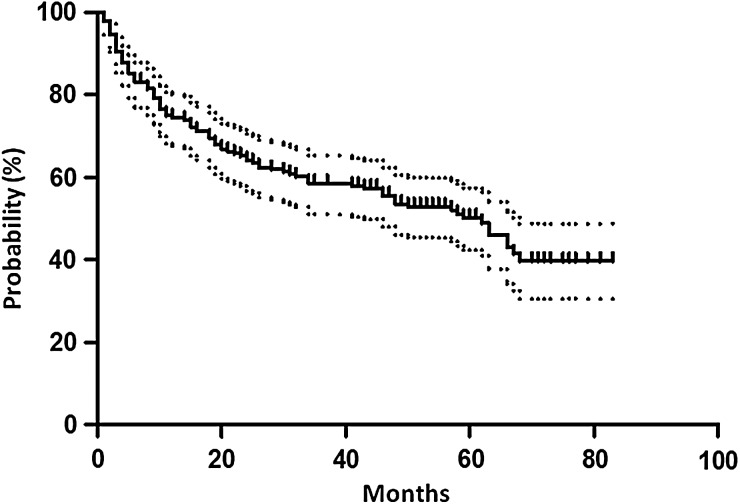
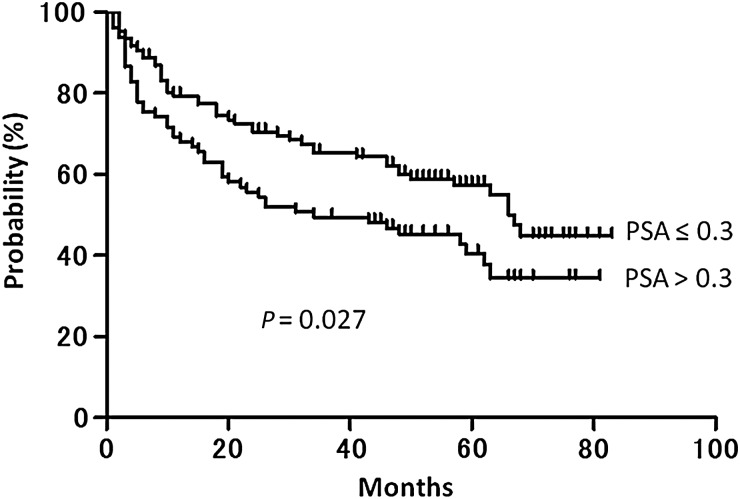
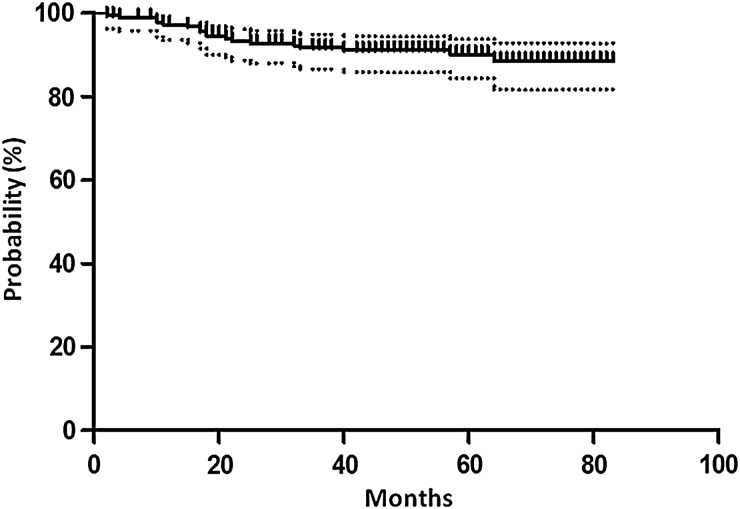
The conditions and outcomes of Japanese patients with prostate cancer who developed PSA failure after radical prostatectomy (RP), and who were treated via salvage radiotherapy (S-RT), were surveyed. Clinical data on S-RT were gathered in questionnaires completed by facilities participating in the Japanese Radiation Oncology Study Group. S-RT was defined as external-beam radiotherapy delivered to the prostate beds of patients with prostate cancer who had eventually developed PSA failure, although their PSA values had at one stage attained levels <0.2 ng/ml following RP. Hormonal therapy was combined with S-RT in ∼40% of cases. Outcomes were evaluated in 186 cases treated via S-RT alone. The nadir PSA level after RP, and the level upon initiation of S-RT, were 0.0135 ng/ml and 0.292 ng/ml, respectively. The median period between RP and S-RT was 18.6 months. The median follow-up period was 58 months. The 5-year PSA recurrence-free survival (PRFS) and clinical failure-free survival (CFFS) rates were 50.1% (95% CI: 42.8-57.9%) and 90.1% (95% CI: 86.4-95.7%), respectively. PRFS was significantly superior in patients with PSA values ≤0.3 ng/ml upon initiation of S-RT than in those with PSA values >0.3 ng/ml (57.5% vs 40.5%, P = 0.027). In Japan, hormonal therapy is combined with S-RT in ∼40% of cases. The 5-year PRFS and CFFS rates of cases treated via S-RT alone were 50.1% and 90.1%, respectively. A PSA value of 0.3 ng/ml served as a significant cut-off for prediction of PRFS.
我们对日本前列腺癌患者在根治性前列腺切除术(RP)后出现前列腺特异性抗原(PSA)失败并接受挽救性放疗(S-RT)的情况及结果进行了调查。参与日本放射肿瘤学研究组的机构通过填写问卷收集了S-RT的临床数据。S-RT被定义为对最终出现PSA失败的前列腺癌患者的前列腺床进行的外照射放疗,尽管这些患者在RP后其PSA值曾一度达到<0.2 ng/ml的水平。约40%的病例中激素治疗与S-RT联合使用。对186例仅接受S-RT治疗的病例的结果进行了评估。RP后的PSA最低点水平和开始S-RT时的水平分别为0.0135 ng/ml和0.292 ng/ml。RP与S-RT之间的中位时间为18.6个月。中位随访期为58个月。5年无PSA复发生存率(PRFS)和无临床失败生存率(CFFS)分别为50.1%(95%置信区间:42.8 - 57.9%)和90.1%(95%置信区间:86.4 - 95.7%)。开始S-RT时PSA值≤0.3 ng/ml的患者的PRFS显著优于PSA值>0.3 ng/ml的患者(57.5%对40.5%,P = 0.027)。在日本,约40%的病例中激素治疗与S-RT联合使用。仅接受S-RT治疗的病例的5年PRFS和CFFS率分别为50.1%和90.1%。PSA值0.3 ng/ml是预测PRFS的一个重要临界值。