Gardner Benedict M, Tuna Floriana, McInnes Eric J L, McMaster Jonathan, Lewis William, Blake Alexander J, Liddle Stephen T
School of Chemistry, University of Nottingham, University Park, Nottingham, NG7 2RD (UK).
School of Chemistry and Photon Science Institute, University of Manchester, Oxford Road, Manchester, M13 9PL (UK).
Angew Chem Int Ed Engl. 2015 Jun 8;54(24):7068-72. doi: 10.1002/anie.201501728. Epub 2015 Apr 27.
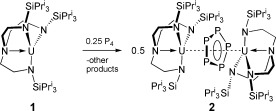
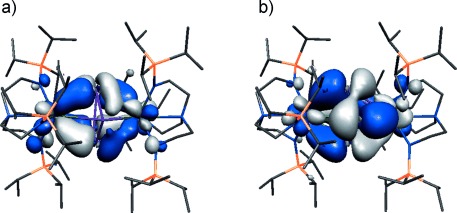
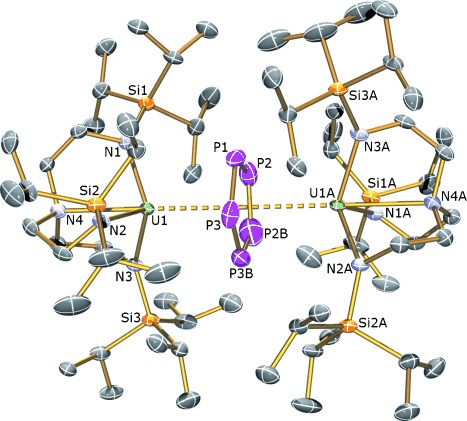
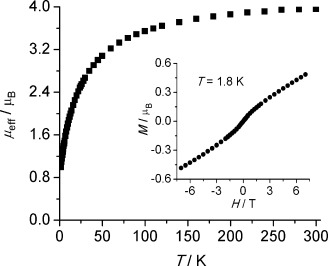
Reaction of [U(Tren(TIPS))] [1, Tren(TIPS)=N(CH2CH2NSiiPr3)3] with 0.25 equivalents of P4 reproducibly affords the unprecedented actinide inverted sandwich cyclo-P5 complex [{U(Tren(TIPS))}2(μ-η(5):η(5)-cyclo-P5)] (2). All prior examples of cyclo-P5 are stabilized by d-block metals, so 2 shows that cyclo-P5 does not require d-block ions to be prepared. Although cyclo-P5 is isolobal to cyclopentadienyl, which usually bonds to metals via σ- and π-interactions with minimal δ-bonding, theoretical calculations suggest the principal bonding in the U(P5)U unit is polarized δ-bonding. Surprisingly, the characterization data are overall consistent with charge transfer from uranium to the cyclo-P5 unit to give a cyclo-P5 charge state that approximates to a dianionic formulation. This is ascribed to the larger size and superior acceptor character of cyclo-P5 compared to cyclopentadienyl, the strongly reducing nature of uranium(III), and the availability of uranium δ-symmetry 5f orbitals.
[U(Tren(TIPS))] [1, Tren(TIPS)=N(CH2CH2NSiiPr3)3] 与0.25当量的P4反应可重复性地得到前所未有的锕系元素反式夹心环戊五磷配合物[{U(Tren(TIPS))}2(μ-η(5):η(5)-环戊五磷)] (2)。之前所有环戊五磷的例子都由d区金属稳定,因此2表明环戊五磷的制备不需要d区离子。尽管环戊五磷与环戊二烯基是等瓣的,环戊二烯基通常通过σ键和π键与金属键合,δ键作用最小,但理论计算表明U(P5)U单元中的主要键合是极化δ键。令人惊讶的是,表征数据总体上与从铀到环戊五磷单元的电荷转移一致,从而得到一种环戊五磷电荷状态,近似于双阴离子形式。这归因于与环戊二烯基相比,环戊五磷具有更大的尺寸和更强的受体特性、铀(III)的强还原性以及铀δ对称5f轨道的可用性。