Moss Darren M, Liptrott Neill J, Siccardi Marco, Owen Andrew
Department of Molecular and Clinical Pharmacology, University of Liverpool Liverpool, UK.
Front Pharmacol. 2015 Apr 10;6:78. doi: 10.3389/fphar.2015.00078. eCollection 2015.
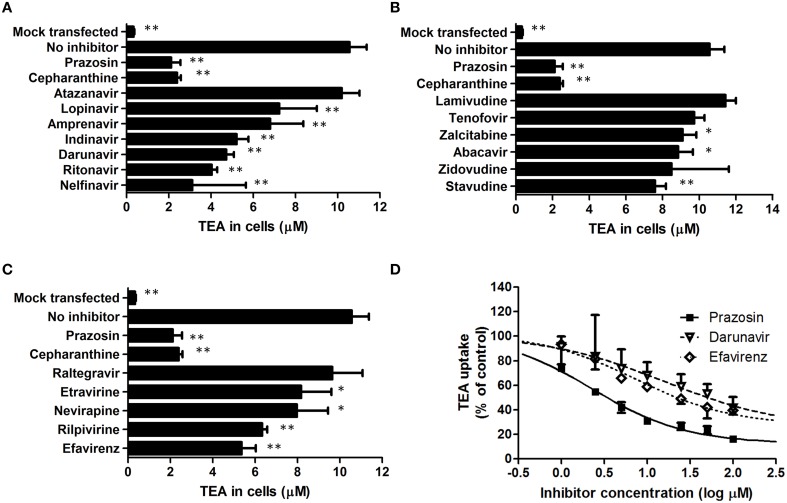
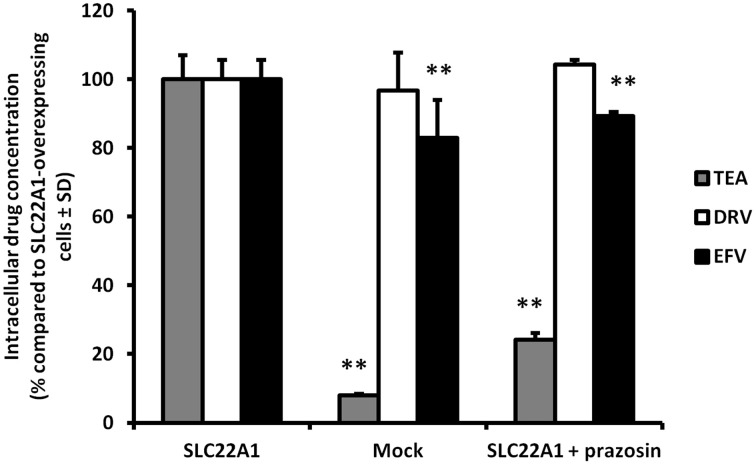
The SLC22A1 influx transporter is expressed on the basolateral membrane of hepatocytes and is involved in the excretion of numerous cations. Inhibition of SLC22A1 by several antiretrovirals, such as the protease inhibitor darunavir, has not previously been determined. In order to better understand and predict drug-SLC22A1 interactions, a range of antiretrovirals were screened for SLC22A1-associated inhibition and transport. Stable SLC22A1-expressing KCL22 cells were produced previously by nucleofection. Control KCL22 cells were transfected with the empty vector pcDNA3.1. Accumulation of tetraethylammonium (5.5 μM, 30 min) was determined in SLC22A1-expressing and mock-transfected cells with and without 50 μM of SLC22A1 inhibitor prazosin, or 50 μM of each antiretroviral drug. SLC22A1 IC50 values for efavirenz, darunavir, and prazosin were determined. Cellular accumulation of efavirenz and darunavir was also assessed in SLC22A1-expressing KCL22 cells and reversibility of this accumulation was assessed using prazosin. Tetraethylammonium accumulation was higher in SLC22A1-expressing cells compared to mock-transfected cells (10.6 ± 0.8 μM vs. 0.3 ± 0.004 μM, p = 0.009) and was significantly reduced in SLC22A1-expressing cells when co-incubated with all antiretrovirals tested except atazanavir, lamivudine, tenofovir, zidovudine, and raltegravir. Particularly noticeable was the predominance of SLC22A1 inhibitors in the protease inhibitor and non-nucleoside reverse transcriptase inhibitor classes. Absolute SLC22A1 IC50 values for efavirenz, darunavir, and prazosin were 21.8, 46.2, and 2.8 μM, respectively. Efavirenz accumulation was higher in SLC22A1-expressing cells compared to mock-transfected cells (17% higher, p = 0.009) which was reversed using prazosin, whereas no difference was observed for darunavir (p = 0.86). These data inform the mechanistic basis for disposition, drug-drug interactions and pharmacogenetic candidate gene selection for antiretroviral drugs.
溶质载体家族22成员1(SLC22A1)流入转运体表达于肝细胞的基底外侧膜,参与多种阳离子的排泄。此前尚未确定几种抗逆转录病毒药物(如蛋白酶抑制剂达芦那韦)对SLC22A1的抑制作用。为了更好地理解和预测药物与SLC22A1的相互作用,对一系列抗逆转录病毒药物进行了SLC22A1相关抑制和转运的筛选。之前通过核转染产生了稳定表达SLC22A1的KCL22细胞。对照KCL22细胞用空载体pcDNA3.1转染。在有或没有50μM SLC22A1抑制剂哌唑嗪或50μM每种抗逆转录病毒药物的情况下,测定表达SLC22A1的细胞和mock转染细胞中四乙铵(5.5μM,30分钟)的蓄积。测定了依非韦伦、达芦那韦和哌唑嗪的SLC22A1半数抑制浓度(IC50)值。还评估了表达SLC22A1的KCL22细胞中依非韦伦和达芦那韦的细胞蓄积情况,并使用哌唑嗪评估了这种蓄积的可逆性。与mock转染细胞相比,表达SLC22A1的细胞中四乙铵蓄积更高(10.6±0.8μM对0.3±0.004μM,p = 0.009),并且在与除阿扎那韦、拉米夫定、替诺福韦、齐多夫定和拉替拉韦外的所有测试抗逆转录病毒药物共同孵育时,表达SLC22A1的细胞中四乙铵蓄积显著降低。特别值得注意的是,蛋白酶抑制剂和非核苷类逆转录酶抑制剂类中SLC22A1抑制剂占主导地位。依非韦伦、达芦那韦和哌唑嗪的绝对SLC22A1 IC50值分别为21.8、46.2和2.8μM。与mock转染细胞相比,表达SLC22A1的细胞中依非韦伦蓄积更高(高17%,p = 0.009),使用哌唑嗪可使其逆转,而达芦那韦未观察到差异(p = 0.86)。这些数据为抗逆转录病毒药物的处置、药物相互作用和药物遗传学候选基因选择提供了机制基础。